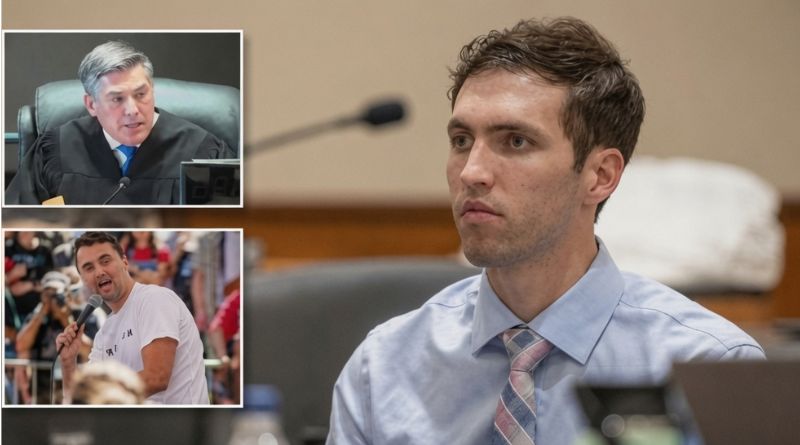
The preliminary hearing for Tyler Robinson, the man accused of assassinating prominent conservative activist and Turning Point USA founder Charlie Kirk, advanced this week in a Provo courtroom, featuring key evidentiary rulings and testimony that underscored the prosecution’s case.
Judge Tony Graf Jr., who is presiding over the high-profile proceedings, issued several notable decisions amid intense pretrial scrutiny. On Wednesday, Graf denied a request from Robinson’s family to publicly display all exhibits presented in court. The denial specifically included what prosecutors have described as a “confession” video involving Lance Twiggs, identified as Robinson’s romantic partner.
The hearing, which began Monday and is expected to continue through the week, has focused on establishing probable cause for the charges against Robinson in connection with the Sept. 10, 2025, shooting at Utah Valley University. Prosecutors allege that Robinson fatally shot Kirk during a campus event organized by the conservative youth organization.
A significant development came Tuesday when a Utah investigator testified about DNA evidence linking Twiggs to key items recovered from the crime scene. Sergeant Jennifer Faumina, with the Utah Department of Public Safety’s State Bureau of Investigation, took the stand to read portions of a DNA analysis report. According to Faumina, male DNA matching Twiggs was identified on two critical pieces of evidence.
“Male DNA was obtained from item 7-1. Item 7-1 was interpreted as originating from two individuals, one of whom is Twiggs,” Faumina testified. She further noted similar findings on “item eight sub one,” also interpreted as a mixture from two contributors, including Twiggs. Court documents identified item 7-1 as a screwdriver recovered from the rooftop of the Losee Center for Student Success, and item 8-1 as a towel that had been wrapped around the rifle allegedly used in the assassination.
The testimony highlighted the collaborative nature of the investigation involving state authorities and provided prosecutors with tangible forensic connections as they seek to bind Robinson over for trial.
The proceedings come after the Utah Supreme Court last week cleared a major procedural hurdle. The state’s highest court declined to hear the defense’s interlocutory appeal of two pretrial rulings by Judge Graf. In a brief order, the court stated: “This matter is before the court upon a petition for permission to appeal from an interlocutory order. The petition for permission to appeal from an interlocutory order is denied. The motion to stay is deemed moot.”
The defense had challenged Graf’s decisions to permit cameras in the courtroom and to allow certain hearsay evidence during the preliminary hearing. This latest denial follows earlier attempts by Robinson’s legal team to delay the hearing pending appellate review. Defense attorneys first raised concerns in May, seeking a blanket prohibition on cameras, but Graf opted instead for a case-by-case evaluation of media requests.
Under the judge’s standing order, news organizations must submit applications for electronic media coverage at least 14 days before a scheduled proceeding. Either party may request restrictions, with Graf retaining final authority. During the current hearing, the judge rejected most defense motions to bar cameras, granting only one narrow exception: a media outlet’s request for still photography on the opening day was denied because it was filed after the deadline.
The camera access dispute has been a recurring flashpoint in the pretrial phase, reflecting broader tensions between open-court principles and the defense’s concerns about pretrial publicity in a case that has drawn national attention. Kirk’s assassination sent shockwaves through conservative political circles, where he had built a substantial following through Turning Point USA’s campus outreach efforts promoting limited government, free markets, and traditional values.
Robinson, who has been held in custody since shortly after the September 2025 incident, faces first-degree murder and related charges. His defense team has not yet presented its full case, as the preliminary hearing serves primarily to assess the strength of the prosecution’s evidence.
Legal observers note that while preliminary hearings rarely result in dismissal of charges, they often provide a preview of trial strategies and evidentiary battles to come. With DNA testimony already entered and disputes over exhibits and media access resolved for now, both sides are preparing for what could be weeks of additional proceedings.
The case continues to captivate public interest, balancing demands for transparency in the judicial process against the rights of the accused in one of the most politically charged criminal cases in recent Utah history. Updates from the courtroom are expected daily as the hearing progresses.