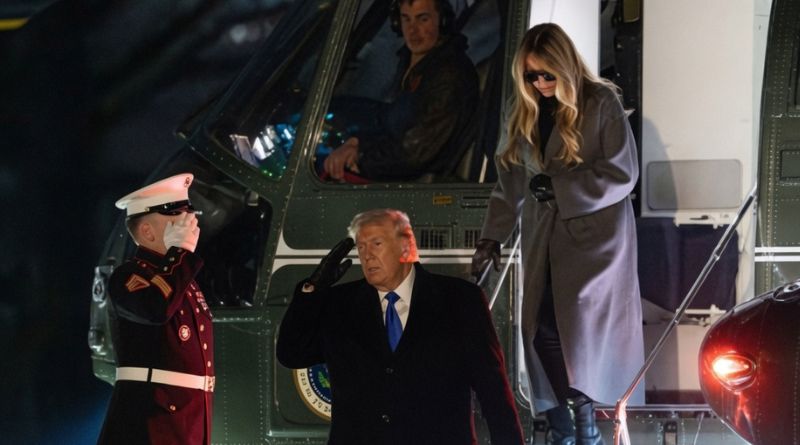
President Donald Trump and First Lady Melania Trump encountered a minor mechanical issue during their departure from the United Kingdom, forcing a precautionary switch of helicopters as they concluded a high-profile second state visit focused on strengthening bilateral ties and securing major economic investments.
White House Press Secretary Karoline Leavitt confirmed that Marine One, carrying the presidential couple from Prime Minister Keir Starmer’s country residence at Chequers to Stansted Airport, landed at a local airfield due to a hydraulics problem. “Out of an abundance of caution, the pilots landed at a local airfield before reaching Stansted Airport,” Leavitt said. “The president and first lady safely boarded the support helicopter.” The scheduled 20-minute flight ultimately took nearly 40 minutes, but the couple proceeded without further incident and boarded Air Force One for the return to Washington.
The visit, marked by pageantry and substantive diplomacy, underscored the enduring “special relationship” between the United States and United Kingdom. King Charles III and Queen Camilla hosted the Trumps at Windsor Castle, providing a regal welcome that blended tradition with forward-looking discussions on global challenges and economic cooperation.
Trump spent part of the visit at Windsor before traveling by helicopter to Chequers for extended meetings with Starmer. Private talks between the two leaders are believed to have addressed key international issues, including the wars in Ukraine and Gaza, environmental concerns, and free speech. These were followed by a business reception with executives from both nations, highlighting opportunities in technology, defense, and energy.
A centerpiece of the trip was the announcement of a substantial mutual investment package, described by officials as a £250 billion (approximately $338 billion) US-UK alliance. Starmer praised the agreement as the “most natural partnership in the world” and dubbed it a “tech-prosperity deal.” Trump echoed the optimism, stating it would generate “billions of dollars of opportunities” and improve U.S. access to the UK’s renowned aerospace supply chain.
“We’re taking the next logical step with a historic agreement on science and technology partnerships,” Trump said during the business event. He highlighted collaboration in artificial intelligence, quantum computing, fusion, 6G, and civil nuclear energy, emphasizing a shared approach of “centered deregulation and innovation.”
The president specifically noted progress on energy projects essential for powering AI advancements. “You need the energy. You have to have the energy,” he remarked. He referenced an ongoing deal between American company X Energy and British firm Centrica for deploying modular nuclear reactors across the UK. The initiative is expected to generate more than $50 billion in economic value, create up to 2,500 jobs, and power 1.5 million homes. Trump also acknowledged contributions from business leaders, including NVIDIA’s Jensen Huang, in the push toward technological dominance.
Additional private sector momentum included a major commitment from Blackstone, part of a broader wave of deals exceeding $350 billion. These investments span AI infrastructure, data centers, and advanced manufacturing, positioning both nations to lead in emerging technologies while addressing energy demands.
Starmer and Trump framed the agreements as more than economic wins—they represent a strategic deepening of the transatlantic alliance amid global uncertainties. The deals build on earlier trade frameworks, focusing on supply chain security, innovation, and reciprocal market access.
Trump returned to the White House on Friday following the overseas trip, which combined ceremonial honors with concrete deliverables. The visit demonstrated a pragmatic blend of diplomacy and deal-making, reinforcing economic and technological cooperation between two of the world’s closest allies.
Analysts view the outcomes as a significant boost for UK innovation ambitions and U.S. strategic interests in critical technologies. With commitments spanning nuclear power, AI research, and aerospace, the partnership aims to deliver long-term growth, job creation, and competitive advantages in the industries shaping the 21st century.