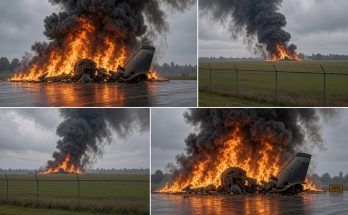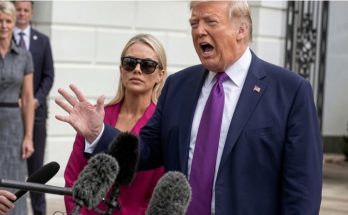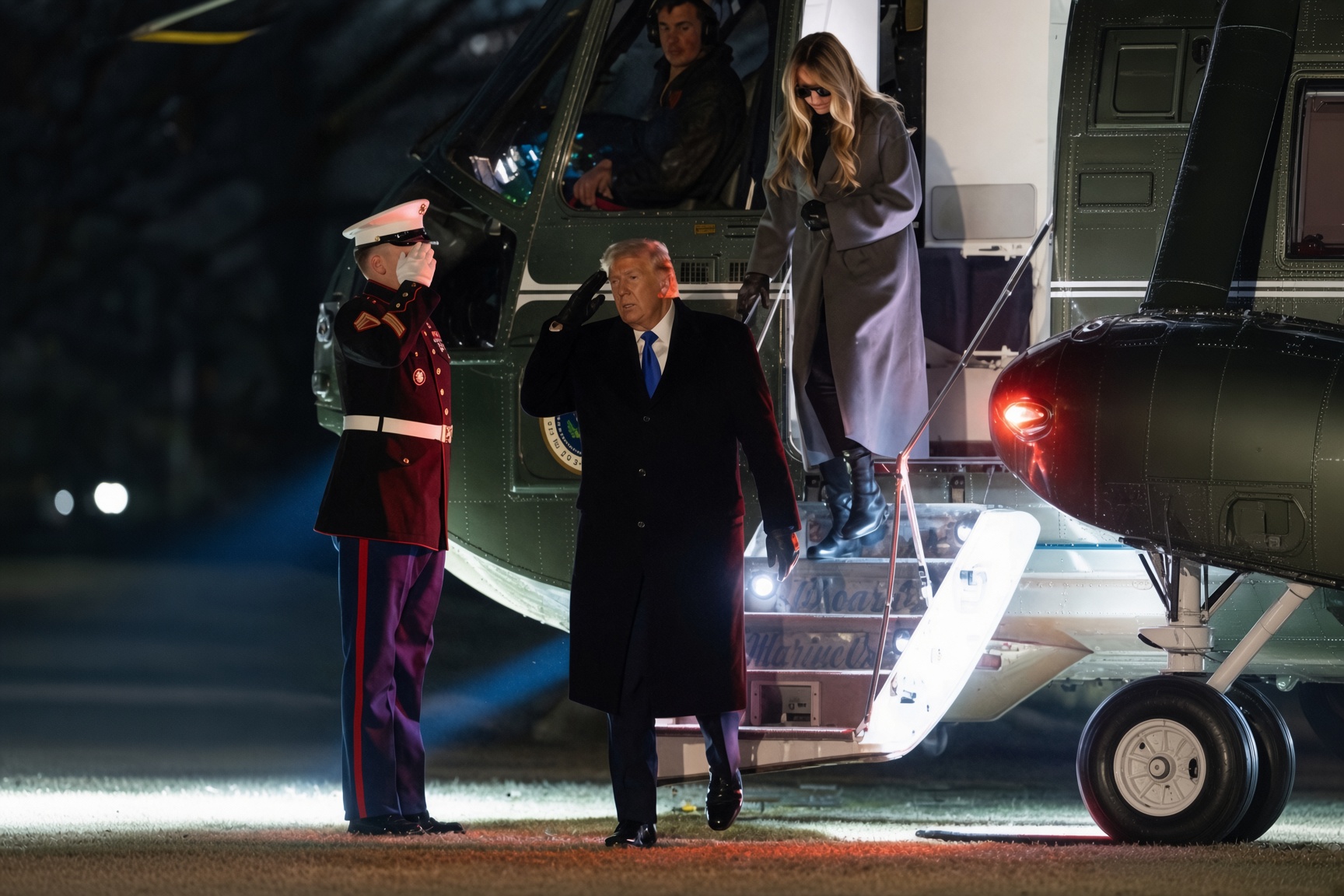
President Donald Trump and First Lady Melania Trump wrapped up a second state visit to the United Kingdom with a last-minute change of aircraft after Marine One developed a hydraulics problem. The couple had been flying from Prime Minister Keir Starmer’s country residence at Chequers to Stansted Airport when pilots made a precautionary landing at a nearby airfield.
White House Press Secretary Karoline Leavitt said the decision was taken “out of an abundance of caution.” The president and first lady then boarded a support helicopter and completed the trip without further trouble. What was planned as a 20-minute hop stretched to nearly 40 minutes. They boarded Air Force One and returned to Washington on Friday.
The mechanical hiccup was a footnote to a visit that mixed royal pageantry with concrete economic announcements. King Charles III and Queen Camilla hosted the Trumps at Windsor Castle, offering the formal welcome expected of a state visit while talks turned to shared challenges and closer commercial ties.
From Windsor, Trump flew by helicopter to Chequers for extended discussions with Starmer. Officials indicated the private conversations covered the wars in Ukraine and Gaza, environmental questions, and free-speech issues. A business reception followed, bringing together executives from both countries to discuss technology, defense, and energy.
The centerpiece was a large mutual investment package presented as a £250 billion (about $338 billion) U.S.-UK alliance. Starmer called it the “most natural partnership in the world” and a “tech-prosperity deal.” Trump said the agreement would create “billions of dollars of opportunities” and improve American access to Britain’s aerospace supply chain.
“We’re taking the next logical step with a historic agreement on science and technology partnerships,” Trump told the business gathering. He listed collaboration in artificial intelligence, quantum computing, fusion energy, 6G networks, and civil nuclear power, describing a shared emphasis on “centered deregulation and innovation.”
Energy for AI was a recurring theme. “You need the energy. You have to have the energy,” Trump said. He pointed to an existing arrangement between the American firm X Energy and Britain’s Centrica to deploy modular nuclear reactors across the UK. Officials said the project could generate more than $50 billion in economic value, support up to 2,500 jobs, and supply power for 1.5 million homes. Trump also credited industry figures, including NVIDIA chief Jensen Huang, for advancing the technological agenda.
Private-sector commitments added further scale. Blackstone announced a major investment as part of a broader wave of deals that officials put above $350 billion. The projects focus on AI infrastructure, data centers, and advanced manufacturing, with both governments arguing the work will help meet rising electricity demand while keeping the two countries competitive in emerging industries.
Starmer and Trump presented the package as more than a collection of contracts. They framed it as a strategic deepening of the transatlantic relationship at a time of global uncertainty. The deals build on earlier trade arrangements and emphasize supply-chain security, innovation, and reciprocal market access.
The visit combined ceremonial honors with measurable deliverables. Analysts said the outcomes give a lift to Britain’s innovation goals and to U.S. interests in critical technologies. Commitments in nuclear power, AI research, and aerospace are intended to support long-term growth, employment, and advantage in the industries expected to define the coming decades.
Trump left the United Kingdom having underscored the “special relationship” in both symbolic and practical terms. The helicopter diversion delayed the final leg of the journey but did not alter the substance of a trip that officials on both sides described as productive. The president and first lady arrived back in Washington after a visit that mixed tradition, diplomacy, and deal-making between two of the world’s closest allies.