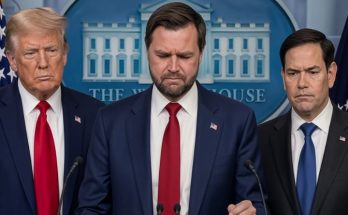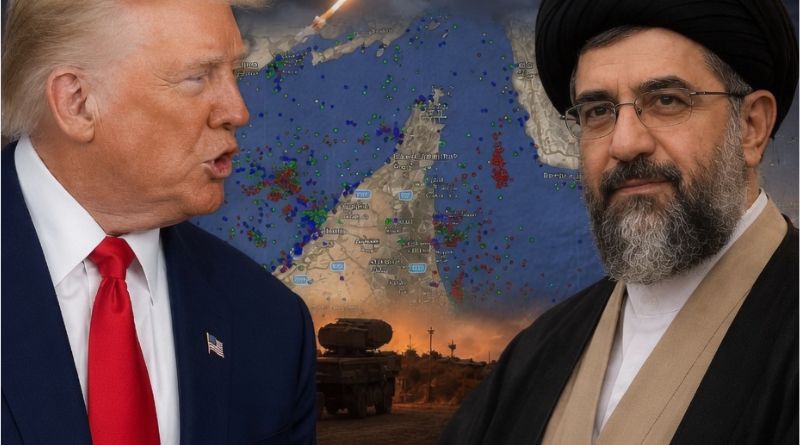
President Donald Trump, Vice President JD Vance, Secretary of State Marco Rubio, and other senior administration officials are working to finalize a possible comprehensive agreement aimed at ending the war with Iran. The effort builds on recent diplomatic talks and U.S. military actions in the region.
Speaking during a trip to India, Rubio emphasized Washington’s determination to restore freedom of navigation through the Strait of Hormuz, a vital chokepoint for global oil shipments. “The straits have to be open, they’re going to be open,” he told reporters. “What’s happening there is unlawful, it’s illegal, it’s unsustainable for the world, it’s unacceptable.”
Rubio confirmed that talks were underway in Qatar and expressed cautious optimism. “There were some talks going on in Qatar today, so we’ll see if we can make progress,” he said. Negotiators were focused on specific language in a draft document, a process expected to take several more days. “The president expressed his desire to make it. He’s either going to make a good deal or no deal,” Rubio added.
The diplomatic push follows U.S. Central Command’s “self-defense strikes” in southern Iran on Monday. The operation targeted missile launch sites and Iranian vessels attempting to deploy mines, according to Capt. Tim Hawkins, a CENTCOM spokesperson.
“U.S. Central Command continues to defend our forces while using restraint during the ongoing cease-fire,” Hawkins said. He declined to specify which U.S. ships came under threat, their locations, or the exact sites of the American strikes. A senior U.S. military official confirmed the action occurred near the key Iranian port and naval base at Bandar Abbas.
The strikes came after threats to American assets from Iranian surface-to-air missiles. Dozens of U.S. warplanes and nearly two dozen Navy warships — including two aircraft carriers and their escorts — have been enforcing a blockade to prevent vessels from entering or leaving Iranian ports in the Gulf of Oman and Arabian Sea.
American and Iranian forces have seen intermittent clashes since a cease-fire took effect about six weeks ago, though both sides have largely avoided major escalations.
Iranian officials meeting in Qatar acknowledged Monday that significant progress had been made. Foreign Ministry spokesman Esmaeil Baqaei told reporters that Tehran and Washington had reached understandings on a large portion of the issues under discussion. He cautioned against expecting an imminent signing.
“It is correct to say that we have reached a conclusion on a large portion of the issues under discussion,” Baqaei said during a weekly briefing. “But to say that this means the signing of an agreement is imminent—no one can make such a claim.” He accused Washington of occasionally shifting its positions.
President Trump has repeatedly insisted that any agreement must serve U.S. interests. He has criticized the Obama administration’s 2015 nuclear deal with Iran, saying it gave Tehran “massive amounts of CASH, and a clear and open path to a Nuclear Weapon.”
A top administration official, speaking Sunday, said the Iranians have agreed in principle to a framework that includes the elimination of highly enriched uranium. In return for Iran reopening the Strait of Hormuz, the United States would lift its naval blockade. Additional sanctions relief could follow if Iran agrees to sharply curtail its nuclear enrichment.
The official described the atmosphere as constructive, noting that most parties agree on the basic concepts and that the Trump administration is pleased with the trajectory of the talks, even as technical details remain under discussion. Iran appears more willing to compromise now than before recent U.S. military operations, the source said.
A central U.S. demand is strong, enforceable commitments against future enrichment. “It doesn’t matter if the promise is for 20 or 30 years; what matters is how it will be enforced,” the official said. Administration leaders believe the emerging deal could go beyond the 2015 agreement, which allowed Iran to enrich uranium to certain levels under international monitoring.
Analysts say a successful agreement could have wide implications for regional stability, global energy markets, and nuclear non-proliferation. The Strait of Hormuz, through which about one-fifth of the world’s oil passes, remains a flashpoint. Its disruption has already affected shipping and contributed to higher energy prices.
As talks continue in Qatar, both sides face pressure to balance security concerns with the economic and humanitarian costs of prolonged conflict. Significant hurdles remain, but sustained U.S. military pressure combined with active diplomacy has opened a narrow window for a possible breakthrough.