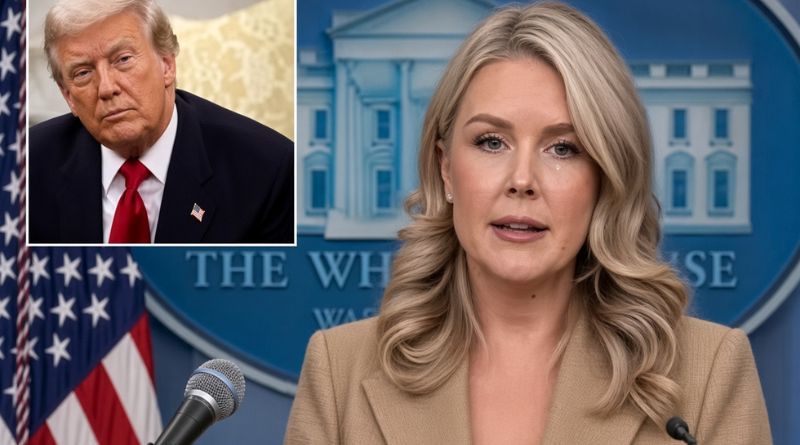
WASHINGTON — White House Press Secretary Karoline Leavitt has framed the Trump administration’s rewrite of presidential press access as an expansion of who gets into the smallest rooms of power, not a campaign to lock journalists out.
In remarks to Axios co-founder Mike Allen, Leavitt said the White House wants more organizations represented in the tight press pools that follow President Donald Trump into the Oval Office, the East Room and Air Force One. Legacy outlets and the White House Correspondents’ Association counter that putting the government in charge of those scarce seats risks turning coverage of the presidency into a political choice.
Thousands of news organizations hold White House credentials. Only a handful of reporters can travel with the president or stand in the room when he signs orders or takes questions. Leavitt has argued that those seats should rotate among print, digital and independent outlets instead of remaining reserved, day after day, for a small circle of established organizations.
“I don’t view them as restrictions. We view them as opening access to more outlets, more voices, more news, journalists and outlets,” she told Allen. “Why should a single outlet have the privilege of being in that 13-person press pool every single day?” She has also said a small group of journalists on the WHCA board should not decide who enters the Oval Office or boards Air Force One.
The administration has put that argument into practice. In January 2025, Leavitt created a rotating “new media” seat in the briefing room for digital publishers, podcasters, influencers and other applicants who meet Secret Service and credentialing rules. The White House said it received more than 11,000 applications. Occupants have ranged from Axios and Semafor to Breitbart, podcast hosts and YouTube personalities. The seat often gets the first question, a role long associated with the Associated Press.
In February 2025, Leavitt announced that the White House press team — not the WHCA — would decide the daily pool. Legacy television networks would keep rotating seats, she said, but “well-deserving outlets who have never been allowed to share in this awesome responsibility” would be added. The WHCA had managed pool logistics, in coordination with the White House, since the 1950s.
The fight sharpened around the wire services. For decades, the Associated Press, Reuters and Bloomberg held regular places in the pool. Their copy and photos feed newspapers, broadcasters and websites that cannot keep a full-time White House staff.
That arrangement fractured after the AP refused to adopt the administration’s preferred name “Gulf of America” for the Gulf of Mexico. The White House barred AP reporters from some events. A federal court later held that the AP could not be treated worse than peer wire services because of an editorial choice. The administration appealed, arguing that access to limited presidential spaces remains a White House prerogative.
In April 2025, rather than restore a dedicated daily wire slot, the White House folded the three wires into a larger print rotation competing for two seats. Officials said the change put similarly situated outlets on an “equal playing field.” AP, Reuters and Bloomberg said the result was less consistent, real-time coverage for the many newsrooms that rely on them. Bloomberg Editor-in-Chief John Micklethwait called the loss of a permanent wire presence a reduction in “scrutiny and accountability.”
The WHCA has stressed that it does not issue credentials or control Secret Service clearance. Those powers sit with the Press Office and the Secret Service. The association does organize pool rotations and bargain over access. After the White House took over the pool list, then-WHCA president Eugene Daniels said the move “suggests the government will choose the journalists who cover the president. In a free country, leaders must not be able to choose their own press corps.”
Space is the practical core of the dispute. A full press corps cannot fit in the Oval Office or on every presidential trip. The administration says rotation is the only fair response and that the media landscape has changed: digital outlets and independent commentators now reach audiences that newspapers once dominated. Critics reply that wire services perform a public function the rotation does not replace, and that day-to-day White House discretion over who stands in the room invites viewpoint-based choices even if officials deny that motive.
Leavitt has compared Trump’s media habits with those of former President Joe Biden. Research by presidential scholar Martha Joynt Kumar, cited by Axios, has long shown Trump giving far more interviews and informal question-and-answer sessions than Biden at comparable points. Those tallies count formal conferences and interviews, not every shouted exchange; they measure visibility, not how pool seats are assigned. Leavitt has used the comparison to argue that Trump talks to reporters often while changing who gets the limited seats.
Later restrictions added to the sense that the relationship had been rewritten. Access to the press secretary’s West Wing offices became appointment-only after officials accused some reporters of eavesdropping or recording without permission.
Leavitt left the press secretary’s job in late August 2026. Vice President JD Vance has said one of her legacies was opening the briefing room to “non-legacy” media and that the administration intends to keep that course.
The underlying question has not changed. Thousands of credentialed journalists want access. Only a few can stand in the smallest rooms. The White House says it is spreading that privilege. The WHCA and the major wires say independent coverage of the president depends on a system the government does not run. How those two claims are balanced will shape what the public sees of the presidency — and who is in the room when it happens.