Viral Marine One Photos of Trump Resurface, Fueling Debate Over Imagery, Appearance, and Online Narratives
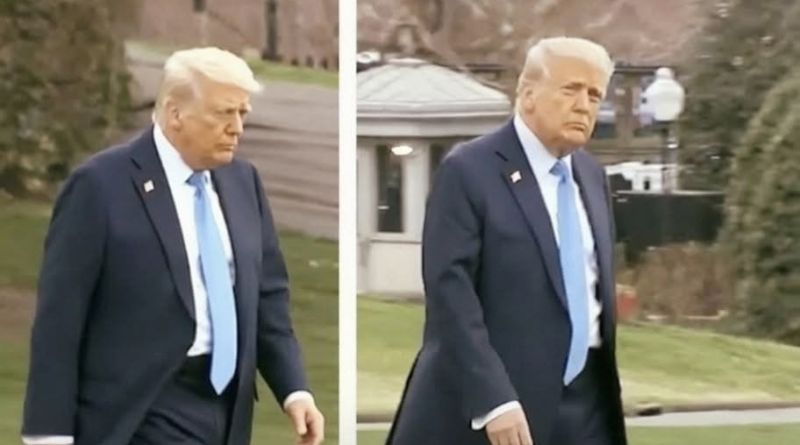
Photographs of former President Donald Trump walking across the White House South Lawn and boarding Marine One have again circulated widely on social media, reviving interest in both the images themselves and the political interpretations attached to them. The pictures, which first spread in 2025, show a familiar official ritual: the short walk from the executive mansion to the presidential helicopter used for travel to Joint Base Andrews and other destinations. What has changed is less the scene than the captions, comments, and assumptions now wrapped around it.
As with many political photographs that travel far beyond their original moment, viewers have focused less on the official context than on details of posture, gait, clothing fit, and overall appearance. Some users have treated the frames as evidence of physical change compared with earlier public appearances. Others have pushed back, arguing that a few still photographs taken in a brief, controlled setting cannot reliably indicate health, stamina, or medical condition. The gap between those readings has become the story as much as the photographs.
Unverified claims and official silence
Alongside the renewed sharing of the images, fragments of health-related speculation have circulated. Such rumors about public figures are a recurring feature of online political conversation; they are also among the least reliable. No authoritative medical disclosure has confirmed the specific claims attached to these pictures. The White House and Trump’s representatives have, in other episodes involving unconfirmed health reports about political figures, typically issued brief denials or declined to engage. Trump himself has repeatedly said in interviews and public appearances that he considers himself in good health and able to keep a demanding schedule.
Age is frequently cited in these discussions, often in comparison with other senior American and foreign leaders. Age is a fact; it is not a diagnosis. Individual health varies widely and cannot be assessed from clothing drape, stride length, or a single sequence of photographs. Professional medical evaluation, not visual interpretation by strangers on social platforms, is the standard that applies to anyone—public figure or not.
How the same picture becomes a new argument
The Marine One images illustrate a now-familiar digital pattern. A photograph is captured in an official setting, released or leaked into circulation, then detached from its date, location, and purpose. Months or years later it is posted again with a new caption that reflects current political weather rather than the original event. Algorithms reward emotionally charged or visually striking content; users supply the narrative. The result is that the same frame can be offered as proof of vigor in one cycle and of decline in another.
This does not mean the photographs are meaningless. Political imagery has always been read for symbolism—clothing, bearing, the company a leader keeps, the setting of an arrival or departure. The difference today is speed and scale. A picture that once appeared in a newspaper captioned with time, place, and official purpose now travels with whatever text a user chooses to attach. Context is optional; engagement is not.
Some commentary has also circled back to long-standing observations about Trump’s well-known preference for certain fast-food items. Those details have been part of public coverage for years and have been used, fairly or not, in broader conversations about lifestyle and nutrition among high-profile politicians. Public figures sometimes change diets or habits over time; those changes are not always announced in detail. Treating anecdotal or dated observations as current medical fact is another form of the same error: substituting inference for evidence.
Scrutiny that outlasts office
Former presidents who remain visible in media and politics stay under a kind of continuous visual inspection that has little to do with election calendars. Appearance, stamina, and health become standing topics because the audience is large, the images are abundant, and the incentives to interpret them are strong. That scrutiny is not unique to one person or one party. It is a feature of a media environment in which leaders are documented constantly and the resulting pictures are instantly reusable.
The responsible response is modest: treat unverified social-media claims as unverified, distinguish official statements from rumor, and resist the temptation to diagnose from a photograph. The Marine One pictures remain part of the visual record of official movement at the White House. Once they leave that record and enter the feed, they become something else—material for argument, projection, and recycled narrative. That transformation is now routine. It does not make the underlying images more or less true. It only changes what people think they are looking at.
Reliable discussion of any public figure’s health still depends on confirmed statements and credible reporting, not on the latest recirculation of a familiar scene. The photographs document a walk across a lawn and a boarding of a helicopter. Everything else that has been said about them since is interpretation. Keeping those two things separate is the difference between looking at a picture and inventing a story.