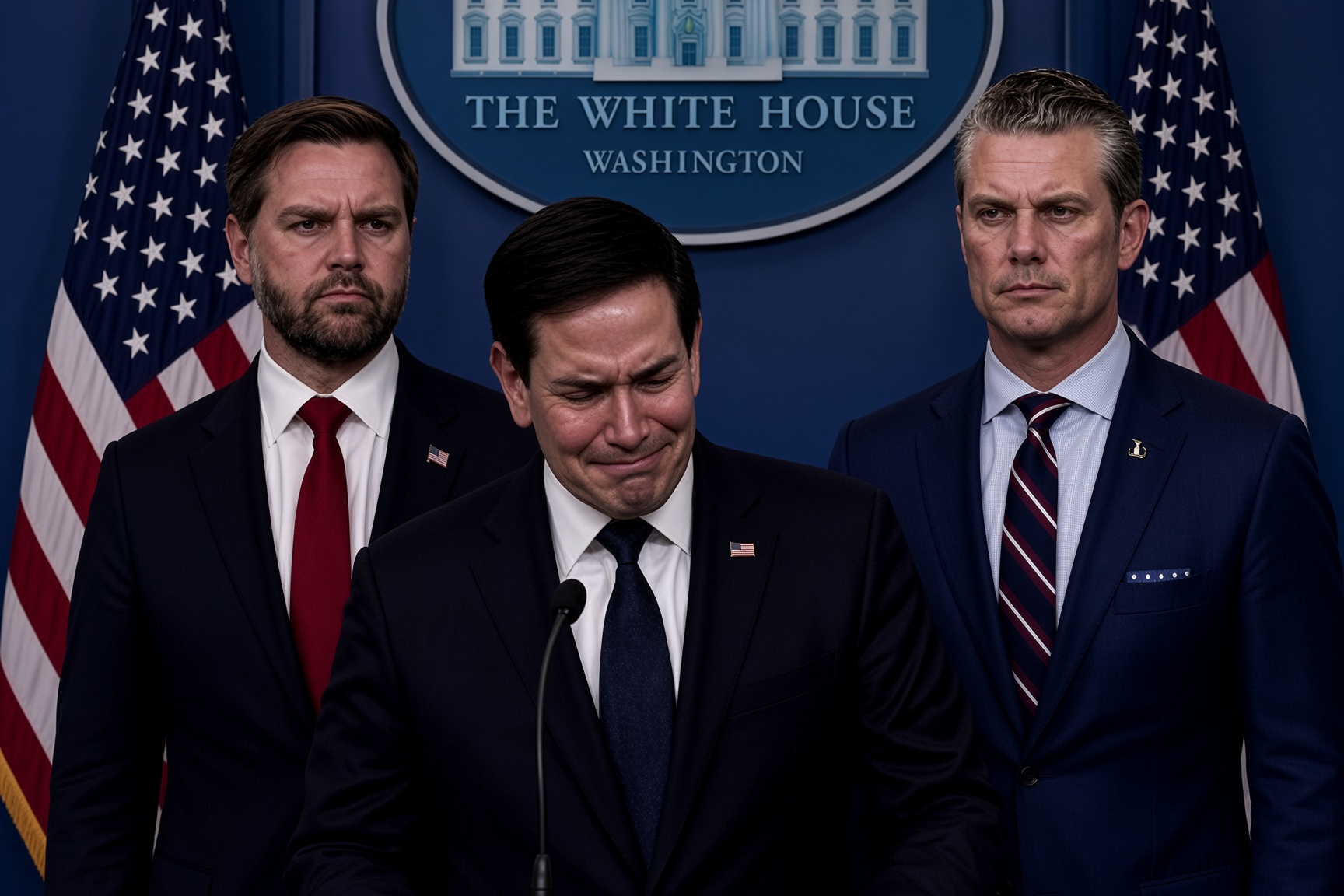
WASHINGTON — Secretary of State Marco Rubio has described an unusual and protracted episode aboard Air Force One in which he and several senior officials spent roughly ninety minutes trying to decide whether a sleeping passenger was simply resting or facing a potentially serious medical emergency.
Rubio recounted the incident during an appearance on the Katie Miller Podcast. The episode occurred on a flight returning from China. At some point during the trip, officials noticed a person asleep inside a conference room on the presidential aircraft. What began as an ordinary observation gradually became a source of concern. The individual remained unresponsive even as activity and noise continued nearby, raising questions about whether the deep sleep was ordinary or a sign that something was wrong.
Officials found themselves in an awkward bind. Waking the person risked interrupting someone who was simply exhausted and difficult to rouse. Leaving the situation alone carried an obvious risk if the individual was experiencing a medical problem. Rather than immediately treating the matter as an emergency, the group continued discussing whether any intervention was necessary. The uncertainty stretched on for about an hour and a half before the situation was finally resolved. Rubio said the person was fine and that there had been no medical emergency.
Rubio did not identify the individual, and no independent confirmation of the person’s identity has emerged. The absence of further details prompted speculation online, with some social-media users offering humorous theories involving prominent political figures. There is no evidence supporting those claims, and Rubio did not suggest that any well-known figure was involved.
The story has drawn additional attention because Rubio has previously been asked whether he has seen President Donald Trump fall asleep during official meetings. During a House Foreign Affairs Committee hearing, Democratic Rep. Ted Lieu asked Rubio if he had personally witnessed Trump fall asleep. Rubio said he had not, describing the president as keeping a demanding schedule and frequently speaking with administration officials early in the morning. Lieu later challenged that account, saying he possessed video he believed showed Trump with his eyes closed during a Cabinet meeting while Rubio was speaking. Rubio maintained that he had never personally seen the president fall asleep.
The Air Force One episode was presented by Rubio as something different from those earlier exchanges. It was not framed as a political dispute but as an unusual moment in which senior officials confronted a basic yet unsettling question: Was someone simply sleeping, or was something seriously wrong? The prolonged discussion reflected the practical difficulty of the situation inside a closely watched aircraft, where ordinary assumptions about rest and alertness could not be taken for granted.
In the end, the uncertainty gave way to relief. What started as an awkward question about whether to wake a passenger became a drawn-out period of deliberation and, finally, confirmation that the person was perfectly fine. For Rubio and the others present, the episode remained an odd story from inside one of the world’s most closely monitored planes—one that ended without injury but left behind a reminder of how even routine moments can turn complicated when the stakes feel unclear.
The account adds a small, human detail to the public picture of travel on Air Force One, where long flights, tight schedules, and high-stakes meetings are routine. It also underscores how limited information can leave officials debating a simple observation for an extended time before clarity arrives. Rubio’s retelling treated the episode as resolved and unremarkable in outcome, yet distinctive enough in the moment to warrant sharing.