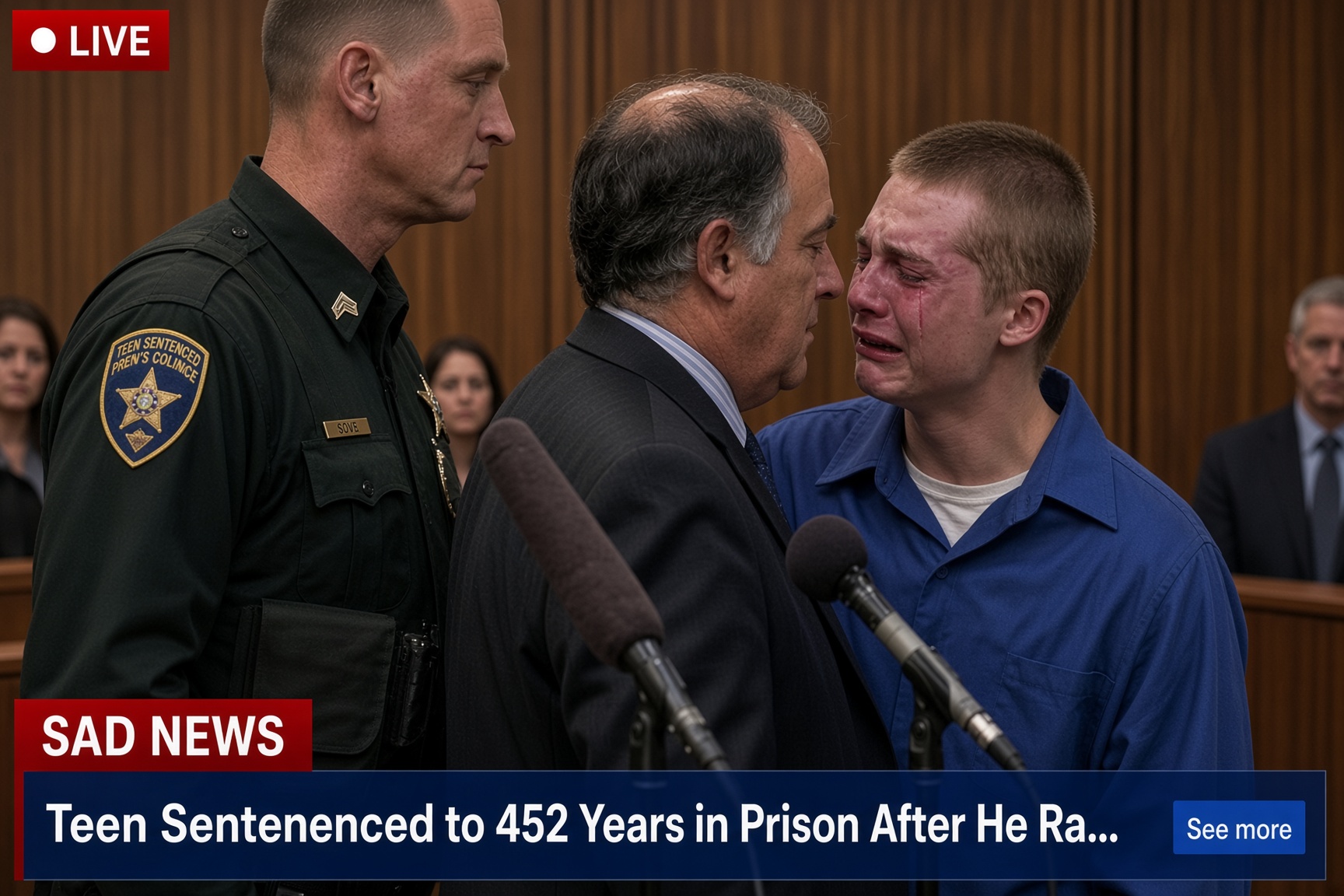
NATIONAL — A dramatic claim that a teenager received a 452-year prison sentence has circulated widely on social media, sparking intense reactions and raising questions about how the justice system treats young offenders. Courtroom footage showing an emotional young man has been shared repeatedly with captions asserting that the defendant had just been handed a punishment spanning centuries. Fact-checkers who reviewed the material, however, determined that the viral description does not match the actual circumstances of the video.
Investigators traced the clip and found that it depicts a courtroom appearance connected to an earlier criminal proceeding rather than a sentencing hearing in which a 452-year term was imposed. Reports indicate that the individual shown in the footage had previously received a 15-year sentence in 2016. The appearance captured in the widely shared video was linked to a probable-cause proceeding, not the extraordinary punishment described in accompanying posts. The gap between the footage and the claims attached to it illustrates how quickly emotionally charged courtroom images can be detached from their original context. A genuine video can lend an appearance of authenticity to a story even when the headline, narration, or captions are inaccurate.
The claim gained momentum after short clips began circulating with text overlays and voice-overs stating that a teenager had been sentenced to 452 years. As the material spread, numerous websites and social-media accounts repeated versions of the story. Many of those repetitions offered no case number, court documents, or reporting from established local news organizations that would allow independent verification. The narrative appeared increasingly plausible to some viewers simply because it had been echoed across multiple platforms, a common pattern in the rapid amplification of incomplete or misleading information.
The figure of 452 years stands out because it far exceeds a typical human lifespan. In criminal cases, courts sometimes order sentences on multiple convictions to run consecutively rather than concurrently. When numerous counts carry separate terms, the arithmetic total can reach hundreds of years. That legal mechanism exists and has been used in documented cases involving both adult and young defendants. Its existence in the abstract, however, does not confirm that the specific sentence described in the viral posts was actually imposed in the proceedings shown on video. Fact-checkers stressed the need to separate what is possible under sentencing rules from what occurred in a particular courtroom on a particular date. Available evidence reviewed in connection with the circulating clip does not support the viral version of events.
Although the 452-year claim attached to this footage is not supported by the records examined by fact-checkers, the episode intersects with a longstanding debate over the treatment of juvenile and young-adult offenders. When adolescents are accused of serious crimes, courts and lawmakers confront competing priorities. Victims and their families frequently emphasize accountability and public safety. Defense advocates and researchers in adolescent development often highlight that young people are still maturing, that brain development continues into the mid-twenties, and that many young offenders show greater potential for rehabilitation than adults. Sentencing practices vary widely by jurisdiction. In some cases, teenagers convicted of grave offenses have received multi-decade terms; in others, judges or statutes have allowed for more individualized consideration of age, background, and prospects for change. Supporters of lengthy sentences argue that the harm suffered by victims should not be minimized solely because the defendant was young. Critics contend that extremely long terms can amount to de facto life sentences that foreclose any meaningful opportunity for reform. Both perspectives appear regularly in legislative debates, appellate decisions, and public discussion.
The rapid spread of the 452-year story also underscores a practical challenge for anyone consuming news online. Authentic video does not automatically validate the claims made about it. Captions, titles, and voice-overs can reframe footage so that viewers receive an impression substantially different from the original event. Reliable accounts of criminal proceedings ordinarily identify the court, the jurisdiction, the defendant, the charges, and the outcome, or they cite reporting from local journalists who have access to primary records. The absence of those details can serve as a signal that further checking is warranted, especially when a claim involves an unusually severe punishment. In this instance, the original circumstances of the video were substantially different from the story that traveled with it. The result was a narrative that gained traction without the supporting documentation that would normally accompany reporting on an extraordinary sentence.
Extreme aggregate sentences for young defendants have occurred in documented cases and continue to generate debate among judges, legislators, and the public. Those real cases can be examined through court records, appellate opinions, and established news coverage. The particular 452-year allegation that circulated with the viral courtroom clip, by contrast, does not appear to rest on comparable evidence. The discrepancy serves as a reminder that debates over punishment, rehabilitation, and public safety are too consequential to rest on an unverified number or a misleadingly captioned video. Accurate court records and careful reporting remain essential whenever extraordinary claims begin to spread.