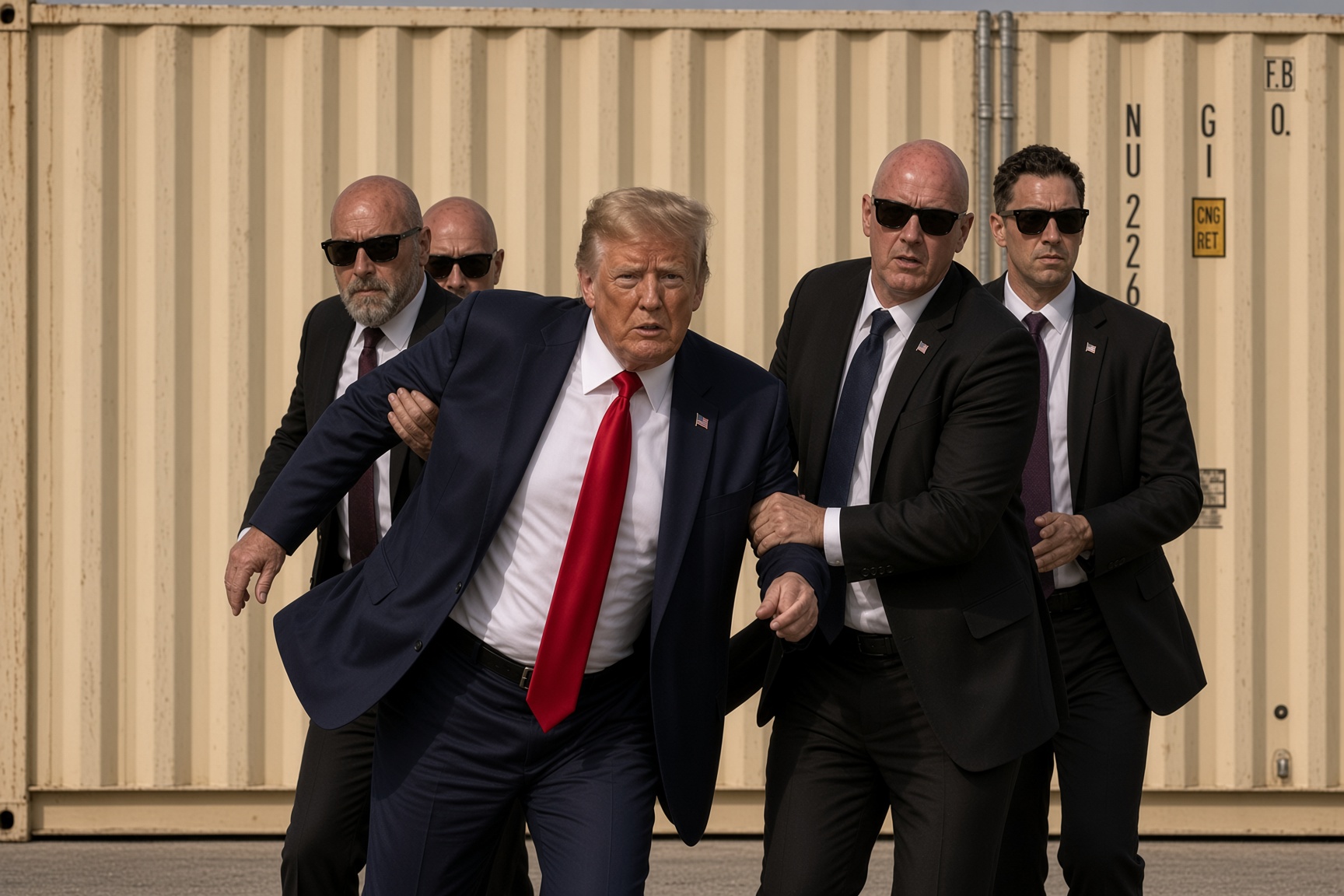
WASHINGTON — Within a matter of hours, unverified claims that former President Donald Trump had been targeted in a shooting in the nation’s capital spread rapidly across digital platforms, generating confusion, speculation, and public concern. Systematic checks by law enforcement, the United States Secret Service, and news organizations quickly established that no such incident occurred.
The assertions surfaced during peak online traffic and relied on fragmented social media posts rather than any accredited reporting. Many featured recycled footage from earlier events, misleading thumbnails, and urgent all-caps language designed to drive engagement. Common phrasing included vague references to “breaking reports” and an “unfolding situation,” without citations to primary sources, official statements, or verified eyewitness accounts.
Law enforcement agencies, federal protective details, and regional trauma centers reported no record of an active security breach involving Trump in Washington, D.C., or elsewhere. The Secret Service issued no alerts or mobilizations. Local police departments and hospital systems likewise reported nothing out of the ordinary. Major news organizations that maintain permanent coverage of protective details, the White House, and Capitol Hill monitored communications channels and observed uninterrupted normal activity, including standard motorcade movements.
Security professionals note that genuine threats against high-profile protectees produce immediate, visible operational responses: temporary airspace restrictions, street closures, coordinated public statements, and hospital preparations. None of those signatures appeared. The absence of any such footprint provided early and decisive evidence that the claims were unfounded.
Origins and Amplification of the Claim
Forensic examination of the rumor’s path points to organic amplification through high-engagement posts that recontextualized archival material. Several widely shared videos showed spliced or cropped imagery from prior incidents, paired with captions suggesting an ongoing standoff. Automated accounts and monetization incentives tied to outrage metrics further accelerated circulation. Independent fact-checkers and mainstream outlets moved quickly to cross-check federal and local channels, confirming the lack of any corresponding official activity.
This pattern is familiar in fast-moving digital environments. Platforms reward speed and emotional intensity; verification requires time and coordination. The window between initial posting and widespread visibility can be measured in minutes, while confirmation or debunking typically takes longer. In this case, the discrepancy between viral reach and institutional silence itself became a key indicator.
Historical Context and Public Sensitivity
Heightened concern around Trump’s safety is grounded in documented events. In July 2024, a gunman opened fire at a campaign rally in Butler, Pennsylvania. Trump sustained an ear injury; one attendee was killed and others wounded. Secret Service counter-snipers fatally engaged the shooter. A subsequent attempted attack was thwarted at Trump International Golf Club in West Palm Beach, Florida. Those incidents prompted congressional hearings, internal reviews of protective operations, and expansions of security perimeters.
Because audiences have seen real security breaches, the threshold for accepting alarming claims can drop. False alerts exploit that residual sensitivity. Observers describe the dynamic as a psychological vulnerability: prior verified trauma makes fictionalized scenarios feel more plausible until primary evidence arrives. The result is not only temporary online panic but also measurable demands on public systems.
Operational and Civic Costs
Public safety officials report that fabricated national-security alerts generate immediate secondary effects. Emergency dispatch lines, police public-information offices, and hospital switchboards receive surges of citizen inquiries. Those calls divert attention from ongoing local emergencies. Political analysts add that uncorrected rumors can feed broader conspiratorial narratives in polarized environments, with different audiences assigning blame or motives that have no basis in fact.
Media researchers point to structural incentives. “Platforms currently reward emotional velocity over accuracy,” one senior fellow in digital forensics observed. “When a sensational claim enters a volatile cycle, the gap between dissemination and verification favors the initial false signal.” Over time, repeated episodes erode confidence in both official channels and journalistic verification, even when those institutions correctly identify and correct the record.
Verification Standards
Media watchdogs and security analysts recommend consistent protocols before sharing claims of national emergencies:
- Cross-check multiple primary news wires and official statements. Silence from major domestic and international outlets during an alleged high-profile incident is a strong negative indicator.
- Look for prompt, attributable confirmations from the Secret Service, local law enforcement, or hospital administrators. Legitimate events produce such statements within minutes.
- Examine visual material through reverse-image search and archival comparison. Recycled clips from earlier events are a common vector.
Federal and local authorities reiterated throughout the day that normal security protocols remained in effect and that no new incident had targeted the former president. The rumor’s relatively rapid dissipation once institutional checks circulated illustrates both the speed of modern digital transmission and the continuing utility of coordinated verification. While false claims can accumulate millions of impressions before correction, structured reporting and official silence or denial remain the most reliable counters to manufactured alarm.