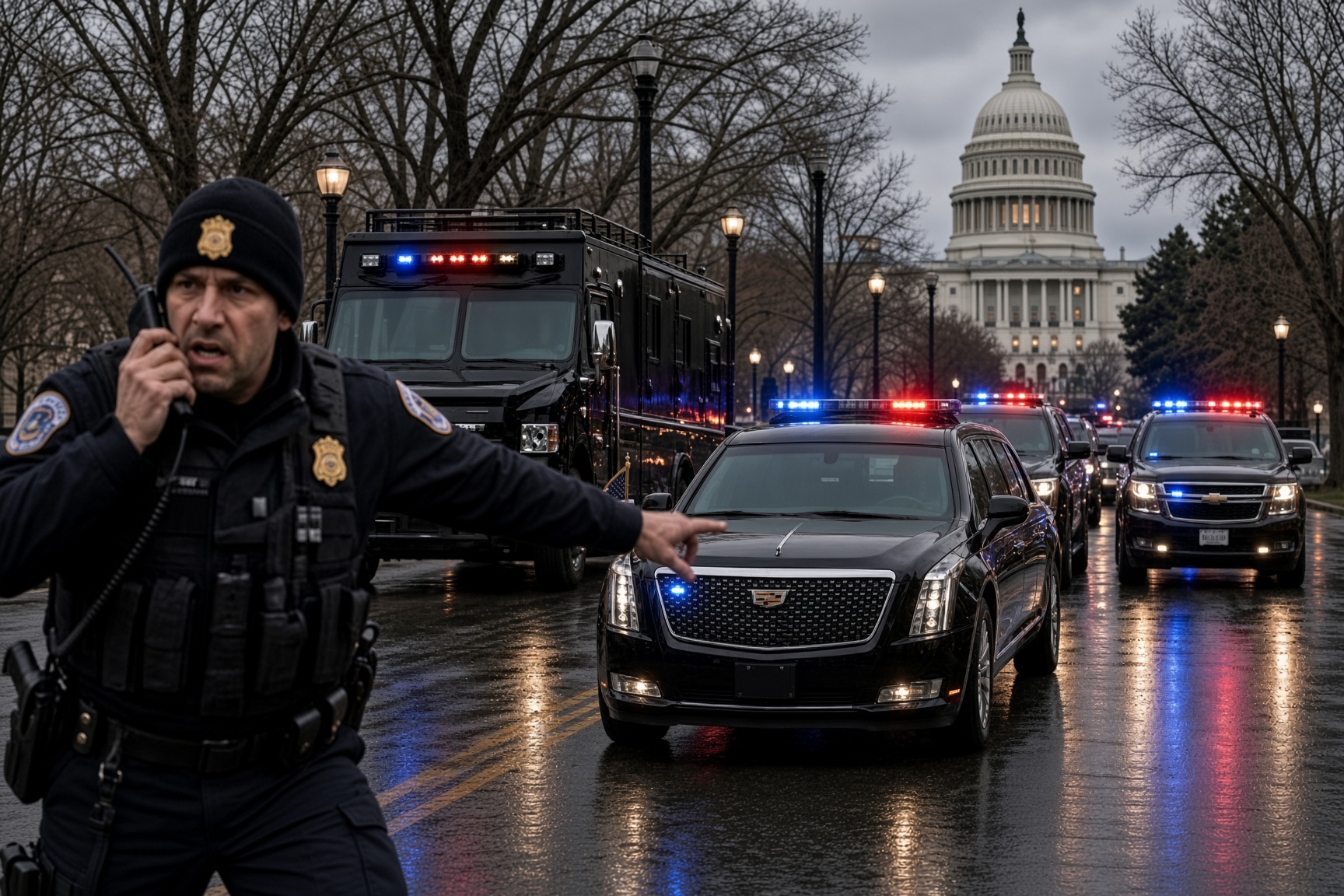
U.S. Attorney Jeanine Pirro identified Michael Marx, 45, of Midland, Texas, as the man accused of exchanging gunfire with U.S. Secret Service agents near the National Mall on May 4, 2026. The confrontation occurred shortly after Vice President JD Vance’s motorcade left the White House, leaving a juvenile bystander wounded and Marx himself shot three times. No law enforcement officers were injured.
According to court documents, the incident began when a plainclothes Secret Service agent observed Marx near 15th Street and Madison Drive and believed he was attempting to conceal a firearm on the right side of his body. The agent notified additional personnel. Agents later encountered Marx near 15th Street Southwest and Independence Avenue Southwest as he walked along the route Vance’s motorcade had just taken.
Agents exited their vehicles and issued commands. Marx allegedly ran across the street alongside a group of bystanders while drawing a handgun from his waistband. Once across the street, he turned and fired toward a Secret Service agent. One of the shots struck a juvenile in the leg. The child, who was with family members, was taken to a hospital with non-life-threatening injuries. Agents returned fire, striking Marx in the hand, left arm, and upper abdomen.
Marx was transported by ambulance to George Washington University Hospital. A criminal complaint alleges that during the ride he repeatedly shouted “kill me” and made a profane statement directed at the White House. The White House was briefly placed on lockdown after the shooting. Secret Service Deputy Director Mathew C. Quinn stated that the confrontation occurred only minutes after the vice president had left the area. The agency confirmed that personnel were on scene at 15th Street and Independence Avenue and described the event as an officer-involved shooting resulting from a confrontation with an armed individual.
The episode marked the second high-profile security incident involving the White House area in roughly a week. Days earlier, Cole Tomas Allen, 31, of Torrance, California, was accused of attempting to enter the Washington Hilton during the White House Correspondents’ Dinner while armed with multiple weapons. President Trump and senior officials were attending the event. Prosecutors told a federal court that Allen had tried to reach the ballroom and charged him with attempting to assassinate the president. U.S. Attorney Pirro described the earlier case as an effort to harm high-ranking officials and said additional charges were expected as the investigation continued. Allen made an initial court appearance and was held pending further proceedings.
In the Marx case, authorities sought preventive detention while the investigation proceeded. The criminal complaint outlines the sequence of the motorcade-route encounter, the drawing of the firearm, the shots fired, and the injuries sustained by both the bystander and the suspect. Officials emphasized that the Secret Service response prevented further harm and that the vice president’s motorcade had already cleared the immediate area.
The two incidents, occurring in close succession, prompted renewed attention to security protocols around the White House complex and official events. In the Marx matter, the rapid identification and detention of the suspect, combined with the non-life-threatening nature of the bystander’s injuries, were cited by officials as evidence of effective interdiction. Both cases remain under active investigation by federal authorities.
Pirro’s office has continued to stress that threats against protectees and the facilities they occupy will be met with prompt prosecution. Court filings in the Marx case detail the alleged statements made en route to the hospital and the physical evidence recovered at the scene. As of the initial charging, Marx remained in medical care under guard while prosecutors prepared further filings.
The May 4 confrontation began with an observation by a single agent and escalated within minutes into an exchange of gunfire in a heavily trafficked public space. The presence of bystanders, including families, complicated the agents’ response yet did not prevent them from neutralizing the threat. The juvenile’s family was notified, and the child received prompt medical attention. Marx’s injuries, while serious, were not immediately fatal.
Taken together, the Marx and Allen cases illustrate the range of threats that Secret Service and other federal personnel confront near the capital’s central institutions. One involved an alleged attempt to breach a secured dinner; the other unfolded in open view along a motorcade route. In both instances, officials credited rapid identification and decisive action with limiting harm. Investigations into motive, prior planning, and any additional accomplices or support networks continue in each matter.
Further court hearings will determine the full scope of charges against Marx and the conditions of his detention. Pirro has indicated that the Justice Department will pursue every available count supported by the evidence. The Secret Service, for its part, has reiterated standard protocols for protective details and public-area surveillance while declining to discuss specific operational adjustments.
As of the latest available information from the charging documents and agency statements, the bystander has been released from the hospital, Marx remains under medical supervision pending transfer to a detention facility, and no additional injuries to law-enforcement personnel or other bystanders have been reported. The dual cases from early May continue to shape the ongoing security posture around the White House and related events.