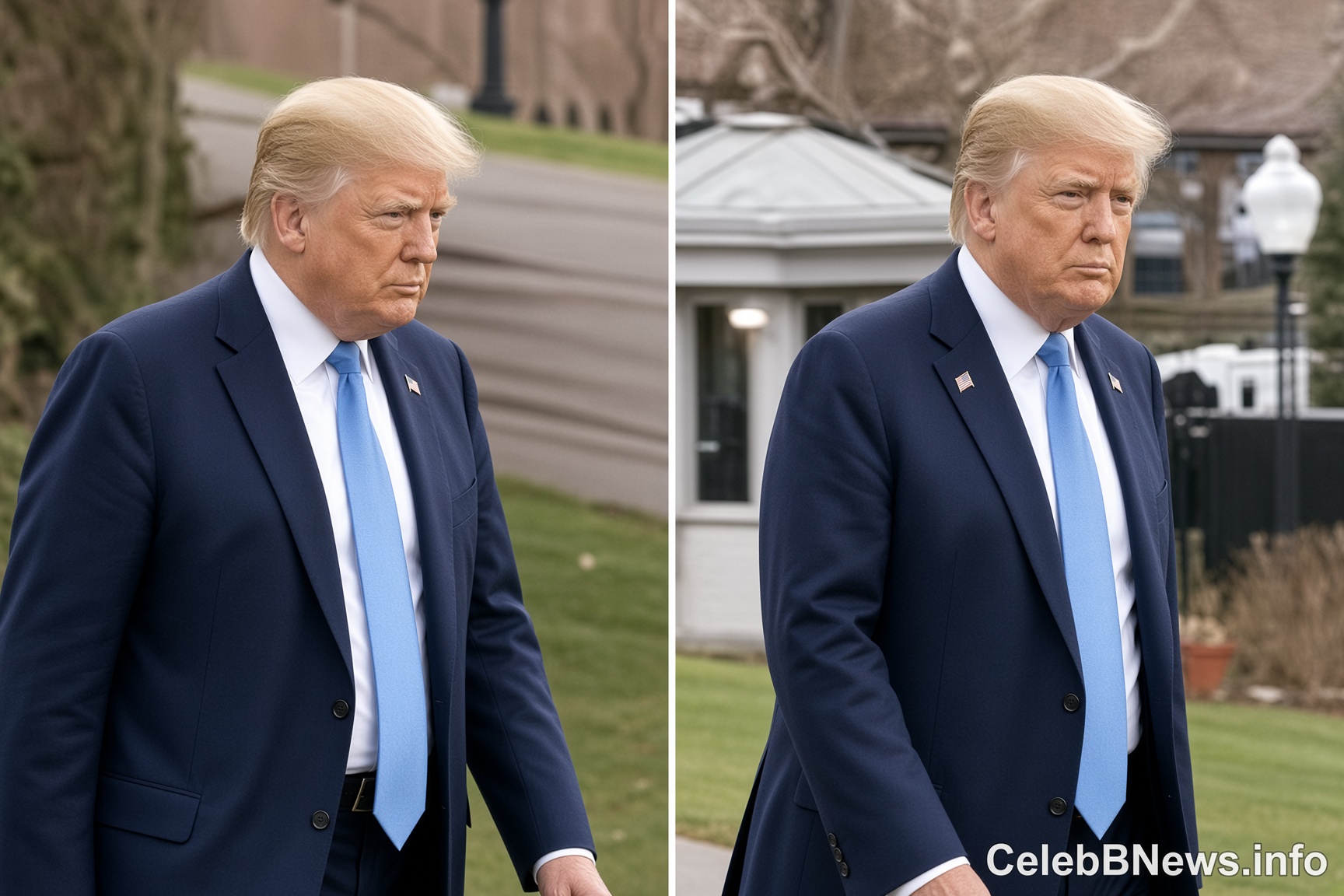
Photographs of former U.S. President Donald Trump walking across the White House South Lawn and boarding Marine One have returned to social media feeds in recent weeks, drawing fresh attention to both the images themselves and the wider conversations they tend to provoke. The pictures, which first circulated widely in 2025, capture Trump in the familiar setting of official presidential transport. Marine One, the distinctive green-and-white helicopter used for short flights from the White House, has long served as a visual symbol of the office, and these particular frames show the former president moving across the lawn before stepping aboard.
As is common with widely shared political photographs, viewers have focused heavily on surface details. Online comments have highlighted Trump’s posture, the fit of his clothing, and his overall appearance, with some users suggesting visible changes compared with earlier public appearances. Such observations quickly blend into broader speculation about his physical condition. Discussions of this kind frequently accompany images of high-profile political figures, especially those who remain active in public life after leaving office. Yet visual interpretation alone provides limited insight. Lighting, camera angle, clothing choices, and the brief nature of a departure can all affect how a person appears in a still photograph, making firm conclusions difficult without additional context.
Health-related speculation has occasionally accompanied the renewed circulation of the images, as it has with other public figures at different moments. Rumors of this type tend to arise periodically around prominent leaders and former leaders, often without supporting medical documentation. Credible assessment of any individual’s health requires professional evaluation and, when appropriate, official statements. In the absence of such confirmation, claims circulating primarily on social media platforms remain unverified. The White House and other official channels have, in past instances involving political figures, responded to unconfirmed reports with brief denials or clarifications when circumstances warranted, though the specific details vary by event.
Trump has repeatedly stated in interviews and public appearances that he considers himself to be in good health and able to maintain a full schedule. His age has been a recurring topic in media coverage and online discussion, both during his time in office and afterward, particularly when comparisons are drawn with other senior political leaders. Age by itself, however, offers only a general reference point. Individual health outcomes differ widely, and factors such as medical history, lifestyle, and ongoing care are more relevant than chronological age alone. Professional medical assessment remains the appropriate standard rather than visual analysis of photographs taken in controlled or momentary settings.
The resurfacing of the Marine One images also illustrates how quickly visual content can travel and change meaning online. The same photograph may be reposted with altered captions or placed alongside current events, allowing new interpretations to form that differ from the original context of an official departure. Algorithms that prioritize engagement can amplify emotionally charged or visually striking material, accelerating this process. Over time, an image originally documenting a routine movement can become a reference point for wider debates about appearance, energy, or fitness. This pattern is familiar in digital media environments, where content often cycles independently of its initial purpose or timing.
Observers have noted that political photography frequently functions as a projection surface for existing opinions. Details that might otherwise pass with little notice—such as posture or clothing—can acquire additional significance depending on the political climate and the viewer’s prior views. Past media coverage has, for example, referenced Trump’s consumption of fast food on certain occasions, and those reports have at times been folded into broader conversations about lifestyle and public image. Public figures may also modify habits over time, though personal adjustments are not always documented in detail. Speculation about weight, medical treatments, or other changes should therefore be distinguished from verified information.
These photographs remain part of the larger archive of images documenting official activities of U.S. leadership. Once released into the public domain of social media, however, they can acquire meanings that extend beyond the moment of capture. Timing, surrounding political events, and shifts in public interest all influence how such material is received. The result is a continuous layer of scrutiny that often persists for former officeholders who maintain a visible presence, even outside election periods or formal announcements. Discussions of stamina, appearance, and health are especially common in these circumstances.
As of the most recent publicly available information, no authoritative medical disclosure has confirmed the specific claims circulating alongside the Marine One photographs. This absence of verified detail underscores a practical distinction: social media commentary can highlight questions and interpretations, yet reliable evaluation depends on official statements and credible reporting. Resurfaced images are frequently detached from their original setting, which allows successive audiences to approach them differently from earlier viewers. Content cycles driven by engagement rather than chronology make such detachment more common.
While reactions to the photographs continue to vary, the consistent recommendation across careful analyses is to ground discussion in confirmed information. Visual material can document events and prompt questions, but it does not substitute for medical evaluation or official context. For political figures who remain in the public eye, appearance-related commentary is likely to persist. Distinguishing between what an image shows and what it can reliably establish helps keep those discussions accurate, particularly when they touch on health or personal well-being.