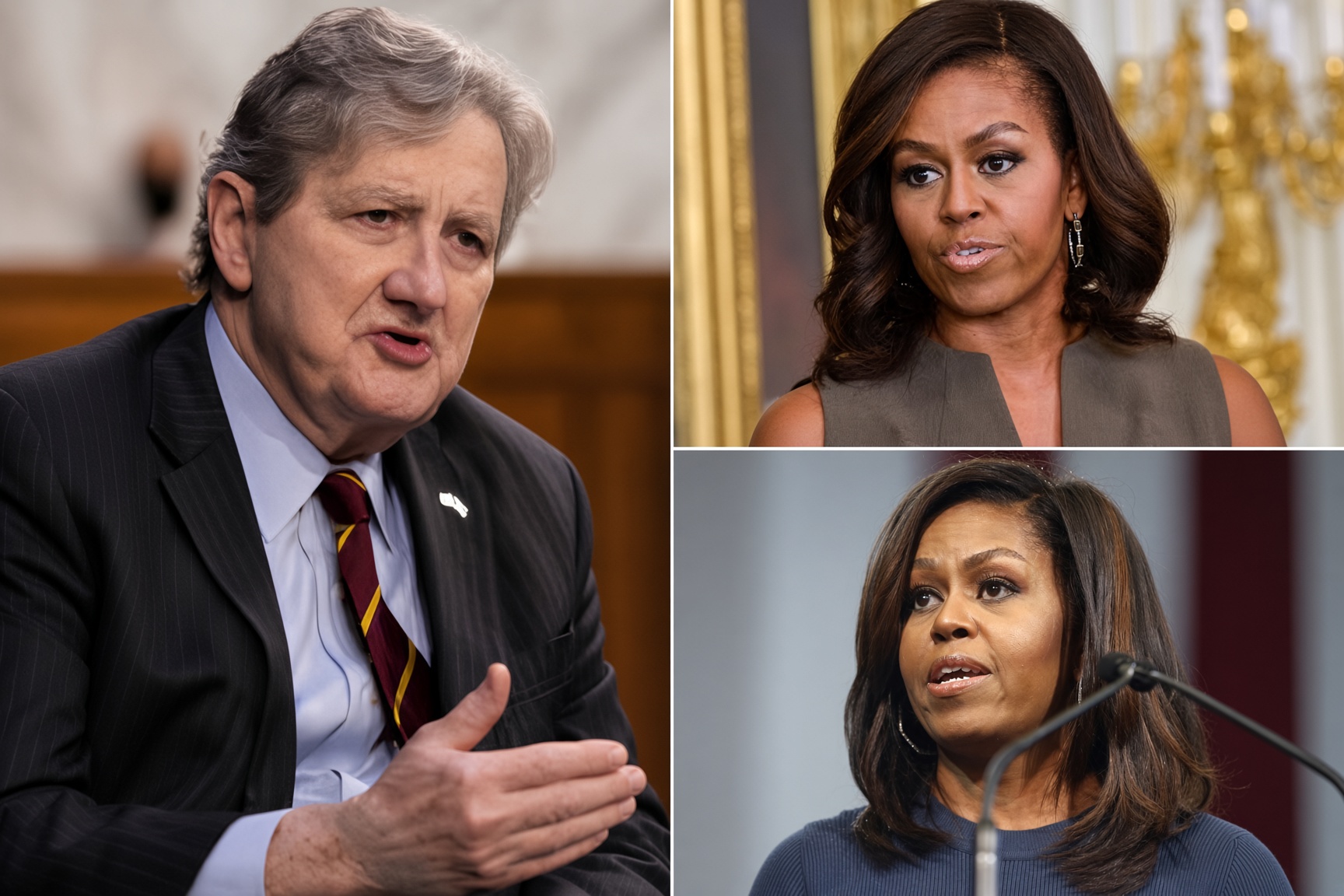
The headline has every ingredient of a political thriller: a former first lady, a sharp-tongued senator, a multimillion-dollar defamation suit, and a surprise witness whose nine-second statement supposedly flips the entire case. According to the version circulating online, Michelle Obama sued Senator John Kennedy over remarks linking her charitable work to political influence. Kennedy’s side allegedly recast the dispute as a matter of public accountability, insisting that questions about money, private foundations, and power should not be dismissed as personal attacks.
The claimed turning point arrives with Thomas Riley, described as a former senior adviser. In the viral account, Riley takes the stand and confirms that Obama participated in confidential negotiations. Those few seconds, the story says, undercut the plaintiff’s position and helped Kennedy prevail. It is a clean narrative arc. It is also unverified.
No court transcript, official judgment, or independent reporting has confirmed that Riley testified as described, or that a jury ever ruled in Kennedy’s favor. Searches of public dockets and major news outlets turn up no case matching the account. Fact-checking examinations of similar online versions have instead flagged the story as a fabrication that spreads through social media and fringe sites without primary documents. Dramatic description is not evidence. Without a record, the nine-second exchange cannot be treated as a documented courtroom event.
The broader tension the story invokes is real enough. Public figures routinely face sharp criticism, especially when questions involve charitable organizations, financial transparency, and political connections. Defamation law exists to address certain false statements that unlawfully harm reputation. The two principles are not mutually exclusive. Asking difficult questions about powerful people is not automatically defamation. At the same time, labeling an accusation “political oversight” does not automatically shield every statement from legal consequences. The precise wording, the available evidence, the applicable standard, and the context all matter.
The circulating account attributes a forceful argument to a lawyer named Marcus Hail, who supposedly framed the case as an attempt to silence a voice rather than protect dignity. It also assigns Kennedy a line about bringing hidden matters into the light. Neither quotation has been authenticated as actual courtroom testimony. Political storytelling can blur the line between a legitimate debate about accountability and an invented confrontation. Treating unattributed dialogue as fact accelerates that blur.
A genuine high-profile defamation trial would ordinarily leave a clear documentary trail: a complaint with a docket number, filings on PACER or a state court system, judicial rulings, and potentially a verdict or judgment. The available record has not established those materials for the lawsuit and outcome described in the viral narrative. Related, verifiable litigation involving Obama family members exists in other contexts, but it does not corroborate this particular claim. That absence does not settle every question that might be raised about the people involved. It does mean the specific assertions of a surprise witness, a nine-second revelation, and a jury victory should not be repeated as established fact.
When a story claims that a few seconds in court destroyed a public figure’s legacy, the first question is whether that courtroom moment occurred. Political accountability depends on asking hard questions. Credible reporting depends on demanding evidence before accepting the answers.