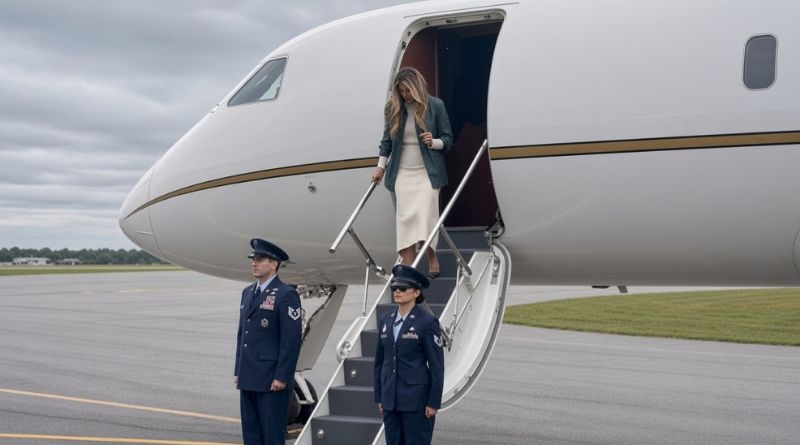
President Donald Trump and first lady Melania Trump left Britain on Thursday after a three-day state visit built around pageantry, politics and a large package of commercial pledges. The departure was delayed when Marine One made a precautionary landing in England because of a hydraulic problem. The couple then switched to a support helicopter and continued to London Stansted Airport, where Air Force One was waiting.
White House press secretary Karoline Leavitt said the pilots diverted “out of an abundance of caution” after a “minor hydraulic issue” on the short hop from Chequers, the prime minister’s country residence in Buckinghamshire, to Stansted. The president and first lady were unharmed. The flight had been scheduled for about 20 minutes; the diversion added delay, and Trump arrived at the airport roughly 20 minutes behind the press pool before departing for Washington. The White House presented the landing as a routine safety call that worked as designed.
The incident closed an unusual second British state visit — the first time a U.S. president has received that honor twice. King Charles III and Queen Camilla hosted the Trumps at Windsor Castle, including a state banquet, before the political and commercial portion of the trip moved to Chequers on Thursday.
Prime Minister Keir Starmer used the visit to advertise a large package of U.S. commercial commitments in the United Kingdom. The British government put the headline figure at £150 billion in inward investment tied to the visit, describing it as the largest commercial package ever associated with a state visit and saying it could support more than 7,600 jobs in clean energy, life sciences and advanced manufacturing. Private equity firm Blackstone accounted for the biggest single pledge cited by London — about £100 billion over a decade, including earlier data-center commitments. Other names attached to the week’s announcements included Microsoft, Prologis and Palantir.
Trump described the commercial wave in larger dollar terms. At a business reception with Starmer, he said a new science-and-technology accord was already associated with more than $350 billion in private-sector deals, “headlined by” a Blackstone figure he put at $136 billion. He thanked Blackstone’s Steve Schwarzman and Nvidia’s Jensen Huang from the stage and framed the package as the “next logical step” in U.S.-U.K. cooperation on artificial intelligence, quantum computing, fusion, 6G and civil nuclear power.
The two governments signed what they called a Technology Prosperity Deal, a memorandum aimed at closer work among research and regulatory agencies on AI, quantum and nuclear energy. Officials said the pact is meant to speed licensing, align standards and encourage private projects rather than function as a single appropriated spending bill. Trump argued that AI and advanced computing require large amounts of electricity and that nuclear deployment is part of meeting that demand.
One project both sides highlighted was a plan by U.S. firm X-energy and Britain’s Centrica to deploy advanced modular reactors in the United Kingdom, with Hartlepool identified as a preferred first site. Trump said the effort could generate more than $50 billion in economic value, create up to 2,500 jobs and power about 1.5 million homes. Company and government statements around the visit used similar job and household figures for a first-phase deployment.
Starmer called the U.S.-U.K. relationship the “most natural partnership in the world” and branded the technology agreement a “tech-prosperity deal.” Trump said it would open “billions of dollars of opportunities” and give the United States better access to Britain’s aerospace supply chain. Private talks were expected to touch Ukraine, the war in Gaza, energy and other political files; both leaders then joined executives for the reception.
The visit mixed ceremony with salesmanship. After Windsor, Trump flew by Marine One to Chequers for the working day. After the helicopter diversion, he and the first lady boarded Air Force One at Stansted and returned to the White House on Friday.
Both governments insisted the larger story of the week was the economic package attached to an unprecedented second state visit. The precise mix of new money, previously planned investment and long-horizon pledges remained a matter of how each capital counted the same announcements.