STOCKTON, Calif. — The cake had not been cut. Balloons still hung in the hall. About a hundred people had come to Monkey Space, a rented room at 1955 Lucile Avenue in the Sherwood Manor neighborhood, for a two-year-old girl’s birthday. It was just before 6 p.m. on Saturday, November 29, 2025. Then the shooting started.
Four people died. Three were children: Maya Lupian, 8; Journey Rose Reotutar Guerrero, 8; and Amari Peterson, 14. The fourth was Susano Archuleta, 21. Thirteen others were wounded, at least one of them critically. Detectives recovered more than 50 shell casings and concluded that at least five firearms had been fired. They believed more than one shooter was involved, that the gunmen wore face coverings and dark clothing, and that the attack was targeted. As of September 2026, nearly ten months later, the San Joaquin County Sheriff’s Office still had not announced an arrest in the killings. Investigators said they were close to sending the case to the district attorney.
What was supposed to be a family afternoon became one of the deadliest public shootings in the Stockton area in years, and one of the hardest for the city to absorb, because so many of the dead were children who had come for cake.
The party and the hall
The gathering was advertised on social media and scheduled to run from 3 p.m. to 6 p.m. The girl’s mother, Patrice Williams, had booked the space in person. Monkey Space was listed on Peerspace, a short-term rental site, but the name did not appear on state or county business licenses. The property at Lucile Avenue sits in unincorporated San Joaquin County, just north of the Stockton city limits, near Thornton Road and a Dairy Queen in Thornton Plaza. That location would matter within minutes.
The building’s owner later said he had leased it to Vertical Compass LLC for office and video work, and that running a banquet hall there was not what the lease allowed. The county had received a complaint on November 5, 2025, that a business at the address was operating without the required permits. That complaint was still open when the party was held. Vertical Compass said it had first sent an application to the city of Stockton by mistake, then applied through the county. None of that paperwork stopped the party. Between 80 and 100 people, some accounts put the crowd closer to 150, were inside or around the hall when the first shots were fired.
Williams later told the Associated Press she thought the noise was the balloons she had inflated earlier. “I actually thought it was my balloons popping. It was gunshots,” she said. Her two-year-old was not hit. Her sister, a cousin, and three friends were. Others were about to sit for dinner. The gunfire began inside the hall, where the four people who died were shot, and continued outside.
How it unfolded
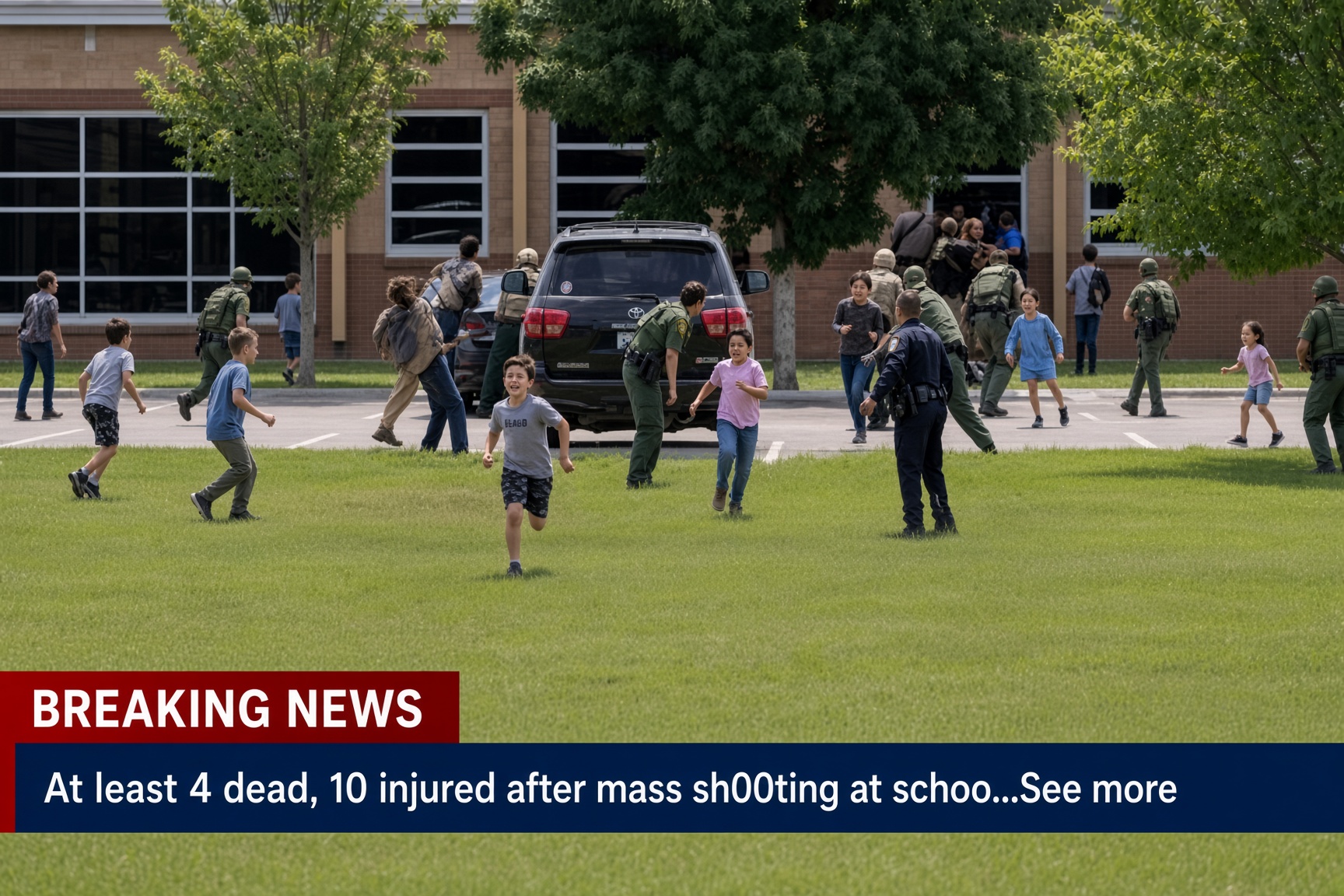
Calls reached law enforcement shortly before 6 p.m. The first officers were at Thornton Plaza in about four minutes, but some of them had been sent to the Dairy Queen next door rather than the hall. Units reached the venue itself about six or seven minutes after the first calls.
Survivors described a room that went from party noise to the floor in seconds. Children were bleeding. Adults dropped or ran. One account, from the father of a boy who was killed, said his son had been walking over to speak with the rapper MBNel when a masked gunman fired toward the rapper and struck the boy in the chest. MBNel was himself wounded and later went into hiding. Another account said the only adult who died had first pushed his girlfriend and several children into a closet, then was shot in the neck.
Bullets also hit a nearby house. A man working on his garage door said rounds narrowly missed him and his dog. He and his girlfriend hid in a backyard shed.
Sheriff Patrick Withrow said early interviews did not produce clear descriptions of the shooters. He said he understood that people had been trying to stay alive, and that he had hoped for more. He stopped short of calling the attack gang-related in the first days, while not ruling it out. City leaders were less cautious. Months later, San Joaquin County District Attorney Ron Freitas still described the November shooting as gang gun violence.
The dead
Families and schools named the victims before officials finished formal notifications.
Maya Lupian was an eight-year-old third grader at Aspire APEX Academy. Her family described a child who liked to draw, sing, and dance, and who had earned a purple belt in karate. Aspire Public Schools confirmed her death.
Journey Rose Reotutar Guerrero was also eight. Her name was released with the others by authorities and relatives in the days after the shooting.
Amari Peterson was 14, a freshman who played football and basketball and had been talking about college. He lived in Modesto and had come to the party with family. His father, Patrick Peterson, told reporters in the weeks afterward that he did not want to question God, and that losing his son had left him questioning everything about life. An aunt’s fundraiser called him a boy whose only mistake was being at a children’s party.
Susano Archuleta, 21, died at the scene. His aunt, Patricia Flores, said he had gone to a friend’s daughter’s celebration and would be missed. His brother, Emmanuel Lopez, told the Los Angeles Times that Archuleta was shot in the neck. Friends later said he was one of many young men from the area lost to gunfire.
Among the wounded was Jasmine Dellafosse, a Stockton community organizer known for neighborhood cleanups, youth parties, and playground work, and a former intern for former mayor Michael Tubbs. She survived.
The investigation
Because the hall is outside city limits, the San Joaquin County Sheriff’s Office led the case, with help from the FBI, the ATF, the California Department of Justice, Stockton police, the district attorney, and the U.S. Attorney’s Office.
On December 9, 2025, Withrow said investigators had found more than 50 shell casings and evidence of at least five guns. They were still trying to learn whether anyone at the party fired back. Witnesses described shooters in masks and dark clothes. Early on, the sheriff said there was no solid information about getaway cars. Guns were also found on the roof of the venue. Detectives had not established whether those guns were used in the attack.
Rewards piled up. The FBI offered $50,000 for information leading to arrests or convictions. The ATF added $25,000. Stockton Crime Stoppers, with money from Mayor Christina Fugazi and Councilmember Mariela Ponce, put up its own reward, later raised to $55,000. A Texas nonprofit tied to the Uvalde response added $5,000. Combined figures cited in early 2026 coverage reached about $130,000.
Two men who had been at the party were arrested, but not as the shooters. One was the father of the birthday girl. Parole records and charging documents alleged he was affiliated with the Sureños and classified by Stockton police as an active member of the Asian Boyz and Muddy Boyz. He had been on GPS monitoring. Prosecutors said the monitor showed he spent more than five hours at the venue. He was charged with assault with a firearm, possession of an assault rifle and high-capacity magazines, being a felon in possession, gang activity, domestic violence, and a parole violation. The district attorney’s office alleged he hosted the party knowing gang members would be there. A second man, described as an uncle of the child and a known rapper, was charged with violating parole conditions that kept him away from places where children gather and away from known gang members. He pleaded no contest to the parole violation and was sentenced to 180 days. His lawyer said he was not involved in the shooting.
On January 17, 2026, the sheriff’s office released surveillance images of two vehicles it believed were connected to the attack, a white car and a silver or gray car, without plates or a location. On February 4, investigators said they had recovered a white Honda Accord and a gray Volkswagen and were processing them. On April 1, Withrow said he expected arrests within a couple of months and that digital evidence was being prepared for the district attorney.
That timeline slipped. On September 10, 2026, the sheriff’s office said a few pieces of evidence were still being worked and that the case was close to being handed to prosecutors, with the aim of charging suspects to the full extent of the law. No arrests in the killings had been announced. On September 23, Freitas said he still had not received the case file. He stood by his description of the shooting as gang gun violence.
Aftermath
A memorial of flowers and candles went up near the hall. Nonprofits brought clothes, food, and counseling. On December 3, two vigils were held: the district attorney’s annual ceremony for crime victims at Weber Point, and a gathering the same day at Greater Christ Temple near the scene. The Nigerian singer Burna Boy, through Vice Mayor Jason Lee, offered to cover funeral costs.
Williams apologized to guests and said she had only wanted her family together. She described seeing bleeding children on the floor. On December 19, MBNel posted condolences after weeks out of public view. The leaseholder said he feared being pulled into gang politics and was considering not reopening.
In December, the Youth Peace and Justice Foundation said it had brought members of rival local gangs to a closed meeting and obtained a 21-day “conditional” truce. Its founder, Daniel Chaplin, warned that if city leadership did not match that step with institutional commitment by January 15, it would bear responsibility for any violence that resumed. The truce did not produce an arrest.
On January 13, 2026, survivors and relatives, including Patrick Peterson, went to the state Capitol. State Senator Jerry McNerney asked lawmakers for more funding for crime victims and violence prevention, including a $10 million one-time grant for family justice centers. Peterson spoke about his son and about the lack of progress in the case.
The New York Times, reporting from Stockton in early January, described a city that has long lived with gang violence and has also tried to reinvent itself, now stuck with a new image: the place where children were shot at a toddler’s birthday. One resident told the paper that was now the narrative.
Stockton recorded 3,680 violent crimes in 2024, nearly double the statewide rate, and the San Joaquin Valley had the highest violent-crime rate in California in 2023. Those numbers do not explain a masked attack on a birthday hall. They do explain why many residents heard the news and were horrified without being surprised that gunfire had found another crowd.
By the fall of 2026 the city had other killings to answer for, including a separate string of nighttime shootings of men that police were investigating as possibly linked. The Lucile Avenue case remained its own file: four names, five or more guns, two recovered cars, parole cases against men who were at the party but are not accused of pulling the triggers, and a prosecution that still had not begun.
What is still open
The public record, as of early October 2026, still does not name the shooters or spell out a confirmed motive beyond the investigators’ view that the attack was targeted and the district attorney’s view that it was gang violence. It does not say whether anyone inside the hall fired back. It does not say why a children’s party became the place the gunmen chose, beyond allegations that gang factions were in the room.
What the record does fix is narrower and harder. A two-year-old’s party. A hall that the county had already been asked to look at for operating without permits. Gunfire before the cake. Four dead, three of them children, thirteen wounded. A sheriff still compiling evidence ten months later, and a district attorney still waiting for the file.