President Donald Trump arrived in Knoxville on Saturday for the nationally televised Southeastern Conference opener between No. 1 Texas and No. 14 Tennessee, adding a presidential security detail, an Air Force One flyover, and another layer of attention to an already highly anticipated game at Neyland Stadium.
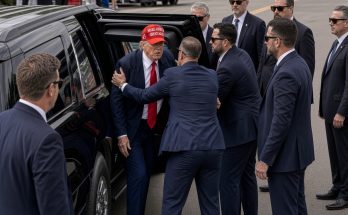
Trump landed at 11:28 a.m. ET, shortly before the noon kickoff. Air Force One made a low-altitude pass over the stadium while Texas and Tennessee players warmed up. Fans inside the stands could be heard cheering during the flyover. His motorcade reached Neyland Stadium at about 11:59 a.m., just as the national anthem was being performed.
When Trump appeared on the stadium’s giant video boards, cheers rose from portions of the crowd. Other accounts and videos from inside the stadium also captured boos from some spectators, producing differing descriptions of the overall reception. From a stadium suite, Trump responded by pumping his fist several times. He watched the game alongside Tennessee’s two Republican U.S. senators, Marsha Blackburn and Bill Hagerty.
The visit placed him at a matchup with both competitive and personal resonance. No. 1 Texas was making its first trip to Neyland Stadium to face the No. 14 Volunteers. The game also gave Trump a chance to see Texas quarterback Arch Manning play in the stadium where Manning’s uncle, Peyton Manning, became one of Tennessee’s most celebrated players in the 1990s.
Security around the presidential visit required substantial preparation. The University of Tennessee opened Neyland Stadium 30 minutes earlier than usual and urged fans to arrive well before kickoff because of additional Secret Service screening. Fans who entered early were offered half-price concessions. The approach appeared to work: the stadium was reportedly about half full 90 minutes before kickoff and nearly full an hour before the game began. Neyland Stadium officially seats more than 101,000 and routinely ranks among the largest college football venues in the country.
There had also been concern that Trump’s movements could interfere with electronic communications used by the football teams. Texas coach Steve Sarkisian said before the game that coaches had been warned they could temporarily lose headset communications whenever Trump entered, left, or moved to another location inside the stadium. The two universities coordinated with the Secret Service before kickoff to limit potential interference, and no significant communication problems were reported during the game.
Trump’s motorcade left the stadium at approximately 2:07 p.m., during the second half. Texas went on to defeat Tennessee 20-17 in a closely contested SEC opener. Longhorns defensive end Colin Simmons tied a Texas program record with five sacks. Running back Raleek Brown rushed for 67 yards and scored two touchdowns; his four-yard scoring run with 5:41 remaining provided the winning margin. Arch Manning finished with 201 passing yards as the Longhorns survived Tennessee’s late comeback attempt and remained undefeated.
The Knoxville trip fits a broader pattern in Trump’s second term. He has increasingly made major sporting events part of his public schedule, attending the Daytona 500 in 2025 and appearing at UFC events, major college football games, and other high-profile contests. Earlier this year he attended Game 3 of the NBA Finals between the New York Knicks and the San Antonio Spurs, and later the World Cup final in New Jersey. College football has been a particularly frequent destination. He has attended Army-Navy games, national championship games, and several regular-season SEC contests, including Alabama-Georgia in 2024.
Saturday’s visit also came as Congress continues debating federal legislation that could reshape college athletics. Lawmakers have been considering measures on name, image, and likeness compensation, athlete transfers, and the authority of the NCAA and conferences to regulate college sports. Trump has taken executive action in the same area, signing an order last year aimed at limiting what his administration described as “pay-for-play” arrangements while attempting to preserve scholarships and opportunities in non-revenue sports.
The result was a presidential appearance set against one of college football’s largest regular-season stages: a top-ranked visitor, a historic home stadium, a divided crowd reaction, and a one-score finish decided late in the second half.