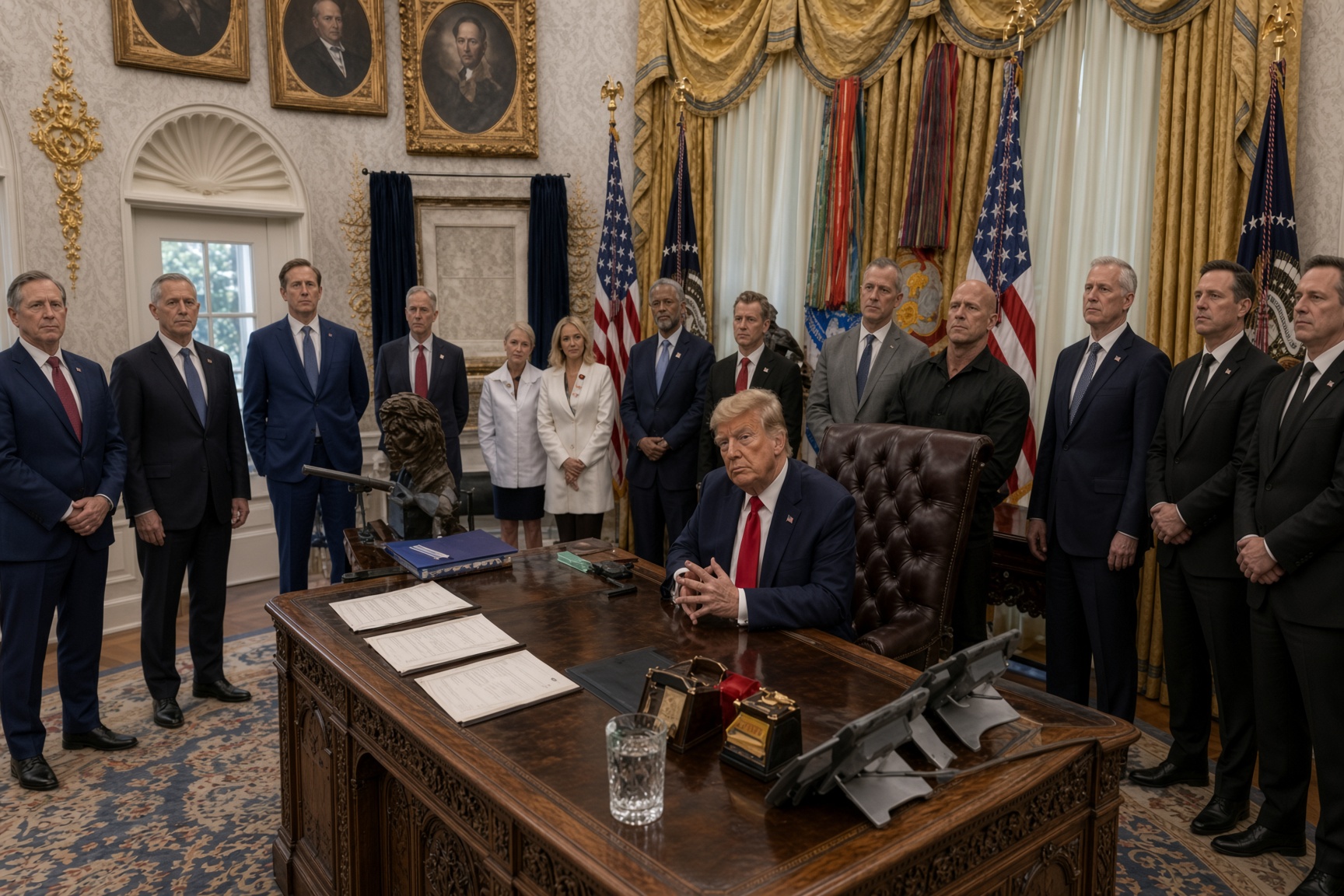
A federal judge appointed by former President Ronald Reagan has resigned from the bench, explaining in a published essay that he could no longer remain silent about what he views as President Donald Trump’s misuse of the law. Mark Wolf, named to the U.S. District Court for the District of Massachusetts in 1985 at age 38, wrote in The Atlantic that he had expected to serve for the rest of his life. He instead stepped down so he could publicly criticize the administration without the constraints that apply to sitting judges.
Wolf stated that he was relinquishing his lifetime appointment because “I no longer can bear to be restrained by what judges can say publicly or do outside the courtroom.” He accused Trump of using the law for partisan purposes by targeting adversaries while sparing friends and donors from investigation, prosecution, and possible punishment. “This is contrary to everything that I have stood for in my more than 50 years in the Department of Justice and on the bench,” he wrote. “The White House’s assault on the rule of law is so deeply disturbing to me that I feel compelled to speak out. Silence, for me, is now intolerable.”
Wolf began his public service career at the Department of Justice in 1974, shortly after the Watergate scandal that led to the resignation of President Richard Nixon. He served under Attorney General Edward Levi during the Ford administration and has credited Levi with shaping his commitment to nonpartisan justice and the rule of law. Wolf later became a federal prosecutor focused on public corruption in Massachusetts before joining the bench. He assumed senior status in 2013; his seat was filled in 2014 by Judge Indira Talwani, an appointee of President Barack Obama. Wolf has said he hopes to serve as a spokesperson for other judges who, bound by the judicial code of conduct, feel they cannot speak candidly about their concerns.
The White House responded through spokeswoman Abigail Jackson, who said judges seeking to inject personal agendas into the law have no place on the bench. Jackson pointed to more than 20 Supreme Court victories for the Trump administration’s policies, arguing they have been upheld as lawful despite numerous legal challenges and what she described as unlawful lower-court rulings. “And any other radical judges that want to complain to the press should at least have the decency to resign before doing so,” she added.
The resignation comes months before November’s midterm elections. Republican National Committee Chairman Joe Gruters has said Republicans may outspend Democrats this cycle, reversing a historical pattern in which Democrats often held the fundraising edge. Speaking on Breitbart, Gruters was asked about the roughly $70 million Democrats spent in Virginia’s recent redistricting fight. He described Democratic finances as weak, stating that the Democratic National Committee is roughly $4 million in the red and that the spending in Virginia came from a broader collective rather than the party committee alone.
Gruters estimated that the collective effort on the right may hold around $800 million, compared with roughly $350 million on the left. He added that an impending court ruling on coordinated campaign limits could further amplify the advantage by allowing fuller coordination and spending at the candidate rate. “When you have that financial advantage… this time, this cycle will either spend at parity or will outspend them, and that’s never happened before,” Gruters said, describing the situation as a historic break from previous election cycles in which Democrats routinely spent more. He cited stronger coordination across conservative groups and committees as a key factor.
Wolf’s decision highlights ongoing debates over the proper role of the judiciary and the boundaries of judicial speech, while the fundraising commentary underscores the intensifying resource competition as both parties prepare for the midterms. The former judge’s public critique and the White House’s rebuttal reflect deeper partisan tensions over the application of law and the independence of the courts.