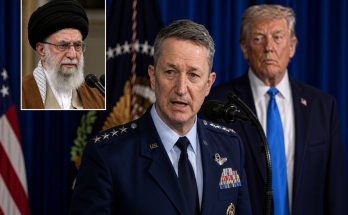
President Donald Trump announced on Saturday that the United States had carried out a “very successful attack” on three key Iranian nuclear facilities: the heavily fortified Fordow site, along with Natanz and Isfahan.
In a Truth Social post, Trump stated: “We have completed our very successful attack on the three Nuclear sites in Iran, including Fordow, Natanz, and Esfahan.” He reported that all U.S. aircraft had safely exited Iranian airspace after delivering a full payload of bombs, with particular emphasis on the mountain-buried Fordow facility. Trump described the operation as “an HISTORIC MOMENT FOR THE UNITED STATES OF AMERICA, ISRAEL, AND THE WORLD” and declared that “IRAN MUST NOW AGREE TO END THIS WAR,” presenting the strikes as a decisive setback to Iran’s nuclear program and a step toward regional peace.
The strikes, conducted with advanced U.S. bombers and precision munitions, targeted Iran’s uranium enrichment capabilities. Trump later asserted that the sites had been “completely and totally obliterated,” though independent assessments of the damage have differed. He characterized the broader situation as “outrageous” and warned of “everlasting consequences.”
Iranian Foreign Minister Abbas Araghchi condemned the action in a statement on X, calling it “extremely dangerous, lawless and criminal behavior” that violated the UN Charter. He said the events were “outrageous” and “will have everlasting consequences,” adding that Iran reserved “all options to defend its sovereignty, interests, and people” under the UN Charter’s provisions for self-defense.
International reactions were sharply divided. Israeli Prime Minister Benjamin Netanyahu welcomed the strikes, congratulating Trump on a “bold decision” he said would “change history” by denying Iran a path to nuclear weapons. Some Western leaders, including UK Prime Minister Keir Starmer, acknowledged the threat posed by Iran’s nuclear activities while underscoring the need for stability and diplomacy.
Others sounded alarms. UN Secretary-General António Guterres warned of a “dangerous escalation” in an already volatile region and called for immediate de-escalation. Leaders in Russia, China, and several European countries urged restraint and a return to negotiations. Gulf states, including Saudi Arabia, expressed concern about the risk of wider regional instability.
The strikes represented a significant U.S. escalation amid stalled nuclear talks. As of mid-2026, the episode forms part of a fragile landscape of ceasefires, renewed diplomatic efforts, and ongoing uncertainty across the Middle East.