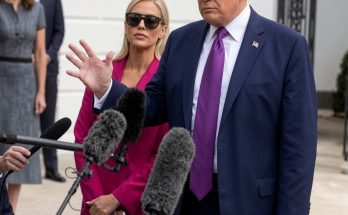
In a capital defined by ceaseless argument and the unrelenting churn of the 24-hour news cycle, the most scrutinized political gesture of the week arrived without a single spoken word. During a high-stakes address on Thursday afternoon, President Donald J. Trump reduced a crowded Washington auditorium to stillness. Lawmakers, foreign dignitaries, and members of the national press had gathered expecting the familiar combination of volume, velocity, and direct confrontation that has marked his public style since the outset of his political career. What they received instead was a calculated departure from that pattern.
As Trump stepped to the lectern, the anticipated opening salvo did not come. He halted. For several long seconds he remained silent, scanning the room with an unblinking, measured intensity. The customary murmur of the crowd thinned into an uneasy hush. The only sound was the rapid, synchronized click of camera shutters. Witnesses described an immediate shift in the room’s atmosphere: rather than conveying hesitation, the pause carried a deliberate weight. In a city where public figures rarely surrender even a second of airtime, the sheer unpredictability of the moment compelled every broadcast lens and every attendee to lock attention on the figure at the podium.
Within minutes of the speech’s conclusion, the brief interval of silence had escaped the hall. Short clips isolating the pause circulated rapidly across X and Truth Social, accumulating tens of millions of views in a matter of hours. The interpretations that followed reflected the polarized character of contemporary political analysis. Supporters and some rhetorical observers framed the stillness as evidence of calculated command—an instinctive grasp of how to seize the stage by refusing its ordinary rhythms. Critics and progressive analysts countered that the pause was either a routine breath taken by any public speaker or an intentional theatrical device designed to manufacture attention from an otherwise ordinary moment. The fact that a roughly five-second silence could dominate editorial discussions and sustain a multi-day cable news cycle itself became part of the story, underscoring Trump’s capacity to set the terms of national conversation with minimal verbal content.
In the higher registers of political communication, silence has long been recognized as one of the more difficult and potent rhetorical instruments. Spoken words invite immediate transcription, fact-checking, and rebuttal. A deliberate pause, by contrast, functions as an open canvas. Audiences and media outlets alike tend to project their own expectations, anxieties, and political assumptions into the void. By declining to fill the opening moments of the address, Trump required the assembled press to wait on his schedule, interrupting the standard cadence of political coverage. Public-relations specialists and scholars of rhetoric noted that the technique exploited a basic feature of mass media: human attention is drawn more forcefully to sudden absence than to continuous noise. In a landscape saturated with constant commentary, the interruption of that noise proved more disruptive than amplification.
The episode stood in clear contrast to the conventional Washington approach. Most politicians are trained to avoid dead air, relying on carefully scripted talking points and teleprompter delivery to maintain a seamless flow. Awkward pauses are treated as liabilities to be edited out or explained away. Trump’s performance inverted that model. After the viral interval, he moved without transition into the substantive elements of his address—economic policy, deregulation, and judicial appointments—never acknowledging or justifying the preceding silence. The White House offered no formal clarification, treating the gesture as self-explanatory. By leaving the moment unaddressed, the administration effectively invited the media to consume itself in speculative interpretation, reinforcing a familiar dynamic in which the political apparatus reacts to the president rather than the reverse.
The broader significance of the episode lies in the way it illustrates the blurred boundaries of contemporary governance. Public policy, personal branding, and theatrical optics have become difficult to separate. Whether the pause originated in a momentary personal reflection, an intuitive sense of televisual drama, or a simple need to gather thoughts, its effect was singular. In a capital that perpetually talks over itself, the demonstration was that undivided attention can sometimes be secured most effectively by saying nothing at all. The episode did not alter the content of the speech that followed, nor did it resolve any legislative or diplomatic question then before the city. It did, however, reaffirm that control over the national conversation can still be exercised through the management of absence as much as through the production of argument. In an environment defined by relentless verbal combat, the decision to withhold speech briefly reset the terms on which that combat would continue.
As the news cycle moves on, the Washington pause remains a compact illustration of how modern political communication operates. It required no new policy announcement, no extended monologue, and no subsequent explanation. It required only the willingness to occupy a moment that others are conditioned to fill, and the confidence that the resulting vacuum would be filled by others on terms the speaker had already shaped. In that limited but precise sense, the silence accomplished what a great deal of ordinary rhetoric often fails to do: it compelled the audience to listen.