Dangerous Escalation in the Persian Gulf: Iran Intensifies Attacks on U.S. Bases in Operation True Promise
In a significant escalation of the ongoing regional conflict, Iran has launched multiple waves of ballistic missiles, cruise missiles, and drones targeting U.S. and allied military installations across the Persian Gulf. These strikes, conducted under the banner of “Operation True Promise” (also referred to as True Promise 4 or IV), represent Iran’s sustained retaliation against earlier U.S.-Israeli operations that struck Iranian leadership, nuclear sites, missile production facilities, and air defenses beginning in late February 2026.
The campaign has stretched across several Gulf Cooperation Council nations, heightening fears of a broader war that could engulf more actors and severely disrupt global energy supplies. As of mid-May 2026, the situation remains highly fluid, with Iranian forces claiming repeated successful hits while U.S. and Gulf officials stress robust defenses and limited operational impact. Independent satellite imagery has confirmed damage at multiple sites, painting a more complex picture than official statements from either side.
Strikes Across Key U.S.-Linked Bases
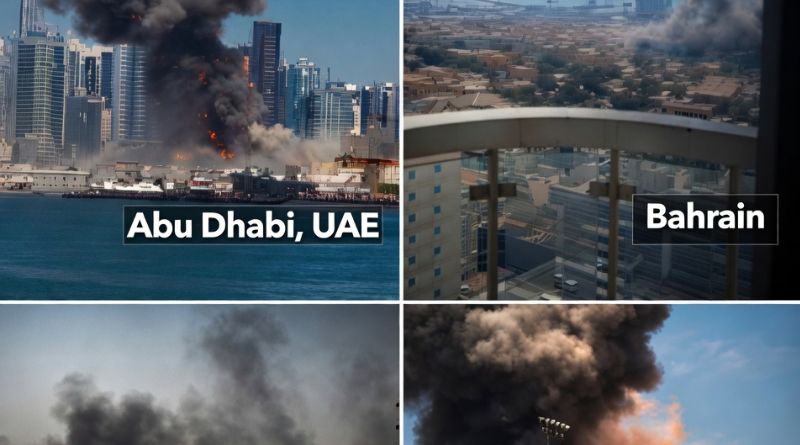
In the United Arab Emirates, Iran repeatedly targeted Al Dhafra Air Base near Abu Dhabi, a critical hub for U.S. Air Force operations, reconnaissance, refueling, and joint activities with UAE forces. Ballistic missiles triggered powerful explosions, with satellite imagery later revealing damage to hangars, infrastructure, radar systems, and support facilities. While advanced air defenses—including THAAD and Patriot batteries—intercepted many incoming projectiles, some strikes caused structural damage and secondary explosions. The UAE responded by temporarily closing its airspace, shifting some operations to remote or dispersed locations, and issuing public safety alerts urging residents to avoid military zones and shelter indoors.
Bahrain experienced direct threats to the heart of U.S. naval presence in the region. Smoke and explosions were reported over the Al Jufair district in Manama, home to Naval Support Activity Bahrain, headquarters of the U.S. Navy’s Fifth Fleet. Iranian media and the IRGC claimed successful strikes on naval facilities and command buildings. Local authorities activated shelter-in-place orders amid audible explosions and air raid sirens. Damage to communications infrastructure and support buildings has been noted in various reports, though the full extent remains under assessment.
In Qatar, explosions echoed across Doha as air defense systems, including Patriots, engaged incoming threats aimed at areas near Al Udeid Air Base—the forward headquarters for U.S. Central Command (CENTCOM). Qatari officials confirmed successful interceptions of multiple projectiles, declared a high state of alert, closed national airspace temporarily, and instructed residents to shelter in place. The base’s strategic importance as a major logistics and command node made it a high-priority target in Iranian planning.
Kuwait also faced intense pressure. Powerful explosions rocked areas near Ali Al Salem Air Base and Camp Buehring, with reports of damage to runways, warehouses, fuel storage, and other infrastructure across multiple attack waves. Authorities issued widespread instructions for citizens to remain at home and avoid non-essential movement. One notable incident involved an Iranian F-5 fighter reportedly penetrating defenses during a saturation attack.
Cumulative Impact and Broader Pattern
These attacks form part of a prolonged pattern since late February 2026. Iran has conducted dozens of waves—some reports cite over 60–80 separate rounds—firing thousands of missiles and drones at U.S. and allied positions. While air and missile defenses have mitigated much of the damage through interceptions, cumulative effects are substantial. Assessments based on satellite imagery indicate damage to radars, hangars, communication systems, runways, and equipment at over a dozen sites, with repair costs potentially reaching hundreds of millions to billions of dollars.
Casualties among U.S. and allied personnel have been relatively limited in individual strikes thanks to early warnings and effective defenses, yet they have accumulated over months of operations. Gulf states have bolstered their own defenses, enhanced public alerts, and coordinated closely with U.S. forces.
Regional and Global Repercussions
The conflict has disrupted civilian and commercial aviation, with multiple countries imposing airspace restrictions. Oil prices have shown volatility amid threats to shipping lanes, particularly the Strait of Hormuz, where Iran has attempted limited blockade actions met with U.S. naval escorts and counter-measures. Global energy markets remain sensitive to any further closure or major incident in this critical chokepoint.
Iranian statements often emphasize maximal damage and the imposition of costs on U.S. forward presence, aiming to deter deeper involvement without triggering full-scale conventional war. U.S. and Gulf officials counter by highlighting successful defenses, degraded Iranian capabilities, and minimal long-term disruption to operations. Independent verification through commercial satellite analysis and official releases continues to provide clearer assessments amid competing narratives.
As the crisis enters its third month in May 2026, international observers warn of the risks of miscalculation. Further escalation could destabilize energy markets, trigger humanitarian challenges, and draw additional regional or global players into open conflict. Diplomatic efforts persist alongside military posturing, but the situation on the ground underscores the vulnerabilities of even well-defended forward bases in an era of proliferating precision munitions and saturation tactics.
Authorities in affected nations continue to update safety guidance. The evolving dynamics in the Persian Gulf serve as a stark reminder of the fragile balance in one of the world’s most strategically vital regions.