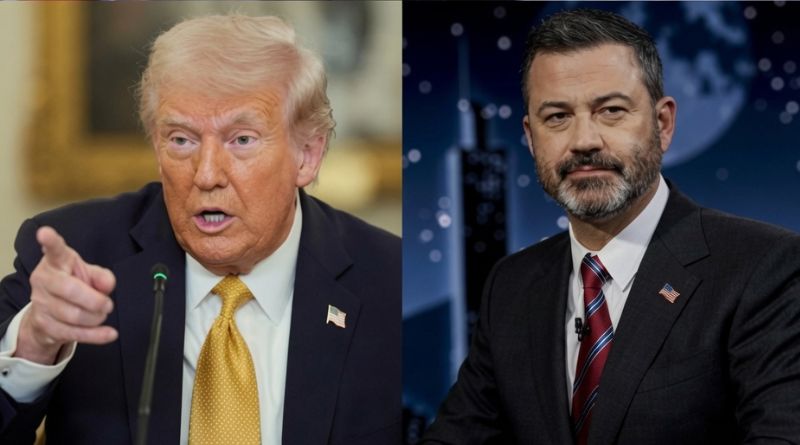
Late-night host Jimmy Kimmel faces renewed pressure from President Donald Trump and first lady Melania Trump after a satirical bit on Jimmy Kimmel Live! that described the first lady as having “a glow like an expectant widow.” The remarks, delivered in a mock White House Correspondents’ Dinner routine, have reignited debate over the boundaries of political comedy, personal attacks, and media accountability.
On the April 23, 2026 episode, Kimmel staged an alternative version of the annual correspondents’ dinner, a traditional venue for political roasting. Addressing an imagined Melania Trump in the audience, he said: “Mrs. Trump, you have a glow like an expectant widow.” The line formed part of broader material that also touched on the couple’s age difference and the president’s health. The segment aired several days before a real security incident at the actual White House Correspondents’ Dinner, in which an alleged gunman attempted to breach the perimeter while the president and first lady were inside.
Melania Trump responded on social media, calling the monologue “hateful and violent” and “corrosive.” She argued that it deepened “the political sickness within America” and urged ABC to “take a stand,” stating that Kimmel “shouldn’t have the opportunity to enter our homes each evening to spread hate.” President Trump followed with a post on Truth Social labeling the joke a “despicable call to violence” and “far beyond the pale.” He demanded that Disney and ABC “immediately” fire the host.
Kimmel addressed the controversy on his subsequent monologue. He characterized the remark as a “very light roast” about the age gap—Trump is nearly 80 while Melania is younger than the host himself—and rejected any interpretation as a call to assassination. “It was not, by any stretch of the definition, a call to assassination. And they know that,” he said. Kimmel expressed sympathy for the trauma experienced by the Trumps and others at the real event but did not issue a direct apology for the joke. He also pointed to what he described as the president’s own use of heated rhetoric.
Unlike a previous episode in September 2025, when ABC briefly suspended Jimmy Kimmel Live! after comments related to the assassination of conservative activist Charlie Kirk, the network has not taken the show off the air this time. An ABC source told Page Six the network is “sticking by” Kimmel, with no plans to suspend, fire, or cancel the program. Production has continued as usual. Kimmel’s contract with ABC runs through at least May 2027.
The Federal Communications Commission has ordered early license-renewal applications for eight ABC-owned stations in the wake of the backlash, a move that adds regulatory pressure even without a formal content suspension. Industry observers note that late-night television operates in a highly charged environment in which clips spread instantly on social media, amplifying both support and outrage.
The incident has revived longstanding arguments about satire. Defenders of Kimmel maintain that political comedy has historically tested boundaries and that interpreting an age-related joke as advocacy for violence stretches the material beyond its intent. Critics, including the Trumps and their supporters, contend that certain personal attacks—particularly those involving a spouse and imagery of widowhood—cross into degradation and risk normalizing dangerous rhetoric, especially when timed near real-world security threats.
Advertiser sensitivity and public mobilization remain factors in the late-night landscape. While no widespread advertiser exodus has been reported in connection with this specific episode, the speed with which social media can generate pressure continues to influence corporate decision-making. Previous controversies have shown that networks weigh free-expression traditions against reputational and financial risks.
Melania Trump’s public statement marked a relatively rare direct intervention; the first lady has often maintained a lower profile on entertainment disputes. Analysts have described her response as signaling a firm line against what she views as corrosive personal commentary. Trump, a frequent target of late-night hosts throughout both of his presidencies, has repeatedly called for greater accountability from networks and comedians.
As of late April 2026, Jimmy Kimmel Live! remains on the air without interruption from the Melania remarks. The episode underscores persistent tensions between Hollywood satire and the political sphere: how far comedy may go in personalizing criticism of public figures, what responsibility networks bear for the content they broadcast, and how digital amplification shapes the consequences. Those questions are unlikely to resolve quickly, as both sides continue to stake out positions on where satire ends and unacceptable attack begins.