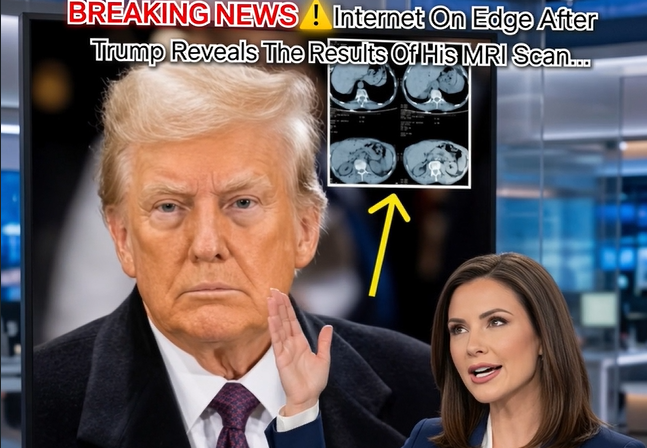
Asked why he needed an MRI if the visit was “just” a routine physical, President Donald Trump offered no clear clinical reason. Instead he called the results “outstanding,” “excellent,” and “the strongest they’ve ever had.” He could not say whether doctors had examined his brain, his heart, or any other part of his body. The vagueness only sharpened attention on what remained unrevealed.
The White House insisted nothing was wrong. Officials framed the October 2025 trip to Walter Reed National Military Medical Center as an “expanded wellness evaluation” conducted ahead of a heavy travel schedule. Yet this was Trump’s second physical in a single year—following a more conventional exam in April—and no detailed medical summary or imaging report was released at the time.
Critics, comedians, and foreign social-media accounts quickly mocked the “mystery MRI.” Questions multiplied: Why advanced imaging for a president already declared in excellent health? Why the refusal to specify what was scanned? In an election season still defined by public concern over age and fitness, the most powerful man in the country was asking voters to accept results he described as perfect while declining to explain them fully.
Trump later told reporters he had “no idea” what the doctors analyzed, only that whatever they examined had produced the best outcome his physicians had ever seen. He ruled out a brain scan on the grounds that he had aced a cognitive test, but offered little else. White House physician Navy Capt. Sean Barbabella eventually released a memo stating the imaging focused on the cardiovascular and abdominal systems, was performed for preventive reasons common in men of Trump’s age, and returned “perfectly normal” findings. Heart chambers, major vessels, and abdominal organs all appeared healthy.
Even after that limited disclosure, skepticism lingered. Medical experts noted that routine screening MRIs of the heart and abdomen are not standard preventive care for asymptomatic patients. The absence of a full imaging report and the initial opacity continued to fuel speculation. Trump himself later clarified that the scan had been a CT rather than an MRI, yet the core issue remained the same: selective transparency about the health of a 79-year-old commander-in-chief.
In the end, one reality persisted. Voters were being asked to trust assurances of perfect results while the supporting details stayed carefully controlled—an approach that, in a political climate obsessed with fitness for office, only invited more questions than it answered.