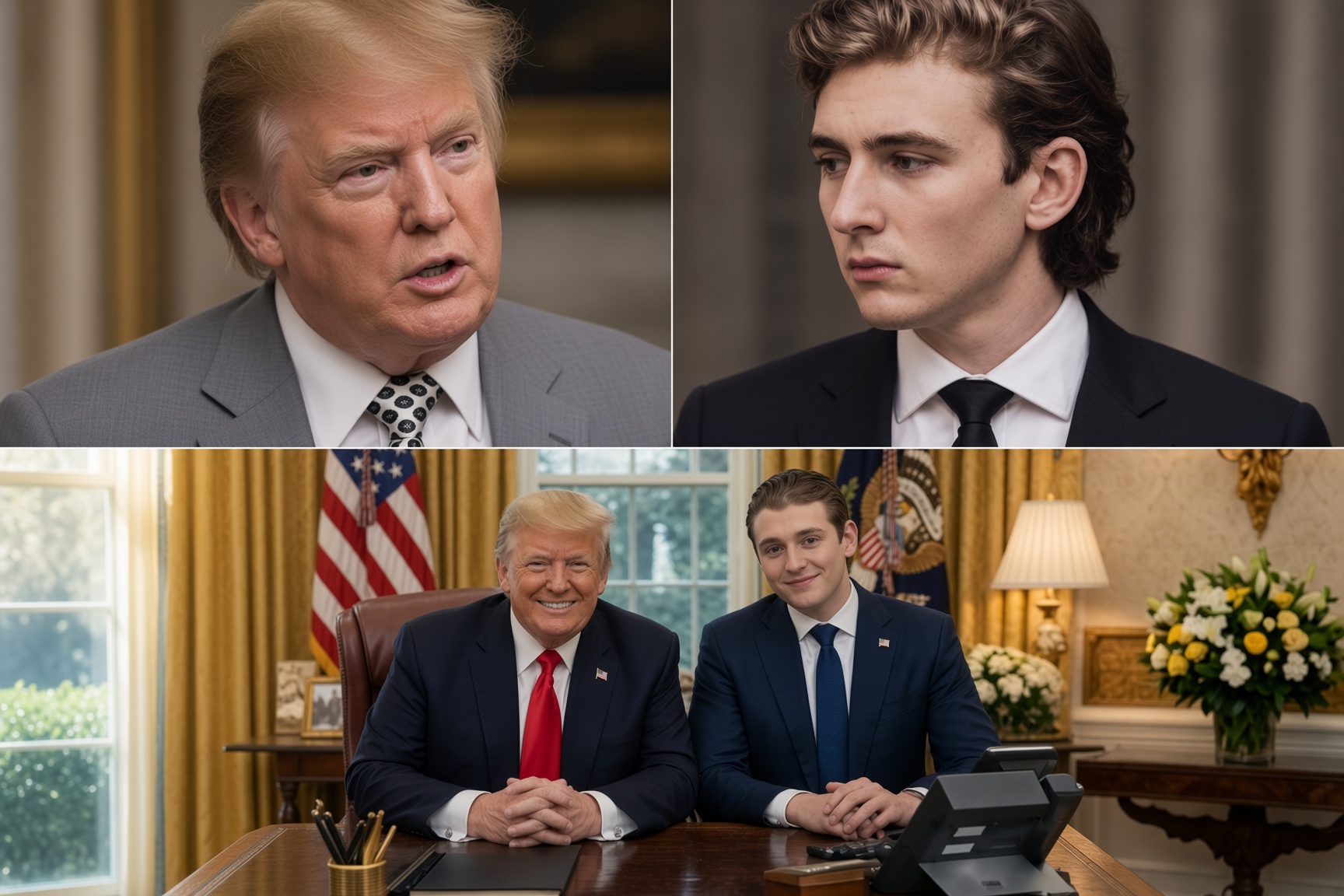
Barron Trump and the Weight of Other People’s Stories
For years, Barron Trump has been one of the most closely watched people in American public life who has almost never asked to be watched. As the youngest son of Donald Trump and Melania Trump, he grew up inside a household that rarely left the news cycle. Childhood, adolescence, and the first steps into adulthood all unfolded under cameras, commentary, and a constant stream of guesses about who he was and who he might become. That contrast—intense visibility without much self-disclosure—has made him a magnet for speculation.
The fascination did not begin when he turned 18. It only grew louder. Headlines treated the birthday as a turning point, as if a legal milestone would suddenly produce a manifesto, a campaign, or a confession. People close to the situation described something quieter. In a brief public acknowledgment of the attention around him, Barron pushed back against the idea that strangers already knew his mind. Much of what circulated about his views, ambitions, and private life, he suggested, was invention layered onto a last name.
That response was easy to overread. Online, modest comments often become “revelations.” The more restrained the subject, the more room there is for projection. Barron has given the public very little raw material: few interviews, no regular social-media presence of his own, and a long pattern of staying out of political performance. The vacuum filled itself. Commentators mapped him onto politics because of his father, onto business because of the family brand, onto sports because of his height and athletic build, onto technology because that is what young men of his generation are assumed to care about. Each theory sounded plausible until it was asked to rest on evidence.
His upbringing helps explain the silence. Unlike some children of famous political families who enter the arena early, Barron was largely kept at a distance from rallies, interviews, and partisan combat. The family’s stated aim was an upbringing as ordinary as extraordinary circumstances would allow. The result was a public image built from fragments: a tall figure at the edge of a photograph, a rare appearance, a secondhand remark. Reserved demeanor and infrequent sightings did not reduce interest. They increased it.
That dynamic is not unique to him. Children of presidents and other high-profile figures have always drawn curiosity. The internet simply made the curiosity faster, louder, and less disciplined. A single understated comment can be recast as a signal that he is “ready” to become more visible. People who know the family have cautioned against that leap. Turning 18 changes legal status. It does not automatically convert a private young man into a political heir, a media personality, or a symbol.
What can be said with more confidence is narrower. Education and personal development have remained the stated priorities. Reports over the years have pointed to interests in sports and technology, and to a thoughtful, analytical temperament. None of that amounts to a declared career path. He has not publicly committed to politics, to a particular industry, or to a long-term public role. The image that remains is of someone still choosing, still testing, still keeping most of that process offstage.
There is a reason the guesses persist. Height, quiet confidence, and scarcity of access make a compelling character in a culture that treats proximity to power as a story in itself. Observers read meaning into posture, clothing, seating arrangements, and the fact that he is seldom heard. Experts who study celebrity and media note how quickly minor facts become narrative. The last name supplies the plot. The person supplies almost none of the dialogue.
Barron’s recent remarks, such as they were, pointed in the opposite direction. People assume they understand him because they recognize the family. In reality, he described himself as a young adult still figuring out a path—an ordinary condition dressed up as mystery because of who his parents are. That is not a tease and not a manifesto. It is a request, however mild, that speculation not be mistaken for biography.
Whether he later chooses a high-profile life, a private one, or some mixture of the two is still unknown. Adulthood will eventually make his choices more visible, if only because adult lives leave more records than childhoods do. Until then, the most honest account is also the least dramatic: curiosity has outrun information. Assumptions are abundant. Confirmed detail is not. The story of Barron Trump is still being written, and most of the drafts circulating online are not his.