The viral “Fox News” claim that Joe Biden, Jill Biden, and a grandson died in a plane crash near the Canadian border is not supported by credible evidence.
As of September 7, 2026, major news organizations, official aviation authorities, and government sources have not confirmed any such accident. The story circulating online is a social-media allegation dressed up as breaking news.
What follows is a rewritten, expanded account of that rumor, why it is unverified, how claims like this spread, and what actual reporting about the Bidens shows.
The claim as it appears online
The post is written like an emergency alert. It often begins with “Just In” or “Breaking,” then attributes the information to Fox News. The core assertion is that former President Joe Biden, former first lady Jill Biden, and a grandson “perished” in a plane crash “a few minutes ago” near Canada.
That packaging is the point. “Just In,” a familiar network name, famous people, and the suggestion that the event happened moments earlier all push the reader to react before checking. A Facebook version and copycat posts have used almost the same wording. A social-media post that says Fox News reported something is not the same as a Fox News report.
A search of current Fox News coverage, other national outlets, FAA and NTSB statements, Canadian aviation authorities, and official family or government channels does not produce a matching story. There is no aircraft identification, flight number, departure or destination, crash site, passenger list, or emergency-response statement attached to the claim.
Why a former president’s death would not stay on one post
Joe Biden served as the 46th president from 2021 to 2025. He is no longer in office, but the death of a former U.S. president is still a national and international event. If he, his wife, and a grandchild had died in an aircraft accident, the response would not be limited to an unattributed Facebook or X post.
You would expect interrupted programming on major networks, wire-service alerts, statements from the White House and congressional leaders, comments from other former presidents and foreign governments, and reporting from U.S. and Canadian investigators. Depending on location, the NTSB, FAA, Transportation Safety Board of Canada, and local emergency services would leave a public trail. None of that trail exists for this rumor.
That absence is not a minor gap. It is the main reason the claim should be treated as unverified.
The “few minutes ago” trick
Phrases such as “few minutes ago,” “just now,” and “breaking this second” are common in viral hoaxes. They create urgency. The implied message is that you must share before everyone else hears it.
A timestamp only tells you when the post was published. It does not prove that an event happened, that it happened then, or that the people named were involved. An old wreck photo can be captioned as new. A fabricated headline can be posted five minutes ago and still be invented.
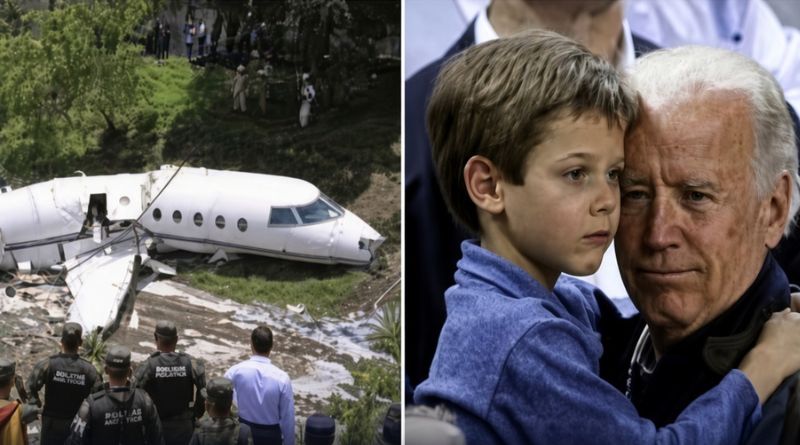
The same logic applies to images. Wreckage pictures are easy to reuse. A photo from another crash, another country, or another decade can look convincing next to a famous name. Seeing a burning fuselage does not prove that Joe Biden was on that aircraft.
What current reporting actually shows
Recent coverage of Joe Biden is not about a plane crash. It is about his post-presidency, health, family comments, and political activity.
As of late summer and early September 2026, reporting has included:
- Treatment for metastatic prostate cancer diagnosed after he left office, with family members describing pain and a narrowed daily life.
- Comments from Hunter Biden that the cancer has spread further into bone and is debilitating.
- Work on a presidential memoir scheduled for publication after the November 2026 midterms.
- Plans for Biden to attend the 25th-anniversary 9/11 ceremony at Ground Zero, alongside other living former presidents.
- Occasional public remarks criticizing the current administration and appearing at Democratic events.
None of that is compatible with a confirmed fatal crash “minutes ago.” If he were dead, those stories would not be the ones on the page.
Jill Biden remains a public figure in her own right. A crash killing both former president and former first lady would dominate news for days. It would not appear only as a nameless social post with no wreckage location, no airline, and no official quote.
The unnamed grandson is even thinner. The posts do not identify which grandchild, which aircraft, or why that person would have been aboard. Real accident reporting usually includes at least some of those basics even in the first hours. This rumor supplies famous names and almost nothing else.
Why “Fox News said” is a common trick
Attaching a trusted or familiar brand to a claim is one of the oldest shortcuts in online misinformation. The reader sees “Fox News,” recognizes the name, and may assume verification already happened.
Anyone can type those words. Logos can be copied. Screenshots can be fabricated. The test is simple: go to the outlet itself. Search its site. Check its live coverage and wire partners. If the story is not there—and if Reuters, AP, major newspapers, and broadcast networks are also silent—the attribution inside the post is not evidence.
The same rule applies if the post says CNN, NBC, ABC, CBS, Reuters, or “officials.” The brand in the caption is not the source. The published report is.
Official sources for an actual crash
Aviation accidents generate records. In the United States, the FAA regulates civil aviation and the NTSB investigates many serious accidents. In Canada, the Transportation Safety Board of Canada investigates. Airports, police, fire departments, and hospitals issue statements. Flight-tracking data often exists for identifiable aircraft.
A credible first report typically includes some mix of:
- aircraft type or registration
- route or intended destination
- approximate location
- number of people aboard
- whether wreckage was found
- which agency is responding
The viral Biden post has none of that. It substitutes shock for facts.
Why people share stories like this
False death reports are common because death is emotionally powerful. A famous name plus sudden death can produce shock, sadness, anger, or morbid curiosity. Those feelings often come before skepticism.
Other reasons people pass the post along:
- It came from a friend or relative, so it feels pre-vetted.
- The language looks like television news.
- The claim involves a real, well-known family.
- The wording implies that “everyone already knows.”
- Even doubters share it with “Is this real?” which still feeds the algorithm.
Engagement rewards speed. Platforms amplify posts that get comments and shares. A rumor can travel farther in an hour than a correction does in a day.
That does not mean only careless people fall for it. It means the format is designed to short-circuit the pause that verification requires.
The Biden family and real loss
This rumor is especially ugly because the Biden family has lived through documented tragedies. In 1972, Joe Biden’s first wife, Neilia Hunter Biden, and their infant daughter Naomi died in a car crash. Their son Beau Biden died of brain cancer in 2015. Those events are in the historical record. They are not internet inventions.
Fabricated new deaths exploit that history. They mix real grief with a fake headline. Readers should not treat a viral post as an update to those genuine losses.
Unverified is not the same as “we invented the opposite”
Responsible wording matters. The accurate statement at the time of checking is: there is no credible confirmation that Joe Biden, Jill Biden, or a Biden grandchild died in a plane crash near Canada. Major outlets and official channels do not report it. Current coverage treats Biden as alive and dealing with cancer treatment, a memoir, and public appearances.
If an actual accident were later confirmed by authorities and multiple independent news organizations, the assessment would change. News is not frozen. But inventing crash details—aircraft type, passenger count, cause, rescue scenes, family quotes—would turn a rumor into fabricated reporting. That is worse than saying the claim is unsupported.
How to check the next shocking post
A practical sequence:
- Stop. Do not share first.
- If the post names a news organization, open that organization’s own site.
- Search two or three other major outlets independently.
- For a crash, look for FAA, NTSB, TSB Canada, or local emergency statements.
- Ask for specifics: where, what plane, what flight, who confirmed it.
- Treat photos as unproven until the caption is verified.
- Ignore fake obituary pages unless the same death is reported by established sources.
A real death of a former president would not depend on one obscure page or one Facebook graphic.
Why this pattern matters beyond one family
The same template is used on actors, athletes, musicians, CEOs, and ordinary people. Sometimes the harm is personal cruelty. Sometimes false political or corporate death reports move markets or stir panic. The method is the same: urgency, a borrowed brand name, famous people, and missing official confirmation.
Verification is not pedantry. It is how a public information environment stays usable.
What can be said with confidence
- A social-media claim is circulating that Joe Biden, Jill Biden, and a grandson died in a plane crash near Canada and that Fox News reported it.
- That Fox News attribution has not been matched to an actual Fox News report.
- Searches of current national and international reporting do not confirm the crash.
- Recent Biden coverage concerns health, family interviews, a forthcoming memoir, and planned public events—not a fatal aviation accident.
- The claim should not be shared as fact.
What to watch next
If a real accident involving the Bidens occurred, confirmation would not stay hidden. Authorities would speak. Networks would lead with it. Details about the aircraft and location would accumulate. Until that happens, the viral post belongs in the category of an unsupported social-media allegation.
Speed is not proof. “Just In” is not a source. A logo is not a citation. The safest response to this particular headline is simple: do not treat the deaths as confirmed, and do not help the post travel any farther than it already has.