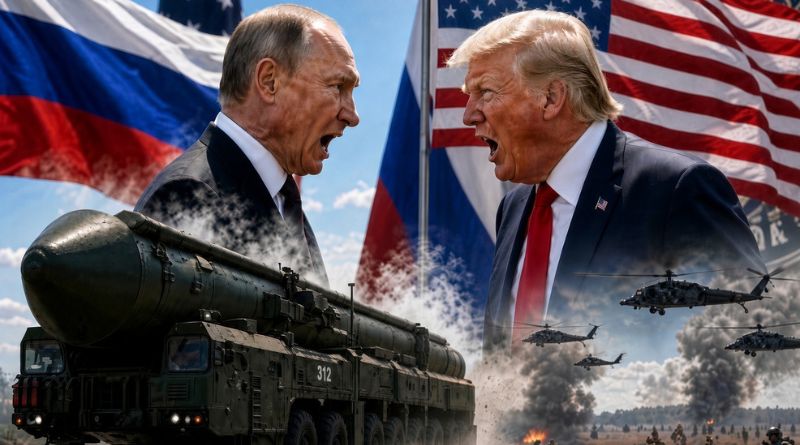
A dramatic graphic pairing U.S. and Russian leaders with tanks, missiles, and battlefield imagery has spread rapidly online, sharpening public debate over the two countries’ deteriorating relationship. The image captures a broader anxiety: years of war, sanctions, military drills, and sharp political language have left Washington and Moscow deeply at odds.
Security analysts say visible force posture and heated rhetoric can heighten fears of a larger clash. They also stress that a direct war between two nuclear-armed states remains unlikely because the costs would be catastrophic. Competition today more often takes the form of economic pressure, cyber operations, intelligence work, technology races, and diplomatic isolation than open battlefield confrontation.
Reactions to the viral image have been split. Some viewers treat it as a warning of coming conflict; others see it as sensationalism designed to attract attention. Experts caution that one picture cannot explain a rivalry shaped by history, alliances, energy, arms control, and domestic politics in both capitals.
As tensions persist, attention has returned to the practical work of crisis management: channels of communication, restraint in military signaling, and diplomacy that can limit miscalculation. Analysts argue that sustained dialogue, even when relations are poor, remains the most reliable way to keep competition from sliding into a crisis neither side can fully control.