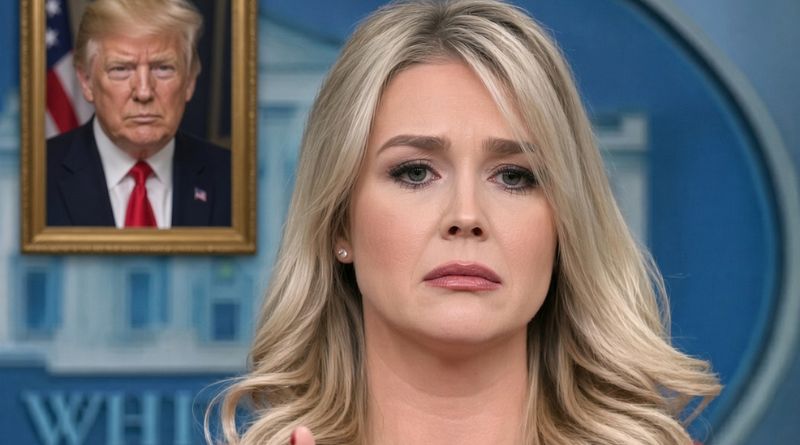
White House Press Secretary Karoline Leavitt used an Axios media event hosted by co-founder Mike Allen to push back against claims that the Trump administration had restricted journalists. She argued the opposite: that the White House had opened the press pool and briefing process to more outlets, more voices, and a wider mix of reporters than the traditional rotation allowed.
Allen pressed her on the Associated Press. The wire service reaches a vast global audience every day, he noted. Its chief Washington photographer, Evan Vucci, took the defining image of President Donald Trump after the July 2024 assassination attempt in Butler, Pennsylvania — fist raised, blood on his face, shouting “Fight, fight, fight.” Did the administration worry that new pool rules would erase that kind of historical record?
Leavitt rejected the premise. “I don’t view them as restrictions,” she said. “We view them as opening access to more outlets, more voices, more news, journalists and outlets.” A handful of organizations, she argued, should not hold a permanent monopoly on the 13-person press pool that travels with the president into the Oval Office, onto Air Force One, and into other limited-space events. Thousands of outlets hold White House credentials. Hundreds show up to cover the beat. Why, she asked, should one outlet occupy a pool slot every single day?
The changes, she said, had already given print outlets such as Axios a better chance at those scarce seats. The result, in her telling, was more transparency and a broader mix of journalists, not less coverage. “I think you’re all still getting your news, right? You’re still hearing about what the administration is doing every single day, because we have good journalists who are in that room covering the president every single time.”
Allen then quoted the White House Correspondents’ Association. After the administration took control of pool selection away from the WHCA, the group said the government should not control the independent media that covers it. Did Leavitt agree?
She did not. “A small group of journalists who comprise the board of the White House Correspondents Association should not dictate who gets to go into the Oval Office and who gets to ride on Air Force One,” she replied. “There should be equal access for all outlets. And that’s exactly what we’re doing.”
If the goal were flattering coverage, she added, the White House would simply exclude critical outlets. It has not. “No one has been restricted. We’ve just given more spots to more outlets and more voices.” Ideology was not the point, she insisted. The point was recognizing a digital media landscape and continuing the nontraditional campaign approach that helped return Trump to office.
The exchange sat inside a larger argument Leavitt and the administration have made since early 2025: that President Trump is far more available to reporters than President Joe Biden was, and that the press paid too little attention to Biden’s distance from unscripted questioning.
Data compiled by presidential scholar Martha Joynt Kumar and highlighted by Axios in 2024 showed the gap clearly at a comparable point in each man’s term. Biden had held 164 press conferences and media interviews. Trump, in his first term, had 468. The next-lowest modern totals belonged to George W. Bush (248) and Ronald Reagan (262). Barack Obama led the group with 570. Biden’s White House pointed instead to hundreds of shorter, informal Q&A sessions with small groups of reporters. Critics countered that those exchanges were often brief, shouted, and easily avoided, while formal interviews and solo news conferences remained scarce.
Trump’s second-term style has been the reverse: frequent Oval Office availabilities, questions on Air Force One, and a high volume of short exchanges. Even some reporters who cover him critically have noted that he answers more questions in public than Biden did. The administration presents that volume as proof of transparency. Opponents present the pool overhaul as proof of control.
The pool fight began in February 2025, when Leavitt announced that the White House, not the WHCA, would decide the daily rotation. Wire services that once had standing slots — most notably the AP, after it declined to adopt the administration’s “Gulf of America” usage — lost guaranteed places. Conservative and digital outlets gained them. Photographers such as Vucci were at times kept out of the tightest spaces even as they retained briefing-room access. Litigation followed. The WHCA warned that a future Democratic president could use the same power against conservative media. Leavitt’s answer remained that no small board of journalists should hold a veto over who stands in the room with the president.
The Axios appearance distilled that position. Leavitt framed the new system as an update for an era of podcasts, digital-native outlets, and campaign-style media rather than a rollback of press freedom. Supporters see a briefing room that better matches how Americans actually get news. Critics see the executive branch choosing its own chroniclers and weakening an independent rotation that had existed across administrations of both parties.
What has not disappeared is coverage itself. Pool reports still go out. Briefings still happen. Photographers still document the presidency, even if the cast of organizations inside the smallest rooms has changed. The dispute is over who decides that cast, and whether a president who talks constantly to cameras is more accountable than one who largely did not.
Leavitt’s closing argument at the event was straightforward: the administration is not shrinking the window on the presidency. It is widening who gets to look through it. Whether that produces a fuller historical record or a more curated one remains the argument that will follow these changes long after the current press secretary leaves the podium.