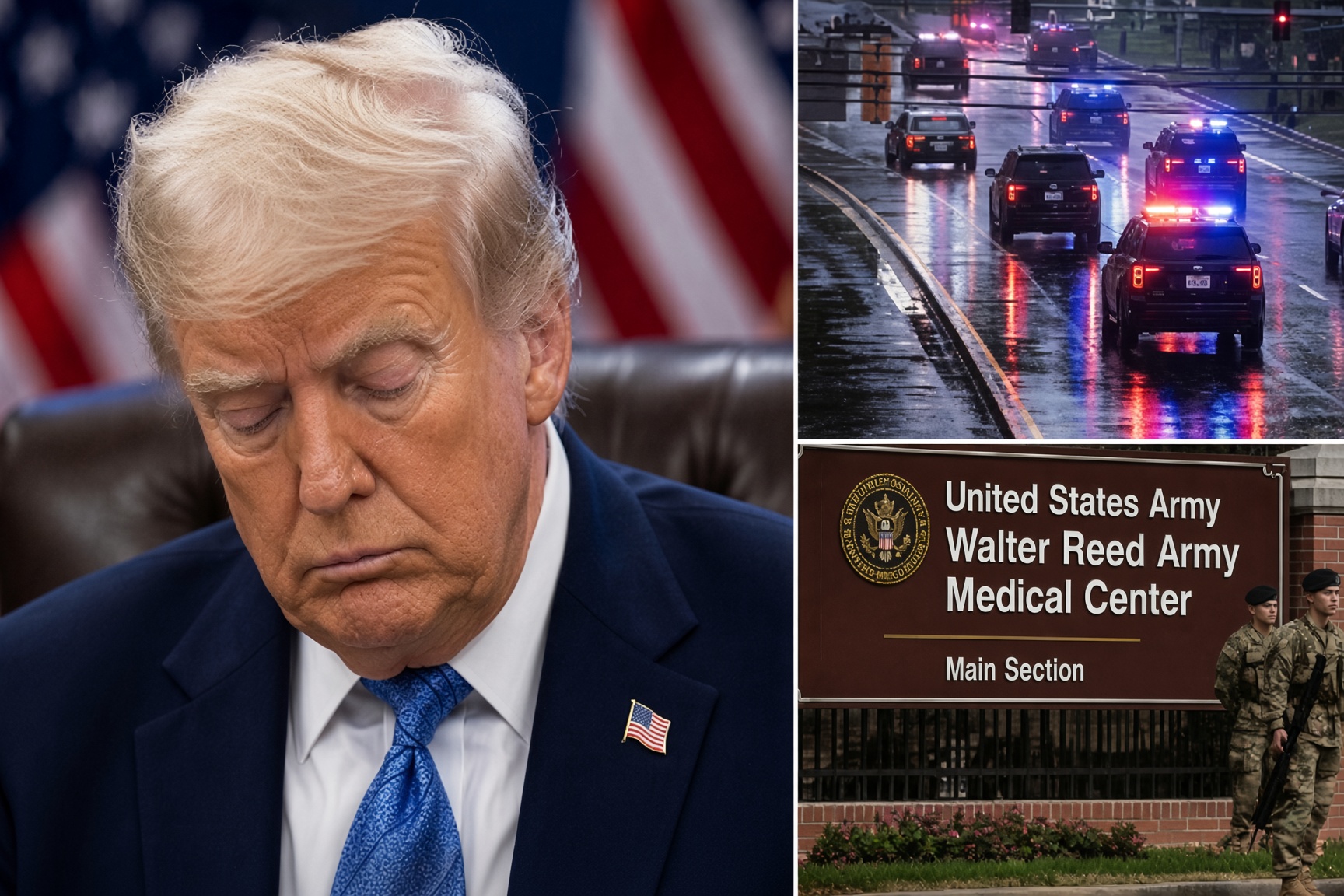
President Donald Trump’s physician says the president remains in excellent health and fully able to serve after a comprehensive exam at Walter Reed National Military Medical Center, according to a White House memo released after the visit.
Navy Capt. Sean P. Barbabella, physician to the president, wrote that Trump “remains in excellent health, demonstrating strong cardiac, pulmonary, neurological, and overall physical function.” The memo concluded that his “cognitive and physical performance are excellent” and that he is “fully fit to carry out all duties of the Commander-in-Chief and Head of State.” Trump, then 79 and approaching his 80th birthday, described the visit afterward as a success, saying everything had checked out “perfectly.”
The examination on May 26, 2026, was described as an annual physical and as one of several disclosed medical visits since Trump returned to office. Barbabella said the workup included a review of diagnostic studies and laboratory testing from the prior year, along with consultations involving a large team of specialists. Reporting on the memo said the evaluation included advanced cardiac imaging such as an echocardiogram and coronary CT scanning, cancer screenings, and other preventive assessments.
Vital signs released with the report were unremarkable on their face. Trump was listed at 6 feet 3 inches and 238 pounds, with blood pressure of 105/71 mm Hg, a resting heart rate of 73 beats per minute, oxygen saturation of 98 percent on room air, and a temperature of 98.7 degrees Fahrenheit. The weight was 14 pounds higher than the 224 pounds recorded at his April 2025 physical. At that height and weight, his body mass index was about 29.7 — in the overweight range and just below the conventional obesity cutoff of 30. Physicians said they counseled him on diet, increased physical activity, and continued weight loss.
Heart-related findings were presented as a point of strength. Barbabella has previously and in related summaries described Trump’s “cardiac age,” estimated from ECG analysis, as roughly 14 years younger than his chronological age. Lipid numbers in the May memo were also markedly improved from earlier years: total cholesterol of 143 mg/dL, HDL of 70, LDL of 53, and triglycerides of 104. Doctors attributed much of the change to medication, including rosuvastatin and ezetimibe, along with aspirin for cardiovascular prevention. Those three drugs were identified as his regular regimen.
The memo also addressed two issues that had drawn public notice: bruising on Trump’s hands and swelling in his lower legs. Hand bruising was described as minor soft-tissue irritation from frequent handshaking in the setting of aspirin use — common and benign, the physician wrote. The White House had previously disclosed a diagnosis of chronic venous insufficiency, a condition in which leg veins have trouble returning blood to the heart. Barbabella said slight lower-leg swelling was still present but had improved compared with the prior year.
On cognition, Trump again took the Montreal Cognitive Assessment, a brief screening tool used to look for signs of mild cognitive impairment or dementia. Physicians said he scored 30 out of 30, matching results reported from earlier examinations, including in 2025 and 2018. The memo also said a broader neurological exam showed normal mental status, cranial nerves, strength, sensation, reflexes, gait, and balance, and that depression and anxiety screenings were normal.
Presidents are not legally required to release complete medical records, and White House summaries have historically emphasized fitness while leaving some clinical detail unpublished. The May 2026 readout followed that pattern: it was upbeat and relatively detailed on labs and screening scores, while still a physician’s summary rather than a full chart. It also included routine preventive advice that sat alongside the “excellent health” headline — lose weight, move more, watch diet, and use low-dose aspirin.
The political context is unavoidable. Trump is the oldest person ever elected president, and age and stamina have been recurring campaign and governing issues for both parties. Public interest in presidential health typically rises around elections and whenever visible symptoms — bruising, swelling, fatigue on camera — invite speculation. A physician’s memo cannot settle every question voters may have, but it is the administration’s official account: no disqualifying cardiac, pulmonary, or neurological finding; improved cholesterol on medication; a perfect score on a widely used cognitive screen; and a recommendation to manage weight as he continues a demanding schedule of meetings, travel, and public events.
Whether that record reassures the public depends less on a single Friday memo than on what voters see over time. For now, the White House position is straightforward. According to Barbabella, the president remains medically cleared to perform the job.