In a media environment that never really sleeps, a missing public appearance can travel farther than a press conference. That pattern returned in early April 2026, when President Donald Trump disappeared from public view over the Easter weekend and online claims quickly filled the gap. Posts asserted that he had been taken to Walter Reed National Military Medical Center. Some went further and treated the rumor as settled fact. There was no official confirmation of a hospitalization, and within hours the White House was calling the claims fake news. The episode still became a case study in how schedule gaps, recycled video, and emotionally charged posts can outrun verification.
What actually changed on the calendar
The spark was not a medical bulletin. It was absence.
Trump had last appeared in public around his early-April remarks on the conflict with Iran. He remained in Washington for Easter rather than traveling to Mar-a-Lago. On Saturday, April 4, the White House called a press “lid” in the late morning, a routine signal that no further public events were expected that day. For a president whose brand is constant visibility, even a short stretch without cameras is enough to start a hunt for explanations. Social media users soon pointed to alleged road closures near Walter Reed, flight restrictions, and secondhand “reports” that he had been admitted. Those claims were not corroborated by hospital alerts, local police, or the White House press pool. Montgomery County police said they had not been told of closures around the hospital. Naval Support Activity Bethesda, which hosts Walter Reed, issued no weekend gate alerts of the kind that would typically accompany a restricted presidential visit.
The information vacuum did the rest. Users treated the lid as evidence of an emergency. Others noted that Trump had not been seen for roughly three days. In a political culture already primed to read physical decline into every bruise, swollen ankle, or off day, the missing hours became a plot.
How the rumor grew
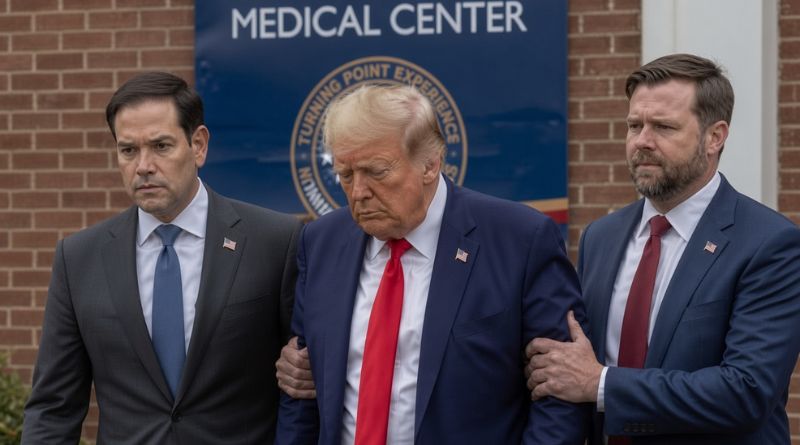
The claim that Trump was at Walter Reed circulated across X, Facebook, Threads, Bluesky, Reddit, and YouTube. Monitoring data later cited by fact-checkers found that “Trump” and “Walter Reed” were mentioned together more than 100,000 times across major platforms in a one-week window, with heavy engagement. High-follower accounts amplified “breaking” posts that offered no primary source. Some users attached old motorcade footage from earlier years. Others circulated an AI-generated image and, weeks later, an AI-generated video that purported to show Trump at the hospital. Walter Reed’s communications office later said the logo and signage in that video did not match the facility. The White House called the video fake.
This is a familiar sequence. First comes a real, observable fact: fewer public events. Then comes an unproven inference: therefore he is in a hospital. Then comes the visual “proof,” which is often old, mislabeled, or synthetic. Algorithms reward the most alarming version. By the time a correction arrives, the first frame has already defined the story for millions of people who will never read the follow-up.
What officials said—and what the public could see
The White House response was blunt. Communications director Steven Cheung wrote that Trump had been “working nonstop in the White House and Oval Office” over the Easter weekend. The administration’s rapid-response account dismissed the hospitalization talk as conspiracy theorizing. A spokesperson later told reporters the Walter Reed rumors were “fake news.” Officials also said the president was involved in a search-and-rescue effort after a U.S. fighter jet was shot down over Iran—an explanation that, whether or not it satisfied critics, placed him at work rather than in a hospital bed.
There were also physical clues inconsistent with an emergency admission. A Marine sentry was posted at a West Wing entrance on April 4, a sign the president was inside. Trump continued posting on Truth Social. On April 5 he was photographed at Trump National Golf Club in Virginia. On April 6 he appeared at the White House Easter Egg Roll and spoke with reporters. Those appearances did not prove he was in perfect health. They did make an unannounced Easter weekend hospitalization at Walter Reed extremely difficult to reconcile with the public record.
Fact-checkers at Snopes, PolitiFact, and PBS NewsHour reached the same core conclusion: there was no evidence he had been hospitalized that weekend. The more dramatic versions of the story—critical condition, media blackout, imminent death—rested on anonymous social posts, not on medical records, pool reports, or hospital confirmation.
The health record that already existed
The rumor landed on a president whose health had already been a running political argument. Trump, then 79 and the oldest person ever inaugurated, has long insisted he is in excellent condition. His physician, Navy Capt. Sean Barbabella, has repeatedly described him as fit for duty after examinations at Walter Reed.
One documented condition is chronic venous insufficiency, disclosed after swelling was noticed in his legs. The condition is common in older adults and involves veins that do not return blood from the legs as efficiently as they should. Official summaries have described it as manageable and have not tied it to an acute emergency. Separate notes have addressed bruising on his hands, which the White House has attributed in part to frequent handshaking and aspirin use. Later in 2026, after additional Walter Reed visits, Barbabella again reported “excellent” overall health, with routine cardiac, pulmonary, and neurological findings and a cognitive screening score described as normal. Those later exams are a separate chapter from the April rumor. They matter here only as context: public curiosity about Trump’s stamina did not begin on April 4, and it did not end when the Easter posts faded.
None of the official medical summaries released around that period stated that venous insufficiency, bruising, or age had produced a sudden hospitalization over Easter. Treating a previously disclosed chronic issue as proof of a secret emergency is how a health file becomes a rumor engine.
Why schedule changes invite this kind of story
Presidents live on calendars. When the calendar goes quiet, two interpretations compete. One is banal: a holiday, a lid, private meetings, a golf outing, a national-security problem that does not need a podium. The other is catastrophic: concealment. High-profile figures are watched so closely that the second interpretation is always available. Trump’s own communications style intensifies the effect. He posts constantly when he wants to, appears often, and treats stamina as a political argument. A stretch without cameras therefore reads, to supporters and opponents alike, as a break in character.
That does not mean every absence is innocent, and it does not mean the public has no right to ask questions about a president’s fitness. It means the leap from “no public events today” to “he is at Walter Reed in critical condition” is a leap. Responsible coverage keeps that distinction visible. Many established outlets did wait for confirmation before treating the hospitalization claim as news. Many social posts did not.
Misinformation after the correction
Corrections rarely travel as far as the original scare. Weeks after the Easter weekend, users were still sharing fabricated video as if it were new proof. That lag is now a standard feature of digital politics. A rumor that answers an existing suspicion—“he is older than he admits,” “the White House is hiding something”—has a longer half-life than a denial. Partisan incentives make the problem worse. Accounts that wanted the story to be true kept it alive. Accounts that wanted it buried treated any question about the president’s health as bad faith. Neither posture helps a reader who simply wants to know whether the commander in chief was in a hospital.
Media literacy is the unglamorous remedy. Check whether a hospital, a local police department, or the White House pool has confirmed the claim. Ask whether the video is dated and original. Treat “sources close to” posts without names as entertainment until they become reporting. Health rumors deserve more caution, not less, because they exploit worry.
What can be said now
As of the documented record from that episode, there was no confirmed hospitalization of Donald Trump at Walter Reed over the 2026 Easter weekend. Officials said he was at the White House. He was later seen in public. Recycled and AI-generated media that appeared to show otherwise did not survive fact-checking. A previously disclosed vein condition and the ordinary scrutiny that follows an aging president explain why the rumor found an audience. They do not convert an unverified social-media narrative into a medical event.
The larger lesson is not unique to one politician. When public life is live-streamed and then suddenly is not, the internet will write the missing scene. Sometimes the scene is true. Often it is a collage of old tape, synthetic images, and the hunger for a simple explanation. The only durable defense is slower reading: wait for the official schedule to be explained, wait for the pool report, and refuse to let a trending phrase do the work of evidence.