One editorial note before the piece: the supplied headline says Thomas and Doria “reveal the real reason she married Harry,” but nothing in the transcript or extracted facts shows either parent revealing anything. I’ve written the article around what the material actually contains and flagged that gap in the text.
Dates and figures drawn from public record should be checked against your own sourcing before publication. — A YouTube commentary panel has published a video ranking what its hosts describe as the ten worst moments in Meghan Markle’s relationship with Prince Harry, tracing events from the 2018 royal wedding through to the couple’s most recent media and business ventures.
The panel, led by a host identified only as “D” alongside guests appearing under the banner “Outspoken,” argues that Meghan deliberately managed her public image and her husband’s relationships with his own family. The hosts repeatedly acknowledge on camera that much of what they offer is opinion rather than established fact.
That caveat matters more than it might appear. The video’s central proposition — that a concealed motive sat behind the marriage — is built entirely from inference drawn from public events, not from any document, testimony, or named source.
The video does not identify its sourcing at any point. Participants refer throughout to “the source material” without specifying a book, report, court filing, or interview.
The first item concerns Thomas Markle, Meghan’s father, who did not attend the May 2018 wedding at St George’s Chapel. In the weeks beforehand he acknowledged an arrangement with a photographer to produce staged pictures of himself, later saying he regretted it, and then withdrew from the ceremony citing heart surgery.
Those events are a matter of record. What the panel adds is a claim about intent — that Meghan never wanted him present because he might have contradicted her account of her own background.
No evidence is offered for that assertion, and the hosts do not claim to have any. It rests on the sequence of events rather than on anything Thomas Markle himself has said about being excluded.
The hosts also noted that Thomas was not flown to Britain or fitted for a suit, unlike Meghan’s mother, Doria Ragland, and presented this as circumstantial support for their reading. Ragland travelled with her daughter in the days before the wedding and walked part of the aisle, with the then Prince of Wales accompanying Meghan for the remainder.
Second, the panel pointed to the evening reception guest list, which they said excluded some of Meghan’s former “Suits” colleagues who attended only the daytime service. The hosts suggested the split was designed to keep people from her earlier life away from Harry in a relaxed setting.
The two-tier guest list is not itself unusual. Roughly 600 people were invited to the chapel service and lunchtime reception, with a substantially smaller evening gathering at Frogmore House — a structure common to large weddings and one used at previous royal ceremonies.
Third, the video highlights that Harry had reportedly never met Thomas Markle in person before the wedding, despite Thomas being expected to walk his daughter down the aisle. One host described this as a significant warning sign.
Public accounts indicate the two men had spoken by telephone but had not met face to face. The panel treats the absence of a meeting as evidence of engineered distance rather than of geography and a short engagement.
Fourth, the hosts revisited the couple’s engagement interview, broadcast in November 2017, arguing that Meghan discussed her family selectively. They also drew attention to a remark they attribute to Harry, that Meghan would do anything he asked.
That quotation appears in the video without a citation to the broadcast, and the hosts do not say when or where it was made. It is repeated as though established.

Fifth, the panel referred to reported unease inside the royal family, including a claim that Queen Elizabeth II personally telephoned Harry to warn him that Meghan’s conduct could not continue. The video explicitly flags this as unconfirmed.
No royal household source has corroborated such a call, and claims about private conversations between senior royals are a recurring feature of unsourced commentary precisely because they cannot be checked. Buckingham Palace does not comment on private family exchanges, which leaves assertions of this kind permanently unfalsifiable.
Sixth on the list is the couple’s interview with Oprah Winfrey, broadcast on CBS in March 2021 and watched by an audience in the tens of millions in the United States alone. The panel described it as the critical moment after the Sussexes stepped back from royal duties.
The hosts characterised the broadcast as having aired while Prince Philip was dying. The Duke of Edinburgh had been hospitalised in the weeks before the interview and died in April 2021, roughly a month after it was shown — a gap the video’s framing compresses.
Seventh, the panel criticised the Netflix docuseries “Harry & Meghan,” released in December 2022, which they characterised as containing sustained attacks on the royal family and the institution. The series was among Netflix’s strongest documentary debuts at the time, a commercial detail the hosts do not weigh against their description of the couple’s projects as failures.
Eighth is Harry’s memoir “Spare,” published in January 2023. The hosts described it as an escalation intended to damage the monarchy, pointing to its passages about Prince William and about family grief.
The book sold in very large numbers on publication, with its publisher reporting more than a million English-language copies on the first day. The panel’s further suggestion that Meghan shaped its contents is unverified; Harry has publicly credited a collaborating writer and described the book as his own account.
Ninth, the video covers the end of the Sussexes’ Spotify partnership and the on-the-record comment by executive Bill Simmons, who called the couple grifters on his own podcast. That remark, made in 2023, is one of the few items on the panel’s list that is directly quotable and attributable.
The Archewell Audio arrangement produced one season of Meghan’s “Archetypes” podcast before the partnership ended. Both sides described the parting as mutual at the time.
Tenth, the panel discussed Meghan’s lifestyle venture, launched under the name American Riviera Orchard and later relaunched as a differently branded operation alongside a Netflix cooking programme. The hosts characterised it as unsuccessful.
No audited sales or performance figures were presented, and none are publicly available. The venture experienced trademark difficulties and launch delays, but early product drops were reported to have sold out quickly, and neither fact settles the question of profitability.

Alongside the brand, the hosts argued that a number of high-profile figures have cooled toward the couple, naming George and Amal Clooney, the Beckhams, Oprah Winfrey, Gwyneth Paltrow, Elton John, Serena Williams, Beyoncé, Jamie Kern Lima, and Martha Stewart. These claims rest on the panel’s reading of public appearances and social media activity rather than on any statement from the individuals named.
Claims of this kind are difficult to test in either direction. The absence of a photograph is not evidence of a rupture, and none of those named has publicly described a falling out with the Sussexes.
The video also drew a contrast between accounts of Meghan from different quarters. The hosts said celebrities who have worked with her describe her as warm and generous, while unnamed former associates have described her, in their telling, as calculating and a master of deception.
Both characterisations are attributed to people the video does not name. That asymmetry — flattering accounts assigned to identifiable public figures, damaging ones to anonymous sources — is a structural weakness the hosts do not address.
Other points raised include a claim that early reports of paparazzi pursuing Meghan lacked supporting video evidence, and a Netflix cooking project the hosts said was championed by executive Ted Sarandos. The panel compared one segment unfavourably to Gwyneth Paltrow’s widely circulated kitchen video, and mocked a line about Meghan’s children visiting her at work.
The hosts also argued that Netflix’s subsequent move to a first-look arrangement rather than a full production deal signalled dissatisfaction with the couple’s output. Netflix has not characterised the change that way, and first-look deals are a standard industry structure rather than an inherent demotion.
On Harry’s separate work, the panel raised questions about spending, travel, and publicity connected to the Invictus Games. No financial data was offered.
That omission is notable because the information is obtainable. Invictus operates as a registered charity with published accounts, and Harry’s role with it predates his marriage by several years.
The video referenced a vehicle pursuit in Manhattan in May 2023, following an awards ceremony, which representatives for the couple described at the time as near catastrophic. The New York Police Department said afterwards that the journey involved numerous photographers but resulted in no collisions, injuries, or arrests, and that characterisation gap has never been fully reconciled.

The panel further claimed that Meghan had been keen to appear at high-profile events, drawing comparisons to Diana, Princess of Wales, but was told a particular speech would be delivered by Harry alone. The hosts do not say who told her, or when.
They also briefly raised, and then dismissed, speculation about drug use by Harry, stating there was no evidence for it and noting he has spoken publicly about seeking help. Harry has written about his past drug use himself, in the memoir the panel elsewhere criticises.
The video sits within a large and commercially active genre of royal commentary on YouTube, where sensational titles and thumbnails compete for attention and where sustained hostility to the Sussexes has proved reliably monetisable. Fact-checking organisations have repeatedly documented fabricated royal stories circulating on the platform, including invented divorce announcements, false pregnancy claims, and statements attributed to palace officials that were never issued.
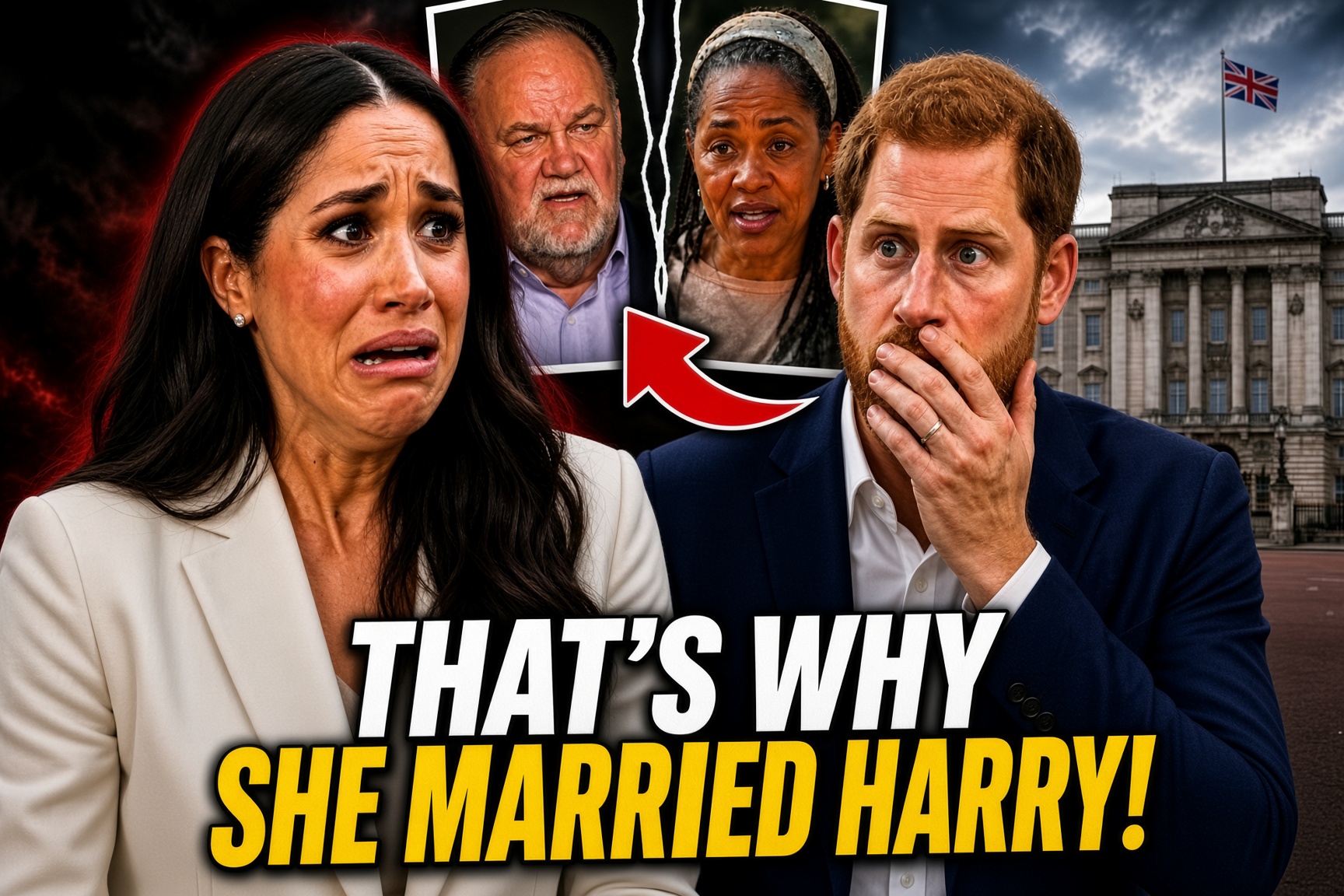
This video is more careful than the worst of that material, in that its hosts flag their own speculation. But its title promises something the content does not deliver.
Nothing in the video shows Thomas Markle or Doria Ragland revealing a reason for the marriage, and neither parent is quoted making any new claim. Ragland has never spoken publicly about her daughter’s motives, and the packaging of the video attributes to both parents a disclosure that does not appear in it.
The panel closed on the possibility of reconciliation, claiming that King Charles wants to repair his relationship with his younger son as part of his legacy. Relations between Harry, his father, and his brother remain publicly unresolved, with limited contact reported over the past two years.
Neither Meghan, Harry, nor Thomas Markle has responded to the specific allegations made in the video. Representatives for the Sussexes have, as a general matter, declined to engage with commentary content of this type.
What remains is a list assembled from real, verifiable events, joined together by a theory of motive that no participant claims to be able to prove. The events happened; the explanation offered for them is interpretation, and the hosts say so themselves more than once.