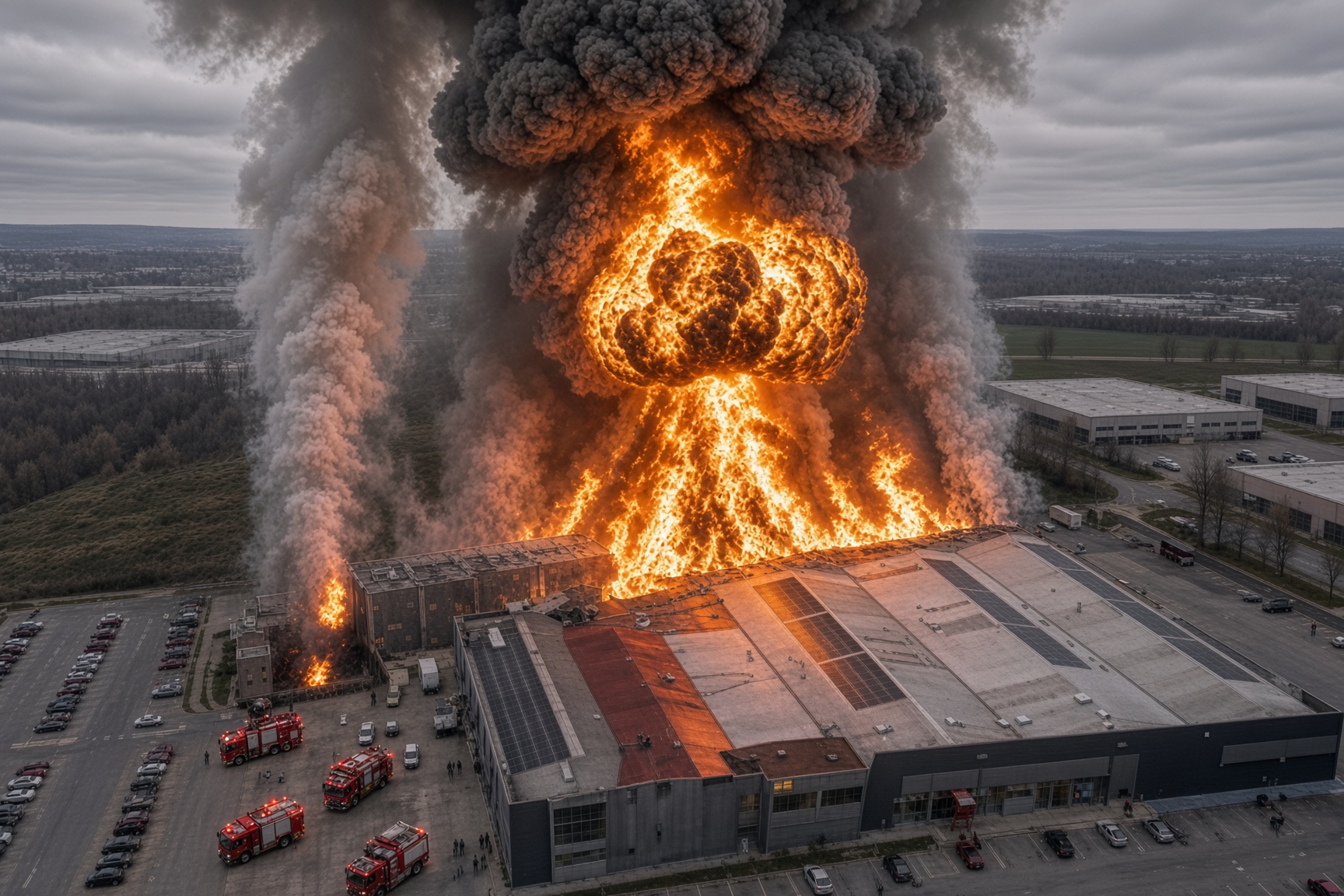
TRIKALA, Greece — A powerful explosion and fire destroyed the Violanta biscuit and confectionery factory on the outskirts of Trikala early on Monday, January 26, 2026, killing five female workers and injuring seven others in one of Greece’s deadliest industrial accidents in decades.
The blast struck just before 4:00 a.m. local time inside the 24-hour manufacturing facility, located roughly 320 kilometers north of Athens. Thirteen employees were on the overnight shift in the affected production wing: four men and nine women. Eight managed to escape in the first chaotic minutes; five women remained trapped as the building’s roof and steel framework collapsed.
Search-and-rescue teams worked through the night and into the next morning amid intense heat and thick black smoke. They recovered the last of the five bodies from the rubble on Tuesday, January 27. Authorities later identified the victims as Vasiliki Skampardoni, 42; Elena Katsarou, 45; Stavroula Boukovala; Anastasia Nasiou, 56; and Agapi Bounova, 40. All were mothers of young children.
The Blast and Immediate Response
Residents several kilometers away reported that the explosion shook windows and was audible up to 10 kilometers from the plant. Witnesses described an immediate, high-intensity fire that rapidly consumed the main production and baking area. One worker who escaped called the scene “like a war zone,” saying there was no warning—only a deafening boom followed by flames, thick smoke, and falling debris.
The Hellenic Fire Service sent a large regional force: more than 50 specialized firefighters, 15 engines, ladder units, and a drone team. Temperatures inside the structure were estimated to have reached 1,000 degrees Celsius, severely limiting early entry. Traffic police closed Karditsi Street and diverted vehicles so heavy equipment could reach the site.
Emergency medical teams transported seven people to the General Hospital of Trikala: six factory workers suffering from smoke inhalation and thermal burns, plus one firefighter injured during suppression efforts. All remained in stable condition under observation.
Investigation Focuses on Propane Leak
Greek judicial authorities, the Fire Service’s Arson Crimes Division, and the Arson Investigation Directorate opened a criminal and technical inquiry. Investigators described the incident as a “violent explosion.” The leading theory is a long-term propane leak from a buried pipe roughly 80 centimeters beneath the plant’s basement floor. Gas is believed to have accumulated over months before a spark—possibly from switching on electrical or mechanical equipment—ignited it.
Authorities are examining gas-powered industrial baking ovens and buried fuel lines for structural failure or leaks. They are also checking whether functional gas-detection sensors were present and operational. Employees had reportedly complained for some time about a persistent smell of gas. Investigators are reviewing the last inspection dates of automated thermal and gas-shutoff systems and assessing how effectively the facility’s water-sprinkler systems performed in the early stages of the fire.
In the days after the blast, the factory’s Piraeus-based owner, Konstantinos Tziortziotis, and two other individuals were arrested. They later appeared before a public prosecutor and investigating judge in Trikala to prepare defense statements. Prime Minister Kyriakos Mitsotakis expressed condolences to the victims’ families and pledged a full, transparent investigation.
Company, Community, and Labor Response
Violanta was a major local employer and one of Greece’s largest biscuit producers, exporting products to more than 40 countries. The loss has shaken the Thessaly region. Grief was sharpened by the detail that, only hours earlier, some of the workers had attended the company’s traditional New Year cake-cutting event. That gathering had left a smaller-than-usual night shift of about a dozen people on duty when the explosion occurred.
The Trikala Labor Center and local unions called a 24-hour strike and organized a large rally at Riga Feraiou Square. Protesters demanded justice and stricter workplace-safety enforcement; banners included the message “No more dead workers at the profit’s altar.”
As the legal process advances—including petitions by victims’ families seeking to upgrade charges—the community has remained united in mourning. For the families of the five mothers, an ordinary industrial workplace has become a permanent site of loss. The investigation continues, with authorities still inspecting the site for additional evidence related to gas systems, detection equipment, and emergency safeguards.
The tragedy has renewed public attention on industrial safety standards in Greece, particularly in facilities that operate continuous shifts and rely on fuel lines running beneath production areas. Local officials and labor representatives have called for broader reviews of gas-detection requirements, inspection regimes, and emergency evacuation procedures across similar manufacturing plants. While formal findings are still pending, the scale of the blast, the reported prior complaints about gas odor, and the high number of casualties have placed the plant’s safety record under intense scrutiny. Families and coworkers continue to gather in Trikala, sharing accounts of the victims’ daily routines and the ordinary start to what became their final shift. The factory site itself remains secured, with further structural assessments expected in the coming weeks as investigators complete their technical examination of the buried piping and remaining equipment.