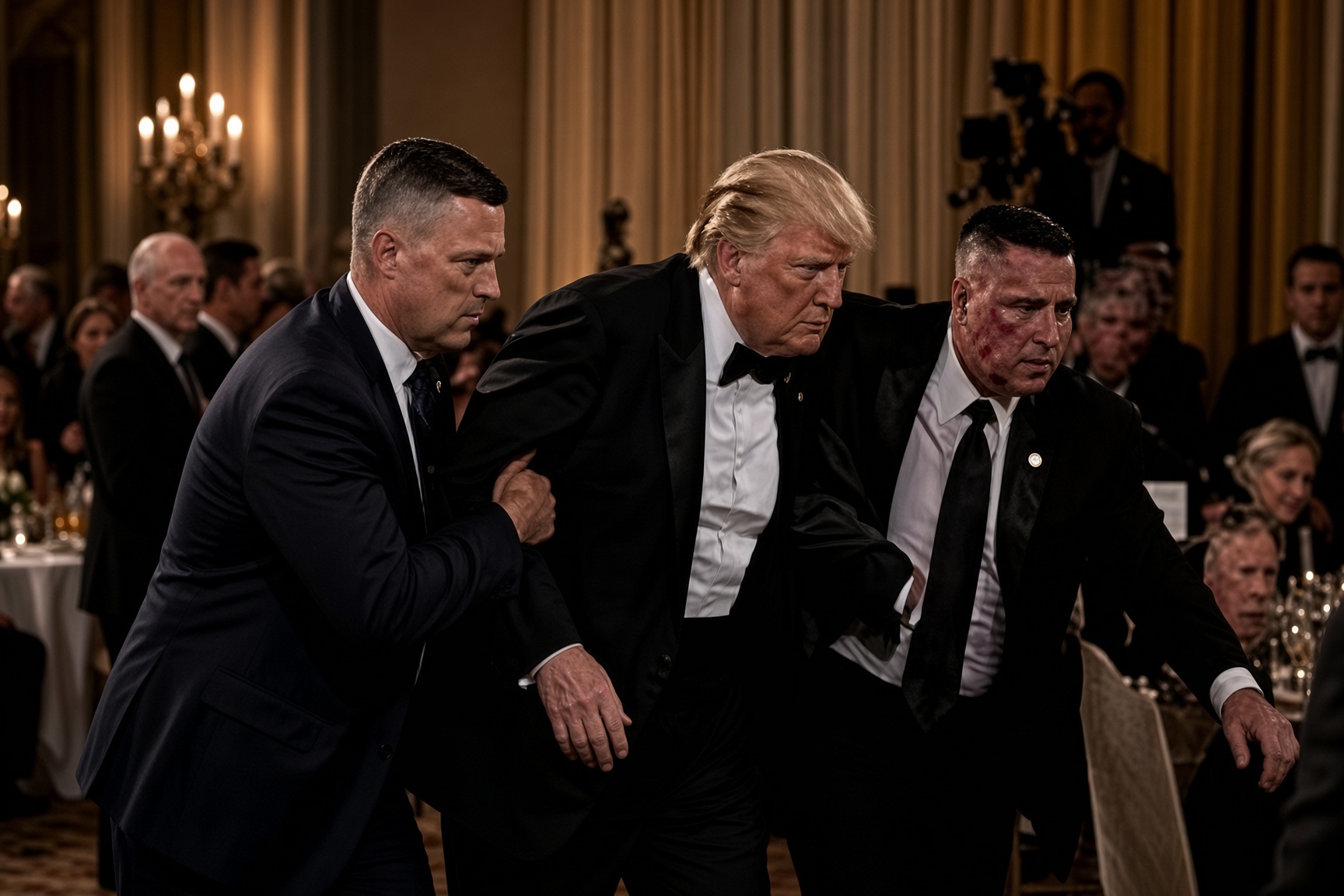
WASHINGTON — Unverified claims that Donald Trump had been “shot again” in Washington, D.C., raced across social media on a single day, generating widespread public alarm, brief market volatility, and a flood of conflicting commentary before federal authorities and major news organizations established that the reports were entirely false.
No law enforcement agency, hospital, or emergency service recorded any shooting or security incident involving the former president. The U.S. Secret Service, which maintains continuous protection and issues immediate notifications in genuine crises, released no alert. National and international news organizations, which typically mobilize within minutes of any credible threat to a current or former president, found no supporting evidence. Federal sources later confirmed that the day’s schedule in the capital and at Trump properties elsewhere proceeded without interruption and that no gunfire or assassination attempt had occurred.
The episode followed a now-familiar pattern of digital amplification. Forensic reviews indicated the rumor first appeared on low-visibility message boards and non-credentialed accounts before migrating to larger platforms. Several widely shared posts paired archival video from earlier security scares with present-tense “breaking” captions. Automated accounts and engagement-oriented aggregators then accelerated distribution, using emotionally charged language that algorithms reward with greater reach. Researchers noted that the claim drew residual credibility from real 2024 incidents: the July 13 rally shooting in Butler, Pennsylvania, in which Trump was wounded and a spectator was killed, and the subsequent arrest of a suspect who approached Trump International Golf Club in West Palm Beach with a rifle. Those events prompted documented expansions in perimeter security, counter-drone measures, and protective staffing. Officials emphasized, however, that the existence of past threats does not authenticate unsourced online assertions. Authentic incidents trigger visible multi-agency responses that cannot remain concealed from the press or public.
The practical consequences of such false alarms extend beyond online traffic. Emergency call centers and police public-affairs offices routinely absorb surges of media and citizen inquiries, diverting personnel from verified incidents. Algorithmic trading systems and financial desks often react to sudden executive-security rumors, producing short-lived but measurable swings in equities and currencies that reverse once the claims are disproven. Repeated episodes also erode baseline trust: audiences grow less responsive to legitimate warnings when sensational falsehoods have previously proven empty. Counter-disinformation specialists observe that prominent political figures remain frequent targets precisely because the initial informational vacuum rewards speed over verification. Headlines engineered for immediate shock encourage rapid reposting before readers consult primary sources.
Spokespersons for protective agencies and public-safety officials continue to recommend a simple sequence: check statements from the Secret Service or relevant law-enforcement bodies, consult established newsrooms that maintain on-the-ground reporting capacity, and examine primary video or official documentation rather than secondary screenshots. In an environment where recycled footage and coordinated amplification can outpace institutional response by minutes, the most reliable safeguard remains deliberate cross-checking against credentialed outlets and on-the-record government communications. The rapid rise and collapse of the Washington rumor illustrated both the speed of contemporary distribution networks and the continuing necessity of that verification step.