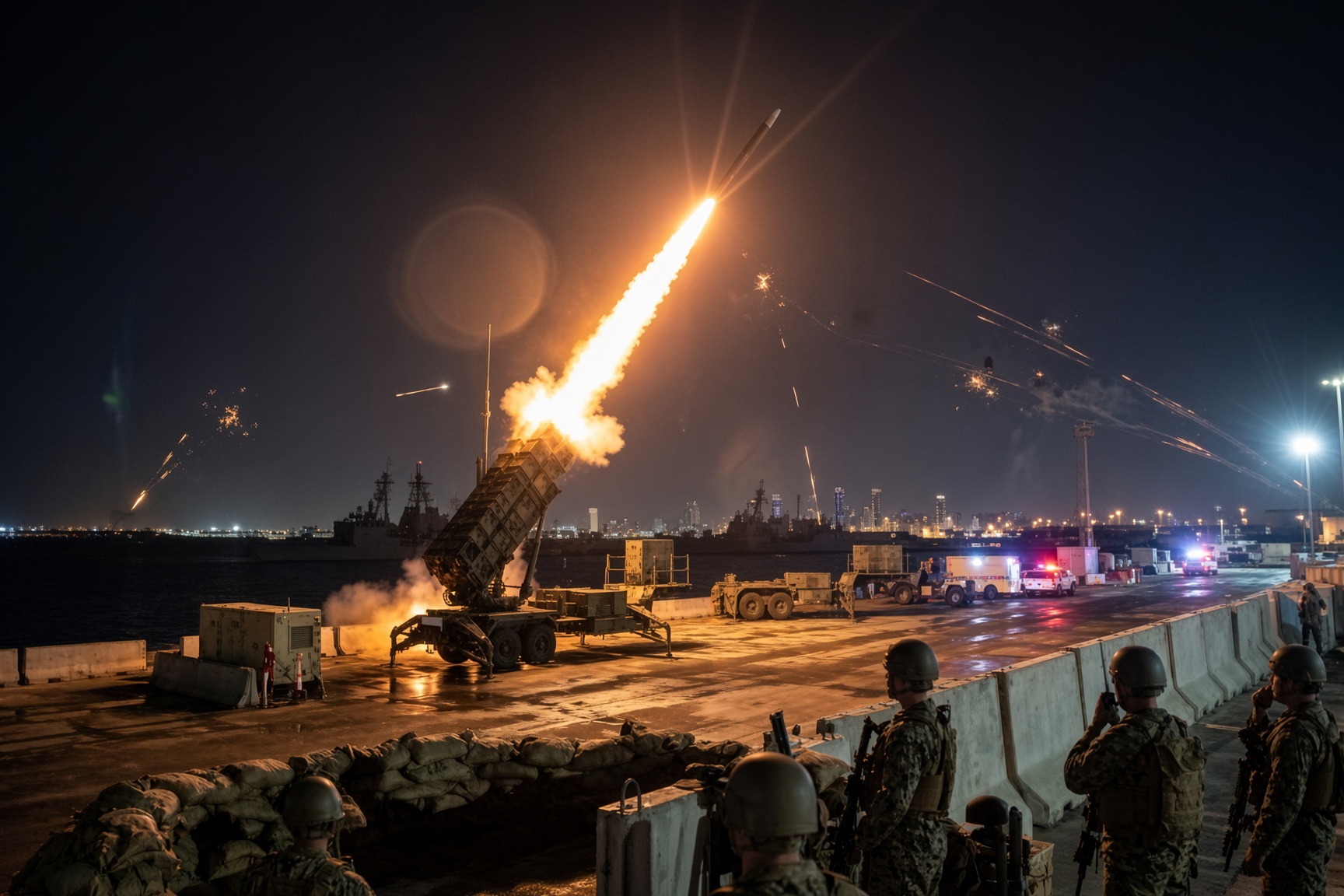
MANAMA, Bahrain — The Persian Gulf is once again on a war footing as Iran has launched fresh waves of ballistic missiles and one-way attack drones toward locations hosting U.S. military forces, forcing Gulf allies to activate air defenses and sending emergency alerts through communities that have spent much of 2026 bracing for further escalation.
This is no longer a contained confrontation. Since U.S. and Israeli strikes against Iran began in late February 2026, Tehran has repeatedly demonstrated its willingness and ability to strike American military positions and regional infrastructure across the Gulf. The United States maintains major strategic installations in Bahrain, Qatar, Kuwait, and the United Arab Emirates, making those sites recurring targets whenever the conflict intensifies. News agencies and satellite analyses have documented multiple rounds of Iranian attacks against U.S. bases and assets throughout the year.
Gulf Air Defenses Engaged
In the United Arab Emirates, reports of incoming threats have repeatedly put security forces on high alert. UAE air defenses have intercepted large numbers of Iranian missiles and drones in earlier barrages. Al Dhafra Air Base, a key node for U.S. operations roughly 20 miles south of Abu Dhabi, has come under particular pressure. Associated Press satellite analysis of earlier strikes showed damage to hangars and other infrastructure there, illustrating how even well-defended Gulf installations can sustain hits when Iran mounts sustained campaigns. Claims of specific damage from any individual barrage continue to require careful assessment until authorities and independent imagery complete their reviews.
Bahrain remains one of the most strategically vital American military locations in the region. It hosts Naval Support Activity Bahrain, headquarters of the U.S. Navy’s Fifth Fleet. Iran has repeatedly claimed attacks against U.S.-linked facilities in the kingdom, including areas associated with Sheikh Isa Air Base. Bahraini authorities have reported intercepting substantial numbers of incoming threats during previous barrages, and air-raid sirens have sounded in Manama during recent exchanges. Regional reporting indicates that Bahrain’s multilayered defenses, including Patriot systems, have engaged waves of missiles and drones since the conflict’s opening phase.
Qatar has faced similar dangers. Al Udeid Air Base, one of the most important U.S. military installations in the Middle East and home to critical command-and-control functions, has been targeted or threatened on multiple occasions. Satellite imagery has documented damage to portions of U.S. infrastructure at Al Udeid from earlier attacks, including impacts on command facilities in the war’s opening days. Kuwait has likewise been directly exposed, with Iranian missiles and drones previously striking or approaching locations supporting U.S. forces. Ali Al Salem Air Base and Camp Buehring absorbed repeated hits; AP analysis found Kuwait among the hardest-hit locations, with damage to hangars, warehouses, and support buildings.
The pattern is clear: American military infrastructure across the Gulf has been exposed to Iranian missile and drone attacks throughout 2026. An Associated Press review of satellite imagery and official accounts through August found more than 115 drone or missile strikes claimed by Iran or Iranian-backed groups had damaged or destroyed structures at 26 military bases and other sites housing U.S. equipment, producing billions of dollars in losses. Early strikes often focused on radar and early-warning systems before expanding to hangars, communications nodes, fuel storage, and other facilities. U.S. officials have noted the relocation of some assets out of the immediate Gulf area in response.
Intense air-defense operations have periodically lit up night skies across the region, with land-based missile batteries and naval vessels working to neutralize threats. Ground-level reports and maritime observers have described sustained interception activity near key installations, where personnel have been ordered to take shelter.
Global Energy Concerns Mount
The Strait of Hormuz remains central to the confrontation. The narrow waterway is one of the world’s most important energy chokepoints; roughly a fifth of global oil supplies historically passed through it. Continued fighting has severely restricted commercial shipping. Tracking data as of mid-November 2026 shows AIS-visible commercial traffic far below pre-crisis levels—sometimes only a small fraction of normal volumes—with ships frequently transiting under U.S. naval coordination while Iran asserts control and demands permits. Dozens of maritime incidents have been recorded since the war began, including attacks on tankers and other vessels, with seafarer deaths confirmed by international maritime authorities.
Several major shipping companies have rerouted vessels or limited transits. Every additional missile launch, drone attack, or naval engagement raises the risk of further disruption to energy exports and already-elevated global oil prices. Gulf producers have increased use of alternative pipelines that bypass Hormuz, but the waterway’s constrained status continues to weigh on markets.
A Dangerous Cycle of Retaliation
Iran has shown it can strike U.S.-linked targets across multiple Gulf states in response to American operations, while Washington has continued significant military activity, including strikes on Iranian coastal defenses, missile sites, and related infrastructure near the Strait. The United States has stated it will take necessary measures to protect its personnel and allies and has maintained naval and air assets in the theater. Tehran has warned that further counter-strikes will be met with greater force.
For American forces and U.S. allies, the immediate priorities remain defense, interception, and damage assessment. Broader questions center on whether the next exchange will trigger a wider spiral. The conflict has already reshaped U.S. basing and operations in the region and imposed sustained costs on energy flows. One more major escalation risks pushing the Persian Gulf into territory that is increasingly difficult for any side to control.