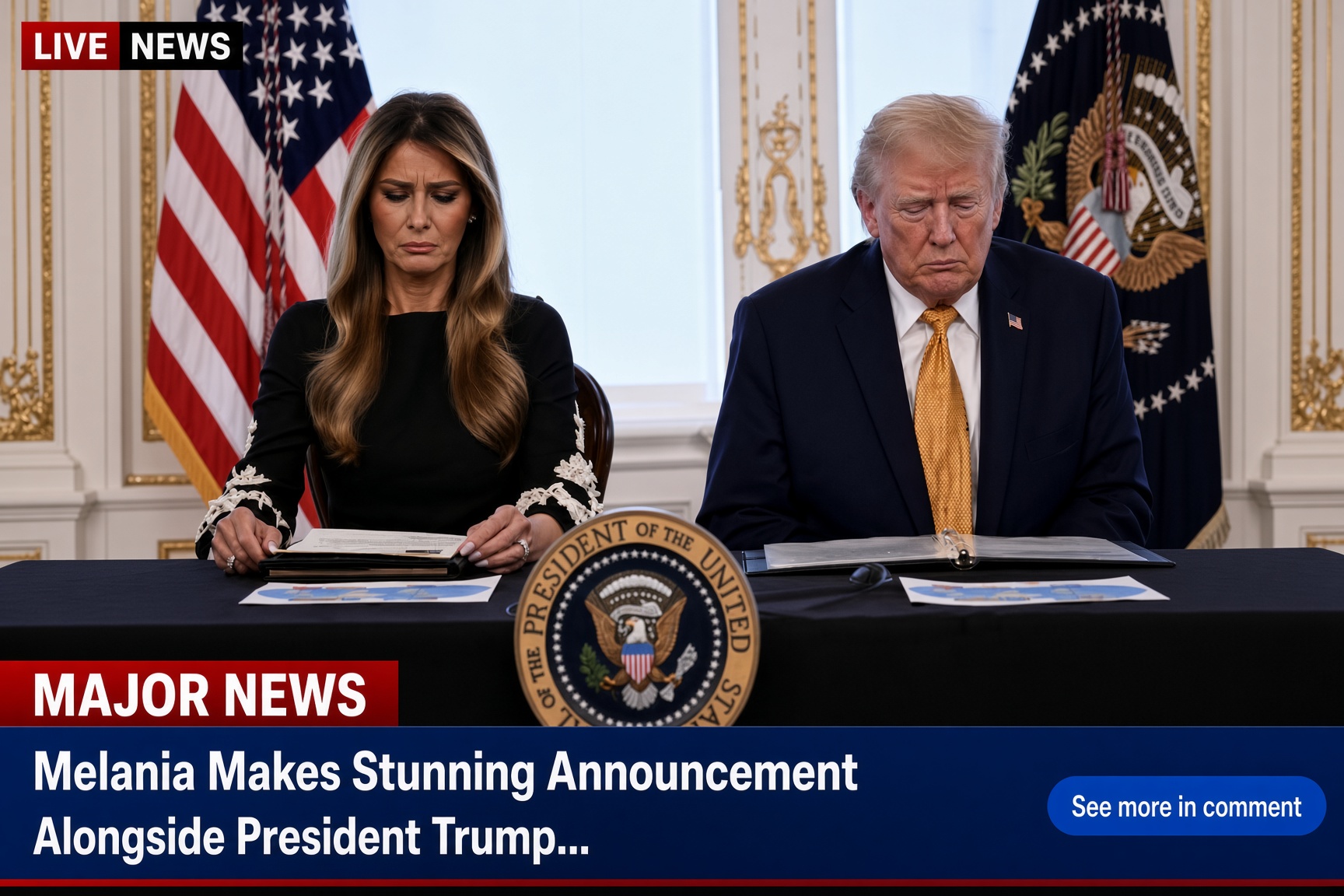
First Lady Melania Trump is once again shaping her husband’s policy agenda, and the result is a significant new federal push for women’s health.
On Monday, President Donald Trump signed an executive order creating both a White House Women’s Health Task Force and a new Women’s Health Division inside the National Institutes of Health. The order, titled “Advancing Women’s Health to Improve Outcomes in All Phases of Life,” directs the Department of Health and Human Services to stand up the NIH division within 90 days. The task force, co-chaired by Health and Human Services Secretary Robert F. Kennedy Jr. and White House Chief of Staff Susie Wiles, will coordinate women’s health policy across federal agencies.
Melania Trump played a central role in developing the initiative. She held working sessions with physicians and other experts, identified longstanding gaps in medical research involving women, and pressed the administration to act. At the White House announcement she called the effort “a transformative moment for women in America” and said the administration intended to establish a new standard for women’s health. “Our mission must serve women at every stage of life,” she added, describing a lifespan approach that runs from childhood through motherhood, middle age, menopause, and later life.
NIH Director Jay Bhattacharya said the new division is meant to close lingering gaps in medical evidence and bring scientific discoveries closer to patients, especially in areas where women have historically lacked clear answers about diagnosis and treatment. The division will focus on conditions that uniquely or disproportionately affect women, including cardiovascular disease, cancer, stroke, Alzheimer’s disease, autoimmune disorders, osteoporosis, chronic pain, endometriosis, fibroids, infertility, maternal health, and menopause. It will work alongside the existing NIH Office of Research on Women’s Health—established in 1990—rather than replace it, coordinating research and accelerating the translation of findings into prevention, diagnosis, and care.
The executive order also calls for greater participation of women and girls in clinical trials and stronger enforcement of NIH requirements that federally funded research account for biological sex when appropriate. Melania outlined five priorities for the effort: directing research funding toward diseases that uniquely affect women; using advanced artificial intelligence to improve understanding of female biology; accelerating promising therapies from laboratories to patients while maintaining safety standards; making medical breakthroughs more accessible and affordable; and encouraging greater education and open discussion about women’s health issues that have historically received less public attention.
President Trump praised his wife for driving the proposal and said the administration intends to pursue additional research into diseases affecting women that have long been understudied. He acknowledged that he initially questioned whether NIH already had a dedicated division when Melania raised the idea—an understandable reaction given the existence of the 1990 office—yet he signed the order and noted that the new structure is intended to give the issue higher visibility and faster action. The task force held its first working session Monday afternoon, immediately after the White House ceremony.
Administration officials described the effort as a comprehensive, lifespan strategy rather than a collection of isolated condition-specific programs. It builds on earlier administration steps that include expanded research into infertility and endometriosis, adjustments involving menopause treatment, maternal health programs, and a proposed pathway for certain fertility benefits. HHS also held its first National Conference on Women’s Health in March, bringing together researchers, physicians, policymakers, and advocates.
The order does not specify a new dollar amount for the initiative, leaving open the question of precisely how much additional federal funding will ultimately flow to the new NIH division and its priorities. It does, however, revoke former President Joe Biden’s March 2024 executive order on women’s health research and a November 2023 presidential memorandum that established the Biden White House Initiative on Women’s Health Research.
By elevating women’s health inside both the White House and NIH, the initiative aims to close research gaps that have left many conditions understudied and many women without clear, evidence-based answers across their lives. Melania Trump’s visible leadership has framed the effort as a practical advance in research, treatment access, and public understanding—steps the administration presents as long overdue for American women.