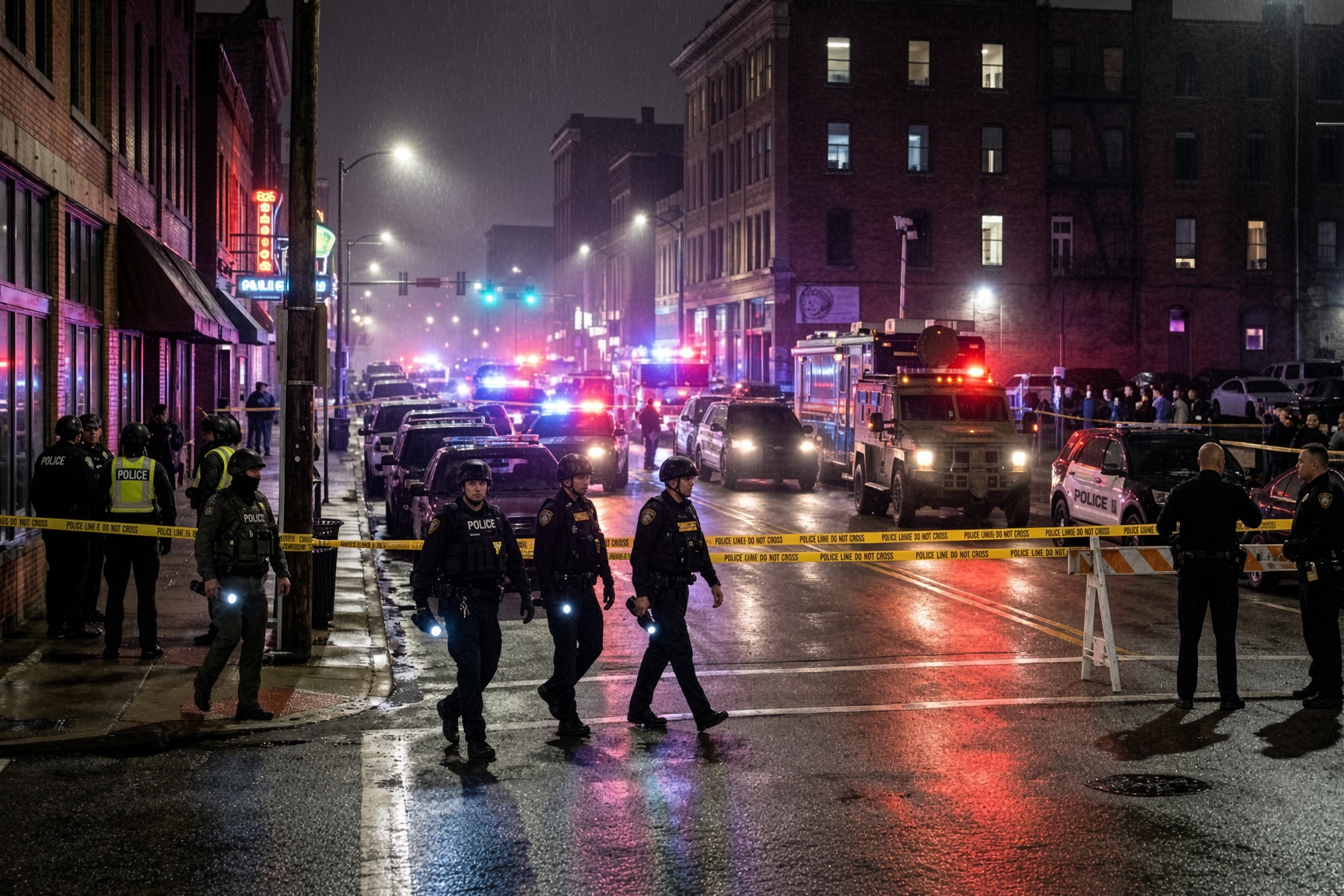
Metro Desk—A massive, highly coordinated mobilization of municipal police, heavily armed tactical squads, and regional emergency services has cordoned off several downtown blocks, establishing a fortified security perimeter that has paralyzed the city’s commercial heart while commanders evaluate an active, unresolved public safety incident.
Public safety directors deployed a unified incident command post within minutes of the initial emergency callout on Thursday evening, October 29, 2026. High-volume thoroughfares were abruptly shuttered, busy pedestrian pathways closed, and urgent mass-broadcast bulletins issued advising residents, office workers, and commuters to bypass the cordoned sector entirely. The scale of the response—marked by the rapid arrival of mobile command vehicles, specialized units, and support apparatus—signaled that authorities viewed the situation as sufficiently serious to warrant an expansive lockdown of the central business district during peak evening hours.
Despite the significant and highly visible police presence, department leadership has maintained a strict operational silence regarding the specific catalyst that prompted the tactical callout. High-ranking officials have declined to specify whether the situation involves an active barricade, a suspicious device, a barricaded subject, or another form of unresolved threat. They have cited the dynamic, fluid nature of the scene and the operational imperative to protect first responders as initial containment sweeps proceed. This deliberate restraint is standard in the early phases of high-risk incidents, when premature disclosure can compromise tactical positioning, endanger personnel, or inadvertently aid any involved parties.
The security footprint escalated rapidly from routine patrol deployments into a multi-agency response. What began as a localized reaction quickly drew mobile tactical operations centers, tactical support units, armored vehicles, and specialized explosive and technical hazard teams to isolate the affected area. Emergency medical crews, hazardous-materials teams, and additional specialized units remain staged at key intersections as field commanders work to determine the precise scope of the threat. Lighting towers, generators, and temporary barriers transformed ordinary intersections into controlled access points, while overhead surveillance and ground teams methodically assessed adjacent structures and open spaces.
“We are dealing with an active, fluid situation, and our absolute priority is containment and the safety of the public and our officers on the scene,” a department spokesperson said during a brief, impromptu media pool briefing just outside the outer perimeter. “We ask for the public’s patience and cooperation as our specialized units work to resolve this safely.” The statement, delivered under the glow of emergency lights with traffic frozen in the distance, underscored the priority of controlled resolution over rapid public disclosure.
Incident commanders confirmed that access across the inner security perimeter has been restricted exclusively to tactical personnel and critical technical specialists. Concrete dividers, heavy patrol vehicles, and retractable barriers have been positioned across primary intersections to secure a clear transit corridor for arriving emergency apparatus and to safeguard the public from potential kinetic or environmental hazards. Field supervisors outlined a multi-tiered containment structure governing the site. In the inner perimeter, specialized tactical teams and forensic sweeps are methodically clearing the immediate incident zone to evaluate structural, explosive, ballistic, or personnel hazards before investigative personnel can enter the primary site. A secondary buffer corridor has been fortified by traffic division officers to intercept incoming vehicle and pedestrian traffic, ensuring emergency equipment maintains unobstructed transit lanes to and from nearby trauma centers and staging areas. Officials noted that perimeter boundaries remain fluid and subject to immediate expansion or contraction based on real-time field intelligence and the movements of tactical teams.
Authorities have firmly declined to offer an estimated time of reopening, emphasizing that lifting the heavily guarded barricades depends entirely on completing thorough safety checks, verifying physical security, and securing a formal operational clearance from the unified command post. Until those steps are finished, the commercial core remains effectively sealed, with only authorized emergency movement permitted inside the restricted zone.
Emergency management coordinators have issued targeted wireless emergency alerts urging the public to heed all instructions from uniformed personnel and authorized civic messaging systems. Occupants within residential buildings, high-rise office towers, and storefronts facing the perimeter were advised to shelter in place, lock external doors, stay away from windows, and await further instructions from official channels. Public safety officials issued strong warnings against crowds forming near the police tape, noting that civilian rubbernecking and onlookers gathered at the barriers impede high-speed tactical maneuvers, risk overwhelming emergency radio communication, and expose bystanders to potential danger should the situation escalate.
“People gathering to watch or take video on their phones do not understand the level of risk they are placing themselves and our officers in,” a field commander noted on the ground. “If this situation changes rapidly, those crowds become a significant evacuation and safety hazard.” The admonition reflected the practical challenges of managing dense urban environments during extended operations, where spectator interest can quickly complicate already constrained logistics.
The prolonged gridlock has triggered severe, cascading friction throughout the metropolitan transit network. The closure of major arterial routes forced regional transit authorities to reroute multiple bus lines, cancel local curb stops, and divert commercial and private vehicles onto already congested secondary roads. The resulting diversions generated widespread gridlock across neighboring business districts during the peak evening transit hours, lengthening commute times for thousands and disrupting scheduled deliveries and service vehicles. Corporate offices, commercial retailers, and public institutions operating within the restricted boundary have suspended business operations for the day, sending employees home where possible or keeping them safely indoors while awaiting an all-clear from city administrators before resuming normal trade. Hotel guests and nearby residents reported difficulty accessing routine services, while restaurants and shops just outside the outer perimeter saw abrupt drop-offs in foot traffic as word of the lockdown spread.
Faced with an information vacuum common during early-stage containment operations, departmental public information officers issued stern appeals against the dissemination of unverified claims across online networks. Emergency directors emphasized that fast-moving incidents frequently give rise to internet conjecture, which can produce fabricated casualty numbers, conflicting descriptions of suspects, and false accounts of gunfire or explosions. Authorities warned that viral speculation generates unnecessary public panic, misdirects critical emergency dispatch and communication resources, and can complicate tactical maneuvers on the ground.
“We urge everyone to refrain from posting unverified hearsay on social media,” the department’s public information office posted. “It spreads fear and distracts our dispatchers and on-scene personnel who need to focus entirely on resolving the situation.” Agency spokespersons stressed that factual updates regarding the nature of the incident, threat mitigations, and transportation updates will be released solely through verified department briefings and municipal alert systems. In the meantime, residents have been directed to rely exclusively on official channels rather than circulating screenshots, secondhand accounts, or speculative commentary.
Detectives, technical forensics teams, and municipal safety inspectors have begun preliminary investigative workflows to establish the sequence of events that led to the heavy emergency response. Investigators are securing and archiving public traffic cameras, closed-circuit security recordings, and building surveillance video from surrounding parcels, while interviewing initial 911 callers and witnesses. These parallel efforts are intended to reconstruct a reliable timeline once the immediate tactical phase concludes and the scene is fully stabilized. Municipal officials have pledged to provide a comprehensive public briefing as soon as investigators verify physical evidence that can be disclosed without compromising the ongoing operation or the safety of the personnel involved.
As the operation entered its later hours, the illuminated perimeter continued to dominate the downtown skyline, a visible reminder of the resources committed to containing an unresolved incident whose precise contours remain, for now, known only to those inside the unified command structure. The city’s commercial heart stayed dark and quiet behind the barriers, awaiting the formal clearance that will allow normal patterns of movement and commerce to resume.