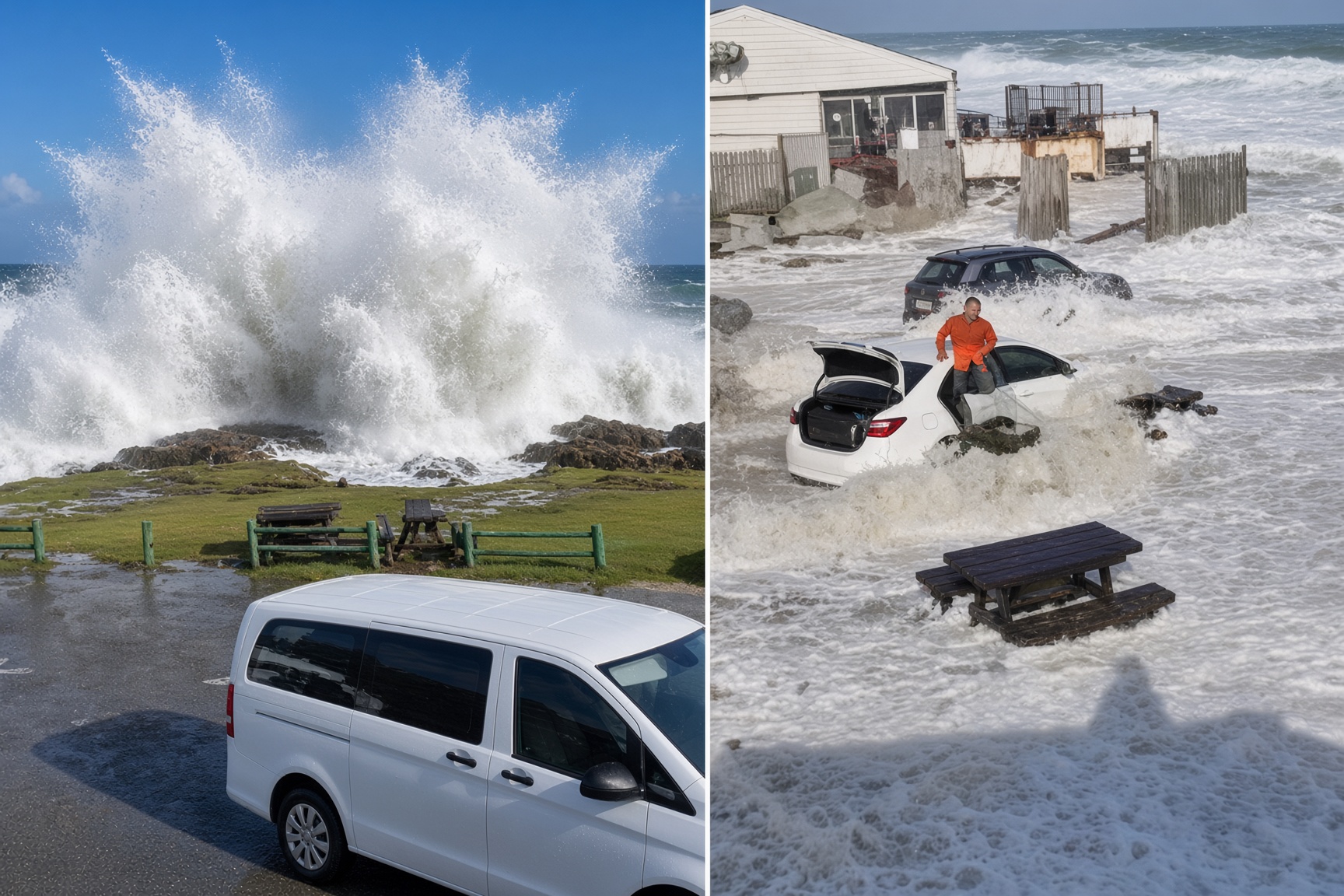
A seemingly ordinary day along South Africa’s coastline turned chaotic when powerful ocean waves surged far beyond the shoreline, flooding beachfront areas, sweeping over coastal roads, and catching people and vehicles off guard. Dramatic footage that spread rapidly on social media has highlighted how quickly calm conditions can give way to dangerous seas, serving as a stark reminder of the ocean’s raw force.
In the widely shared video, enormous volumes of seawater race toward the shore and wash across areas normally considered safe. Cars are pushed by the incoming water, and people struggle to stay on their feet as the surge arrives with little warning. What makes the scenes particularly striking is the speed of the change: moments earlier the beach and nearby roads appear relatively calm, then a large wave transforms the setting into one of sudden hazard.
South Africa’s extensive coastline sits where the Atlantic and Indian oceans meet, creating a zone of complex and often powerful sea conditions. Strong winds, changing tides, and distant storms all play a role. Swells generated by storms thousands of kilometres away can travel across open ocean while retaining substantial energy. By the time they reach shallower coastal waters, sea walls, or beachfront roads, that energy focuses into steep, forceful waves capable of overtopping normal boundaries and flooding nearby infrastructure.
The physics of moving water explains why these events can move vehicles and knock people over. A large wave carries immense mass and momentum. When it hits a car, it can displace or damage the vehicle; when it reaches a person, the sudden volume and current can easily sweep them off their feet or pull them seaward. Additional risks include slippery surfaces, floating debris, and unpredictable secondary currents that form as water drains back into the sea. Coastal authorities regularly advise against standing too close to the water’s edge during rough conditions, precisely because the danger can escalate faster than people expect.
Such events are not new along the South African coast. In September 2023, powerful swells combined with spring high tides affected several locations, including Gordon’s Bay, Stilbaai, Mossel Bay, and Three Anchor Bay. Vehicles were reported damaged or swept into the sea. Cape Town and other Western Cape towns have also seen winter storms produce waves that crashed over coastal roads, underscoring the vulnerability of beachfront infrastructure when extreme sea states develop.
The latest viral footage therefore fits a longer pattern: beautiful coastlines that can become hazardous when large swells arrive. While the images are dramatic and often watched with fascination, they also illustrate practical risks for anyone near the shore. Checking local marine forecasts, heeding warning signs, and keeping a safe distance from the water remain the most effective ways to avoid being caught in a sudden surge. The ocean’s power is constant; only the conditions change.