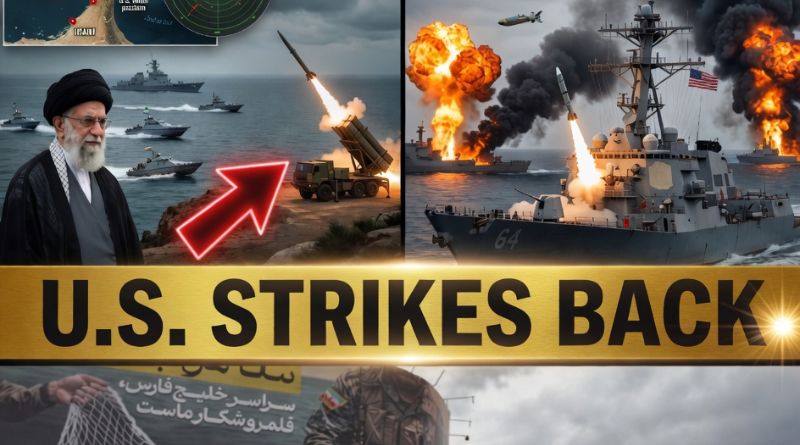
The Strait of Hormuz: From Iranian Killbox to Strategic Victory
For nearly fifty years, the Strait of Hormuz stood as the world’s most dangerous geopolitical chokepoint. This narrow 21-mile waterway, through which roughly 25 percent of global seaborne oil passes daily, gave Iran a powerful lever. Tehran’s Revolutionary Guard Corps boasted that its shore-based missiles, hidden in mountain tunnels, and swarms of fast-attack boats could turn the strait into an impenetrable “killbox.” The assumption was simple: Iran could shut down the global energy artery at will and plunge the world economy into crisis.
That long-held fear collapsed in the spring of 2026. On February 28, the United States and its allies launched Operation Epic Fury, a sweeping campaign targeting Iran’s leadership, nuclear infrastructure, missile sites, and command networks. In retaliation, Iran closed the Strait of Hormuz, unleashed anti-ship missiles and sea drones against commercial tankers, and vowed to set ablaze any vessel attempting passage. Oil prices rocketed past $100 a barrel, shipping insurance evaporated, and global energy markets plunged into turmoil.
Rather than walk into Iran’s trap, U.S. forces methodically dismantled the threat. The decisive blow came on March 17 with the combat debut of the GBU-72 Advanced 5K Penetrator. Designed to defeat deeply buried, heavily reinforced targets, this massive bunker-buster punched through meters of mountain rock and concrete. In one night of precision strikes, American aircraft collapsed much of Iran’s “missile cities” along the coast, destroying approximately 90 percent of the long-range anti-ship missile inventory that had formed the backbone of Tehran’s deterrent.
With the heavy missile threat neutralized, the fight shifted to the surface and littoral zones. Here, older platforms found new relevance. The A-10 Thunderbolt II “Warthog,” long a Cold War-era tank killer, proved devastating against Iran’s fiberglass speedboats. Its 30mm GAU-8 cannon shredded swarm after swarm, turning the Persian Gulf into a floating graveyard of burning hulls. AH-64 Apache helicopters complemented the effort, methodically hunting one-way attack drones with precision Hellfire missiles. By the time major combat subsided, the Iranian Navy had been effectively annihilated, with more than 150 vessels sunk or disabled.
On May 4, the United States initiated Project Freedom: a robust, multi-layered escort operation. Ballistic-missile-defense destroyers, carrier-based fighters, and land-based aircraft created a protective dome over commercial shipping lanes. On April 11, the destroyers USS Frank E. Petersen and USS Michael Murphy made a deliberate statement by transiting the strait with their Automatic Identification Systems broadcasting openly. When Iran launched a final barrage of cruise missiles, the American defensive screen handled every threat. No escorted vessels were lost.
Today, the strategic map of the Middle East looks profoundly different. Iran’s coastal missile networks lie in ruins, its fast-attack fleet rests on the seafloor, and many of the commanders who ordered the closure have been removed from power. The once-feared “impenetrable” strait is now open under American protection.
The lesson is clear. Geography still matters, but in 21st-century warfare, integrated technology, persistent intelligence, precision munitions, and professional joint operations can overcome even the strongest natural advantages. Freedom of navigation through the Strait of Hormuz is no longer a theoretical principle—it is a reality enforced daily by the world’s most capable navy. What Iran once viewed as its ultimate weapon has become Washington’s strongest leverage in the region.