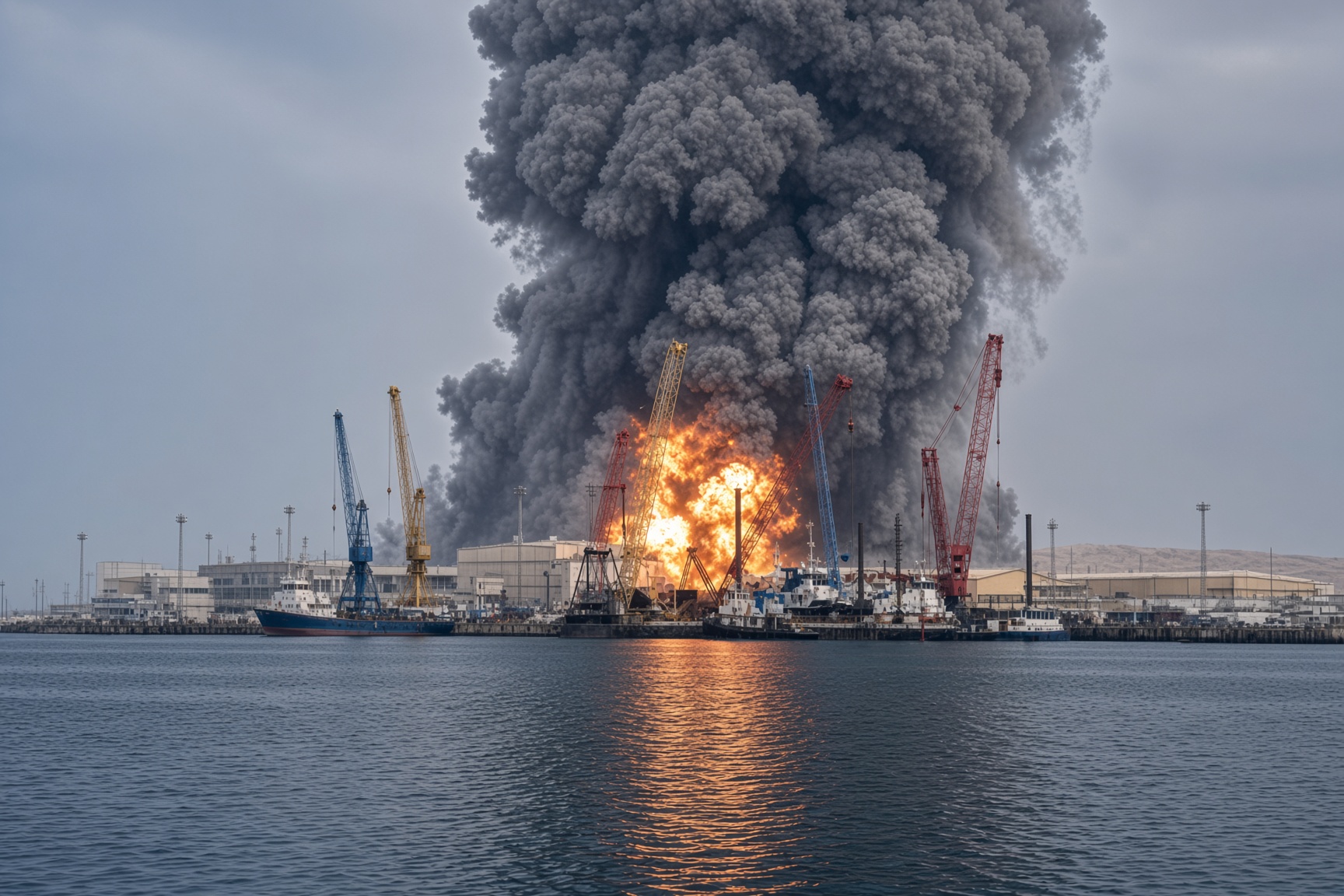
MANAMA, Bahrain — Iranian forces launched coordinated salvos of medium-range ballistic missiles and one-way attack drones toward U.S. military installations across the Persian Gulf, prompting Gulf states to activate layered air defenses, issue civil-defense alerts, and move personnel into shelters. The attacks mark a clear shift from earlier maritime and border skirmishes into a broader campaign that places host-nation territory and American forward bases directly in the line of fire.
Washington’s regional footprint—spread across Bahrain, Qatar, Kuwait, and the United Arab Emirates—has become a primary focus of Iranian retaliation. In the United Arab Emirates, early-warning systems tracked inbound tracks as detonations and low-altitude intercepts were reported near urban areas. Emirati units employing THAAD and Patriot PAC-3 systems engaged projectiles that entered national airspace. Attention centered on Al Dhafra Air Base south of Abu Dhabi, a key logistics and operational hub that supports U.S. Air Force reconnaissance, airborne early-warning, and aerial-refueling aircraft. Iranian state media has repeatedly claimed significant damage at the base; Western analysts and regional officials continue to stress that assessments of runway disruption, command-node damage, or structural effects require independent commercial satellite imagery and verified post-strike evaluation.
Bahrain, which hosts Naval Support Activity Bahrain—the headquarters of U.S. Naval Forces Central Command and the U.S. Fifth Fleet—faced repeated engagements. The base oversees maritime security missions spanning the Persian Gulf, Red Sea, and Arabian Sea, and operates in conjunction with airfield activity at Shaikh Isa Air Base. Bahraini ground-based defenses, working with U.S. Navy Aegis destroyers offshore, engaged multiple inbound targets, producing visible intercept plumes along the coast. The kingdom’s geographic position and role as a naval nerve center make it a recurring target whenever Tehran expands its response.
Further north, Al Udeid Air Base in Qatar remained on high alert. The installation serves as the forward headquarters for U.S. Central Command and houses the Combined Air Operations Center that coordinates combat and surveillance aviation across the theater. Earlier satellite imagery from previous exchanges had shown localized fragmentation damage to perimeter support infrastructure; coalition personnel were again directed into reinforced shelters as interceptors launched. Kuwait similarly saw its air-defense batteries engage low-flying drones and ballistic threats near logistics areas that support U.S. Army Central operations and prepositioned equipment.
These strikes illustrate the burden placed on Gulf Cooperation Council partners. Host nations are expending high-cost interceptor munitions to protect sovereign territory from attacks generated by a conflict they do not control unilaterally. Magazine depth, the hardening of vulnerable support facilities, and the early identification of saturation attacks have become immediate operational priorities for allied commands.
The kinetic activity carries substantial economic risk centered on the Strait of Hormuz, through which roughly 20 percent of global petroleum transit moves. The waterway lies within range of Iranian coastal defense batteries, surface radars, and Islamic Revolutionary Guard Corps fast-attack craft. Increased missile and drone activity, together with coastal alarms, has already disrupted commercial schedules. Shipping lines and energy firms have delayed or rerouted tankers, with some vessels anchoring outside the Gulf of Oman or taking the longer route around the Cape of Good Hope. Marine insurers have raised war-risk premiums, elevating overall transport costs and feeding into refined-fuel prices. Trading floors in London, New York, and Singapore have registered heightened volatility; sustained interdiction or the introduction of naval mines in the transit lanes would produce an immediate supply shock with effects on industrial supply chains and broader inflation measures.
Strategically, the pattern of Iranian ballistic and drone operations demonstrates both available stockpiles and a willingness to strike U.S. assets on the territory of neighboring states. The concentration of forward-deployed American personnel simultaneously constrains Washington’s options: repeated strikes increase pressure for direct counter-actions against launch sites and command networks, while any major penetration that produced significant casualties at a base in Manama, Doha, or Abu Dhabi could collapse remaining de-escalation channels. With early-warning radars active and interceptors on continuous alert, the margin separating managed tactical exchanges from wider regional conflict has narrowed sharply.