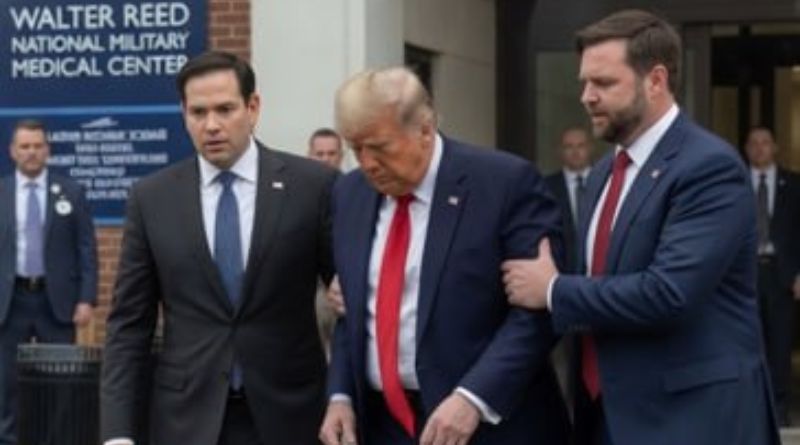
WASHINGTON — In an era where information travels at the speed of a tweet and speculation can outpace official statements, a brief gap in President Donald Trump’s public schedule in early April 2026 ignited a firestorm of unverified rumors about his health. Social media platforms lit up with claims that the 79-year-old president had been rushed to Walter Reed National Military Medical Center, fueling widespread concern and partisan debate before authorities firmly pushed back.
The episode, which unfolded around the Easter weekend, underscores the challenges of managing public perception in a hyper-connected digital landscape, where minor schedule adjustments involving high-profile figures can quickly morph into narratives detached from facts.
The Spark: A Quiet Weekend and Schedule Shifts
The rumors gained traction on April 4, 2026, after the White House announced that President Trump would not attend several previously planned public events. Trump had last been seen publicly on April 1, and his absence over the following days — combined with reports of possible road closures and airspace restrictions near Walter Reed in Bethesda, Maryland — prompted an avalanche of online speculation.
Posts on X (formerly Twitter), Facebook, Threads, and other platforms rapidly circulated unverified assertions. Some users claimed Trump had been admitted for emergency treatment, while others shared old videos, AI-generated images, or unrelated footage to bolster the narrative. One widely viewed post from commentator Ed Krassenstein amplified the speculation, garnering millions of impressions.
By midday on April 4, mentions of “Trump” and “Walter Reed” had exploded across social media, exceeding 112,000 posts in a matter of days, according to social media monitoring data. The story spread beyond partisan echo chambers, appearing in mainstream discussions and prompting questions even from typically skeptical observers.
White House officials moved quickly to contain the narrative. Communications Director Steven Cheung and other spokespeople labeled the claims “conspiracy theories” and “fake news.” They confirmed that Trump was not at Walter Reed but was instead actively working from the White House, including directing operations related to the rescue of a U.S. airman whose jet had been shot down in connection with tensions involving Iran.
“No medical emergency. President Trump is working,” one official statement emphasized. Trump reappeared publicly shortly thereafter, appearing in good spirits and resuming his schedule, including a press conference on April 6.
Context of Heightened Scrutiny
Public interest in presidential health is nothing new, but it has intensified in recent years as America’s leaders have grown older. Trump, the oldest president to assume office at inauguration, has faced persistent questions about his physical and cognitive fitness throughout his second term.
In July 2025, the White House disclosed that Trump had been diagnosed with chronic venous insufficiency (CVI), a common condition among older adults in which veins in the legs struggle to return blood to the heart, sometimes causing swelling. White House physician Capt. Sean Barbabella described it as “benign and common,” particularly for those over 70, with no evidence of more serious issues like deep vein thrombosis. Trump’s overall health was characterized as “excellent.”
That diagnosis followed observations of mild swelling in Trump’s lower legs and ankles. While manageable with lifestyle measures, compression, and monitoring, it became a focal point for critics questioning his stamina. Polls as recent as May 2026 show a majority of Americans — particularly Democrats and independents — expressing concern about Trump’s age and fitness, with many doubting the completeness of official health disclosures.
The April rumors emerged against this backdrop. Trump’s energetic public persona — marked by frequent rallies, long speeches, and a packed schedule — makes any deviation more noticeable. When combined with a “press lid” (a period with no expected public appearances) and the absence of detailed explanations, the information vacuum invited speculation.
The Mechanics of Misinformation
Social media algorithms played a central role in amplifying the story. Content evoking strong emotions — concern, schadenfreude, or political point-scoring — spreads faster regardless of veracity. Fact-checkers, including Snopes, found no credible evidence supporting hospitalization claims over Easter weekend. Many viral posts relied on recycled or fabricated visuals.
This phenomenon is hardly unique to Trump. Similar rumors have swirled around previous presidents, from concerns about Ronald Reagan’s age to questions about Joe Biden’s fitness. Yet the speed and scale have increased dramatically in the smartphone era. Traditional media outlets, for the most part, exercised caution. Major organizations waited for confirmation before reporting, distinguishing between speculation and verified developments — a contrast to the unfiltered flow on platforms like X.
The White House has criticized what it calls “deranged lies” from the “radical left,” framing the episode as politically motivated. Others argue that intense scrutiny of presidential health is legitimate given the demands of the office and the line of succession.
Broader Implications for Public Discourse
The incident highlights several ongoing tensions in American political communication:
- Transparency vs. Speculation: Prompt and detailed official updates can reduce rumor-mongering, yet administrations often prefer to control the narrative tightly.
- Media Literacy: In a fragmented information ecosystem, audiences must navigate between official statements, partisan outlets, citizen journalism, and outright fabrication. Fact-checking organizations and reputable reporters play a vital role, though trust in institutions remains low.
- Polarization: Health rumors often become proxies for deeper political battles. Supporters viewed the claims as baseless attacks; detractors saw any lack of transparency as suspicious.
As Trump approaches his 80th birthday in June 2026, such episodes are likely to recur. The president is scheduled for a routine medical and dental checkup at Walter Reed on May 26 — his third or fourth such visit in roughly 13 months, depending on counting — which the White House has described as standard. Officials continue to assert he remains in excellent health.
Medical experts note that CVI, while not life-threatening, requires ongoing management. Presidents historically have undergone more scrutiny than average citizens, with some releasing detailed reports while others have been more opaque.
Lessons from the April Episode
This latest wave of speculation offers several takeaways. First, schedule changes for visible leaders will almost inevitably draw attention, especially without immediate context. Second, social media’s design prioritizes virality over accuracy, creating fertile ground for misinformation. Third, official responses matter: swift denials helped limit damage, though they rarely fully extinguish online chatter.
In the long term, greater media literacy among the public — cross-referencing sources, understanding algorithmic incentives, and recognizing the limits of unverified posts — could mitigate such episodes. Journalists, too, bear responsibility to verify rigorously before amplifying claims.
As the digital information environment evolves, balancing the public’s right to know with the privacy and operational needs of leaders remains a delicate challenge. The Trump rumors of April 2026 ultimately proved unfounded, but they served as a vivid reminder of how quickly perception can diverge from reality in today’s media landscape.
President Trump has since maintained a robust public schedule, continuing to advance priorities on issues ranging from economic policy to international affairs. The brief controversy appears to have faded, yet it leaves lingering questions about how future health-related discussions around the presidency will be handled — by the White House, the press, and the public.