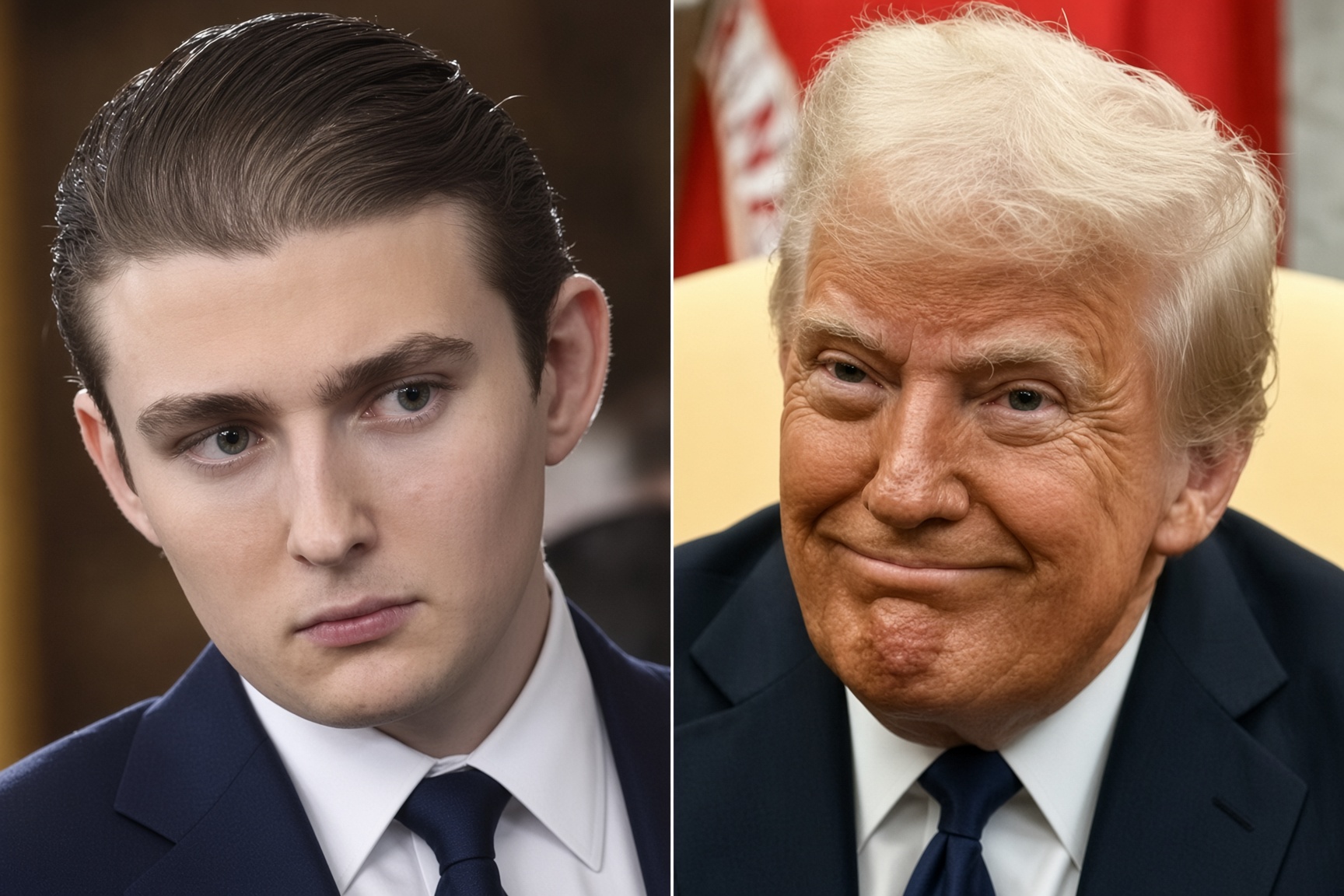
Barron Trump, 20, still draws national attention — not because he seeks it, but because he almost never does.
Whenever his name appears in a headline, the internet reacts as if something dramatic has just happened. Often nothing has. The latest wave of curiosity followed the same pattern that has defined his public life for years: a private young man attached to one of the most visible families in the country, and a media environment that treats rarity as news.
Barron William Trump, born March 20, 2006, in New York City, is the only child of Donald Trump and Melania Trump. He spent part of his childhood in the White House during his father’s first term, then moved to Florida, graduated from Oxbridge Academy in West Palm Beach in 2024, and enrolled that fall at New York University’s Stern School of Business. He later took courses at NYU’s Washington campus and has been described as living closer to family while finishing his sophomore year. He is expected in the class of 2028. Those are the documented facts. Almost everything else that circulates about him is inference.
That gap between name recognition and actual information is the engine. Most children of modern presidents become public figures whether they want to or not. Barron has been unusually insulated. He has given no interviews of note, holds no formal political role, and appears at major events only occasionally — among them his father’s 2025 inauguration and the 2026 State of the Union. When he does appear, photos travel farther than the occasion itself. When he does not, absence becomes its own story.
Why vague headlines work
Digital media rewards uncertainty. A headline that implies a crisis without naming one will be clicked, shared, and argued over before anyone reads a second paragraph. Barron’s name is useful for that purpose precisely because the public has so little to check it against. Commenters say as much themselves: any mention feels larger than the information behind it.
There is a legitimate debate underneath the clicks. Adult politicians choose public life. A 20-year-old student who has never run for office did not. Plenty of people who dislike his father’s politics still argue that Barron should not be treated as content. Others treat the entire family as fair game. The internet does not resolve that argument; it just accelerates whichever version travels fastest.
What is actually public in 2026
The concrete updates of the past year are limited and uneven.
He has begun a small business footprint. In 2026 he was listed as a director of Sollos, a yerba mate beverage brand that launched a pineapple-coconut flavor. Family financial disclosures and reporting have also tied a large share of his reported wealth to the Trump family’s cryptocurrency venture, World Liberty Financial. Those items are business news, not biography. They still became “Barron stories” because almost any commercial move attached to his name is treated as a personality reveal.
Security, not branding, is the more serious recent context. In August 2026, Iranian state-linked media aired a video that named him, displayed locations associated with his public life, and advertised a large bounty. U.S. officials said the Secret Service was aware and investigating. Iranian figures later disputed characterizations of a plot. Reporting since then has described Barron as more reclusive than before — finishing the academic year, spending time with his mother, avoiding routine public outings. That is a security story first. It became a personality story because the public already thought of him as someone who “doesn’t go out.”
A few other episodes have briefly pierced the quiet. In early 2026, British court proceedings described him calling emergency services from the United States after witnessing an assault over a video call, evidence later used in a conviction. He has been photographed at a White House UFC event. Relatives have called him private, close to family, and uninterested in the spotlight. None of that amounts to a public persona. It amounts to fragments.
Privacy as a public performance
The paradox is obvious. The more successfully a famous family shields a child, the more interesting the child becomes to strangers. Barron is recognizable by height, name, and association. He is not recognizable by voice, platform, or stated ambition. People therefore project: that he is the “normal” Trump, the tech-minded one, the future candidate, the recluse, the entrepreneur. Projection fills the space that interviews would occupy.
That is also why criticism of clickbait is only half the story. Audiences complain about manipulative headlines and then click them. Platforms rank engagement, not proportion. A young man who rarely speaks cannot correct the record in real time, so speculation hardens into a kind of unofficial biography.
There is a second, quieter cultural fact. Americans have watched Barron age in public without hearing from him. People who remember a child at inaugural events now see a 6-foot-plus college student. Transitions like that invite narrative even when the person involved offers none. Political families have always been used this way. The difference now is speed. A single post can turn a campus schedule, a product launch, or a security warning into a national conversation before dinner.
What the attention is not
It is not evidence that Barron is entering politics. He declined an at-large delegate role in 2024. Relatives and associates describe business and privacy, not a campaign. It is not proof of a hidden personal crisis every time a headline is vague. And it is not a substitute for the ordinary life of a 20-year-old who happens to live under Secret Service protection.
The honest version of the story is smaller than the traffic it generates. Barron Trump remains a student with family businesses around him, unusual security constraints, and almost no public voice. The country keeps talking about him because silence, attached to a famous surname, is still treated as a plot. Until he chooses otherwise — and he may never — that is likely to stay the pattern: curiosity first, context later, and another reminder that in this media climate, not speaking can be the loudest thing a famous person does.