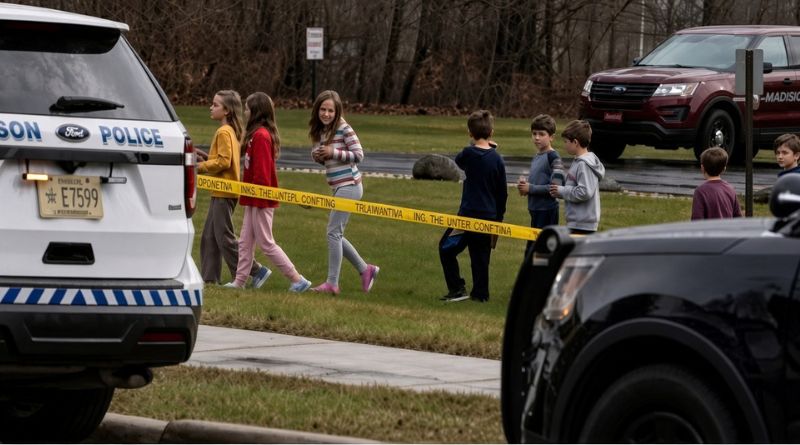
On the evening of November 29, 2025, families gathered at Monkey Space, a banquet hall on Lucile Avenue in unincorporated San Joaquin County just north of Stockton city limits. The occasion was ordinary and intimate: a 2-year-old girl’s birthday. Guests numbered roughly 100 to 150. Cake was about to be cut. Then gunfire tore through the room.
Four people were killed. Three of them were children: Maya Lupian, 8, a third-grader at Aspire Apex Academy; Journey Rose Reotutar Guerrero, 8, a third-grader at Commodore Stockton Skills School; and Amari Peterson, 14, of Modesto, a freshman athlete who played football and basketball. The fourth victim was Susano Archuleta, 21, of Stockton. Thirteen others were wounded. Investigators later said more than 50 rounds were fired from five weapons. The shooting appeared to start inside the hall and continue outside. No shooting suspect has been charged.
The scene that first responders found was the kind that stays with a city. Party decorations, toys, and wrapping paper sat in the same rooms as spent casings and blood. Parents tried to locate children in the panic. Sheriff Patrick Withrow, whose department leads the investigation because the venue sits outside Stockton city limits, later described the attack in blunt terms: people had walked into a child’s birthday party and shot children. “None of us should stand for that,” he said.
Stockton is not unused to violence. The city’s violent-crime rate has long outpaced the statewide average, and gang conflict has shaped public life for years. What stunned residents was the setting. A toddler’s party is supposed to be one of the last places where that history arrives with rifles. Relatives of the dead have said the gathering was meant as a family celebration, not a confrontation. Amari Peterson’s father, Patrick Peterson, who was at the party with his children, later said he did not want to question God—and that losing his son had left him questioning everything about life.
Investigators have treated the shooting as possibly targeted and possibly involving more than one gunman. Officials said known gang members were among the guests. Two men who attended the party were later held on parole-related charges: Luciano Guerrero, 22, for a parole violation tied to a 2024 gang-related conviction, and Billy Lee Williams Jr., 31, who admitted violating parole by being there. Neither has been charged as a shooter in the birthday-party killings. Firearms were recovered on the roof of the hall; authorities have not said those weapons were used in the attack. Detectives have also asked the public about two vehicles they believe are connected to the shooting.
Rewards have piled up. Local offers and a separate FBI reward brought the total well into six figures, at one point reported around $130,000 and higher when federal money was counted separately. Tips have come in. Arrests for the murders have not. In late February 2026, three months after the shooting, the Sacramento Bee reported that no suspects were in custody for the killings and that the district attorney’s office did not yet have a case to prosecute. The sheriff’s office was still working with Stockton police and the state Department of Justice. Commenters on local coverage voiced a familiar fear in cities where retaliation is common: that talking to police can get someone hurt.
The medical aftermath was only the first layer. Trauma teams treated gunshot wounds that ranged from graze injuries—two people later drove themselves to hospitals, raising the wounded count—to critical cases. Pediatric and mental-health specialists were drawn in because so many children had been in the room. Clinicians who work with mass-casualty survivors often describe a second injury that does not show on a scan: the collapse of the assumption that a family party is safe. For children who watched adults fall, that loss of safety can become long-term post-traumatic stress. Families have organized vigils, school memorials, and fundraisers. Stuffed animals and handwritten notes accumulated outside the hall. The objects look small next to the scale of the crime. They are what a neighborhood can still put on the ground.
Stockton’s civic story is larger than one night, and officials have said so. The city has spent years trying to shed a reputation for bankruptcy, vacancy, and street violence and to present itself as a place in remaking. A massacre at a toddler’s party cuts against that pitch. One resident, quoted in national coverage, put the fear in a single sentence: that Stockton would now be known as the place where they shoot kids. That is an unfair summary of a whole city. It is also the sentence families of Maya, Journey, Amari, and Susano have to live beside.
What the public record does not support is the version of events that sometimes circulates in rewritten or generated copy: a sunny February 20 backyard party on a quiet residential street, ten people rushed to trauma centers as a fresh “second-day” investigation, or a national montage that folds the case into unrelated headlines. The shooting was on November 29, 2025, at an event hall, not a private patio. The death toll is four, with thirteen wounded. The case was not solved overnight. It was still unsolved months later. Other 2026 stories—a missing-person investigation in Arizona, political news in New York—are separate files. Mixing them does not make the Stockton deaths more meaningful. It makes the facts harder to hold.
The useful details are narrower and harder. The party was for a 2-year-old. Shots came as cake was about to be served. Multiple weapons were used. Children died in a room decorated for a birthday. Detectives want information on vehicles and on anyone who saw who entered, who left, and who fired. Crime Stoppers and the sheriff’s office have asked the public to call even with fragments: a license plate, a nickname, a phone video from the parking lot.
Justice, if it comes, will not restore the afternoon. It may only name the people who turned a rented hall into a crime scene. Until then the record is this: a celebration in Stockton ended in a mass shooting; four families buried children and a young man; thirteen others carry wounds; and the people who pulled the triggers have not been brought to court. That is the story. It does not need fireworks mistaken for gunfire, or metaphors borrowed from other tragedies, to be grave enough.