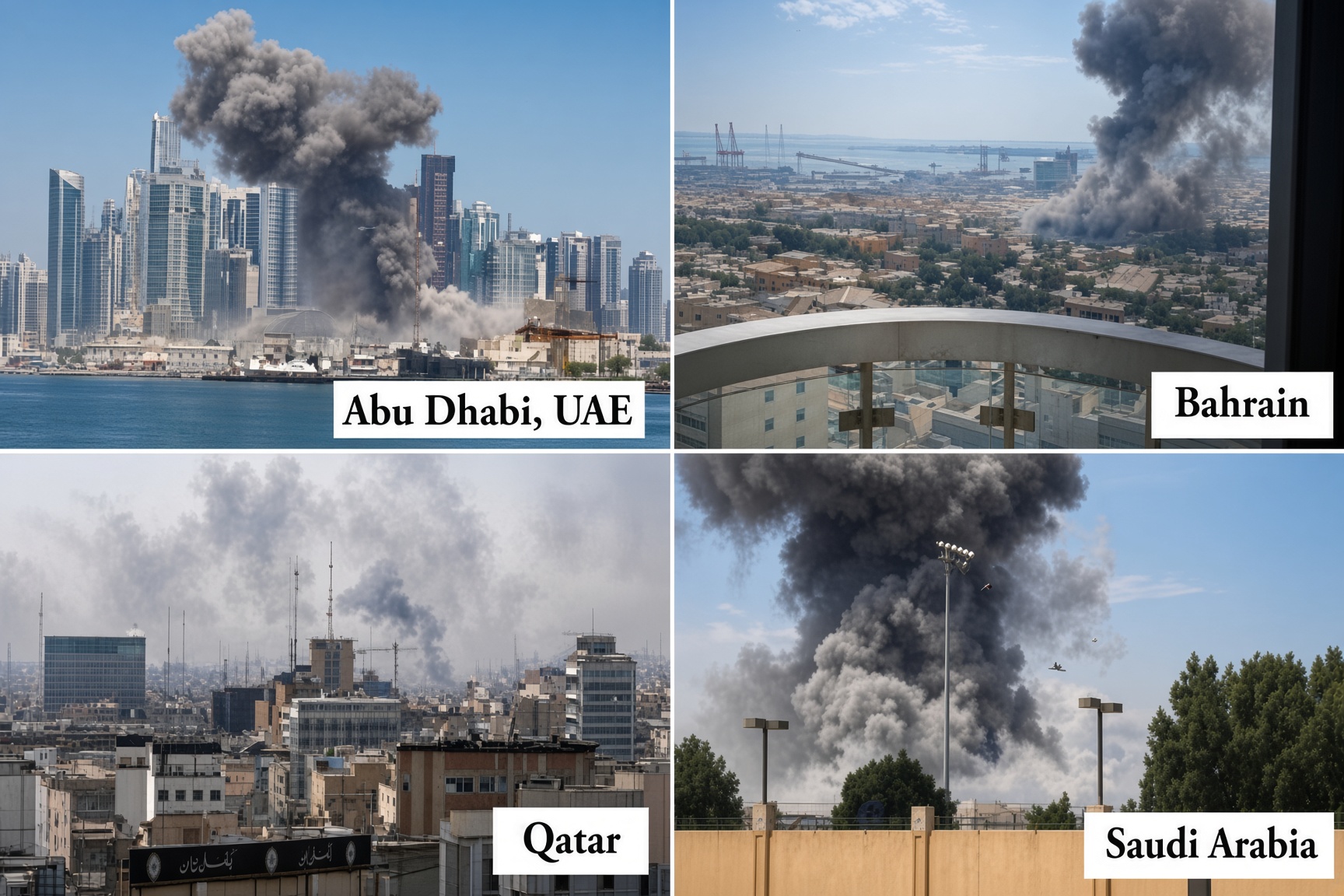
The Persian Gulf has returned to an active war footing after successive Iranian salvos of ballistic missiles and one-way attack drones targeted military sites hosting American personnel across the region. The widening exchanges have pushed Gulf Cooperation Council states to activate integrated air-defense networks and issue emergency public alerts, raising fears that a once-contained confrontation is spreading into a broader regional war.
The strikes show how quickly kinetic operations can jump Iran’s borders and pull the Arabian Peninsula into the fight. The United States maintains a large military presence in Bahrain, Qatar, Kuwait, and the United Arab Emirates. As Tehran has expanded its target list in response to Western pressure and military action, those host nations have seen their airspace and base perimeters become front lines.
Air defenses across the Emirates
In the United Arab Emirates, defense systems went to maximum alert after incoming aerial tracks and retaliatory warnings. UAE multi-layered defenses—including U.S.-supplied Patriot and Terminal High Altitude Area Defense batteries—have engaged hostile inbound threats across successive waves.
The focal point of the Emirati theater is Al Dhafra Air Base, south of Abu Dhabi. The base is a primary hub for the U.S. Air Force’s 380th Air Expeditionary Wing and houses surveillance platforms, multi-role fighter squadrons, and reconnaissance assets central to American command and control.
Iranian commanders have repeatedly claimed hits on logistics nodes and military infrastructure at Al Dhafra. Iranian state media often airs sweeping claims of disruption. Western defense officials and regional monitors have urged caution about unverified battle-damage assessments until structural surveys and satellite imagery can be completed.
American commands in the crosshairs
Tehran’s barrages have reached across the Gulf’s northern and central maritime rim. In Bahrain, sirens have sounded over the kingdom’s core security infrastructure. Manama hosts Naval Support Activity Bahrain, headquarters of the U.S. Navy’s Fifth Fleet and the Combined Maritime Forces, making it one of the most sensitive American defense nodes in the world.
Iranian forces have claimed strikes on several Bahraini facilities tied to American logistics, including Sheikh Isa Air Base. Bahraini defense forces have confirmed engaging aerial threats in recent barrages and have operated in close coordination with American naval assets in adjacent waters.
To the northwest, Qatar’s Al Udeid Air Base—the largest American military installation in the Middle East and the forward headquarters of U.S. Central Command—has faced recurring threats. Al Udeid is the nerve center for regional airspace management and joint air operations. Independent satellite imagery from earlier rounds of strikes showed damage to auxiliary infrastructure, underscoring the persistent risk from Tehran’s inventory of precision-guided munitions.
Kuwait has faced similar exposure. Facilities that support American logistics and troop staging, including Ali Al Salem Air Base, have been placed on heightened readiness as Kuwaiti and U.S. air-defense teams watch radar corridors along the northern Gulf.
Energy chokepoints and maritime risk
Beyond the immediate threat to military personnel, the strike pattern carries serious risks for global energy security.
The fighting sits directly on the Strait of Hormuz, the chokepoint through which roughly 20 percent of the world’s oil consumption moves each day. The threat of aerial debris, coastal missile batteries, and drone swarms has already driven shipping rates higher and prompted major commercial carriers to change routes.
Energy markets remain highly sensitive to Gulf instability. A sustained disruption of tanker traffic or coastal hydrocarbon plants would risk sharp inflationary shocks in global energy prices and add pressure on import-dependent economies.
The logic of uncontrolled escalation
The trajectory across the Gulf is a volatile cycle of attack and response. Washington still holds substantial deterrent power in theater, but host nations face growing operational and political strain as they try to defend airspace against high-volume, low-cost drone swarms and high-velocity ballistic missiles.
For coalition forces and regional partners, immediate priorities remain interception, early-warning verification, and rapid damage control. With every intercepted volley, the margin for error shrinks. A single strike that produces mass casualties on a Gulf installation, or a catastrophic hit on commercial shipping infrastructure, could close remaining diplomatic off-ramps and lock Washington and Tehran into an uncontained regional war.
The host states now occupy an uncomfortable middle ground. They are sovereign partners of the United States and, at the same time, potential targets because they host American forces. Their air-defense networks have performed under pressure, but volume and persistence matter as much as individual intercepts. Iran’s mix of ballistic missiles and cheap one-way drones is designed to saturate sensors, exhaust interceptors, and force difficult choices about what to protect first.
That is why the language of “maximum alert” and public warning sirens has spread so quickly from Abu Dhabi to Manama and Doha. The military problem is no longer only whether a particular base can be hit. It is whether the region can absorb repeated waves without a single successful strike that changes the political calculus on all sides.
For now, the pattern is one of claimed Iranian attacks, active Gulf and American defenses, disputed damage, and rising commercial risk in the Strait of Hormuz. The next phase will be decided less by rhetoric than by whether another volley finds a gap that the last one did not.