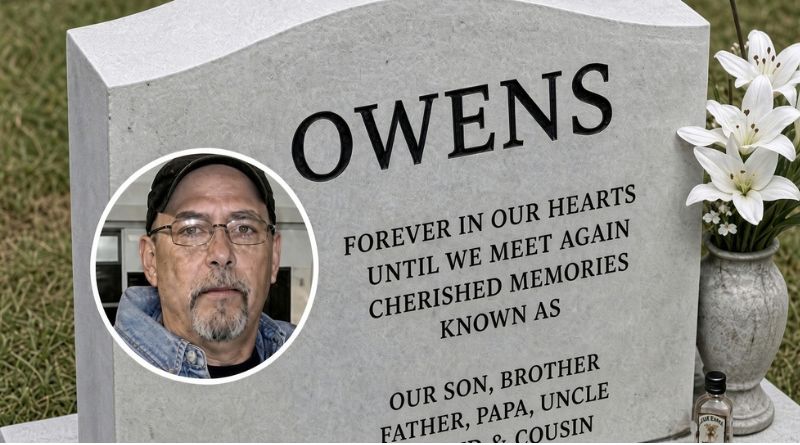
A gravestone meant as a private tribute has become the focus of an unusual dispute after the family of a deceased man incorporated a hidden profanity into the monument’s inscription.
What began as an inside joke between a father and his children has developed into a disagreement with cemetery officials over the limits of personal expression on memorials. The family says the wording was never intended to insult other visitors. Trustees responsible for the grounds say they have an obligation to enforce rules that keep the cemetery an appropriate place for everyone who comes there. The argument has raised a broader question: once words are carved in stone, who decides what they may say?
At the center of the controversy is an acrostic, a form of wordplay in which selected letters from separate words or lines combine to spell a second message. In this case, the arrangement reportedly spells a profanity that is not immediately obvious to someone reading the inscription in the ordinary way. Family members say the hidden wording was deliberate and part of the man’s sense of humor. They treat it as a last private connection between a father and his children, not as an attack on the public.
For grieving relatives, a memorial often does more than record a name and dates. A stone may carry a favorite saying, an unusual expression, or a joke that only the people who knew the deceased will fully understand. That private meaning can be difficult for outsiders to recognize, and harder still to weigh against rules written for a shared place.
Cemetery officials approach the same stone from a different duty. Trustees and operators commonly set rules for monuments, inscriptions, decorations, and other memorial features. Those policies are meant to preserve the appearance of the grounds, keep graves reasonably consistent, and apply the same standards to every family that uses the cemetery. From that perspective, the issue is not mainly what the inscription means to the people who ordered it. It is whether the wording complies with the rules that govern the site.
Officials have reportedly discussed removing or altering the disputed inscription. The family has resisted. The standoff sets two interests against each other: the relatives’ wish to keep a personal tribute intact, and the cemetery’s responsibility to enforce its standards without making an exception that later cases could cite.
The dispute is sharper because the controversial wording is deliberately concealed. A visitor who reads the epitaph line by line may never notice the second message. Supporters of the family can argue that a hidden joke, known mainly to the people it was written for, should not be treated as a public provocation. Cemetery officials can answer that concealment does not erase the words, and that an exception for clever wording would make consistent enforcement harder the next time a family tests the boundary.
A gravestone is deeply personal to the household that commissions it, and it is also permanently displayed where members of the wider community walk. A message relatives consider affectionate or funny may strike another visitor differently, especially if it uses language the cemetery’s rules do not allow. Grief does not remove that tension. It explains why both sides feel the stakes are higher than a single phrase.
Memorials exist to preserve memory, but they also sit inside physical spaces governed by regulation. Families often buy or lease a burial plot under an agreement that already limits what may be placed there: the size and material of the stone, the style of lettering, the kinds of decorations permitted, and sometimes the content of the inscription itself. Those terms are easy to overlook in the days after a death, when the priority is arranging a funeral and choosing words that feel true. Months or years later, when a monument is set and the wording is questioned, the agreement can become the document both sides turn to.
If the family and the cemetery cannot settle the matter between themselves, legal questions could follow. They would likely turn on the cemetery’s regulations, the contract for the plot and monument, and the extent of the operator’s authority over inscriptions once a stone has been approved and installed. Outcomes in such cases depend heavily on the specific rules and on what was agreed before the monument was cut. A cemetery that reserved the right to reject or alter wording may stand on firmer ground than one that approved the inscription and only later objected. A family that can show the hidden message was disclosed, or that the rules say nothing about acrostics or concealed wording, may have a different argument. None of that is settled here. At this stage the dispute is best understood as a conflict between personal remembrance and institutional standards, not simply as an argument about profanity.
The attention the case has drawn comes from that unusual mix of humor, grief, and rules. For the family, changing the inscription could mean removing a part of the tribute they made for someone they loved. The hidden message may stand for memories that a conventional epitaph would not carry. For cemetery officials, the memorial exists in a shared environment where standards have to be applied across many graves and many families. Allowing one concealed profanity, they can argue, invites the next family to test how far an inside joke may go.
Neither view can be separated cleanly from the emotion of the situation. People visiting a parent’s grave are not drafting a policy. Trustees walking the grounds are not only enforcing a clause; they are also answering to other mourners who expect the cemetery to feel orderly and respectful. The same stone can be a private joke and a public object at once.
That dual character is what makes the question durable. When a final message is literally carved in stone, the family that knew the person may feel it has the strongest claim on the words. The institution that maintains the ground may feel it has the duty to decide what remains visible to everyone else. Until those claims are reconciled, the inscription sits between a private tribute and a rule book, and the argument over who gets the last word continues.