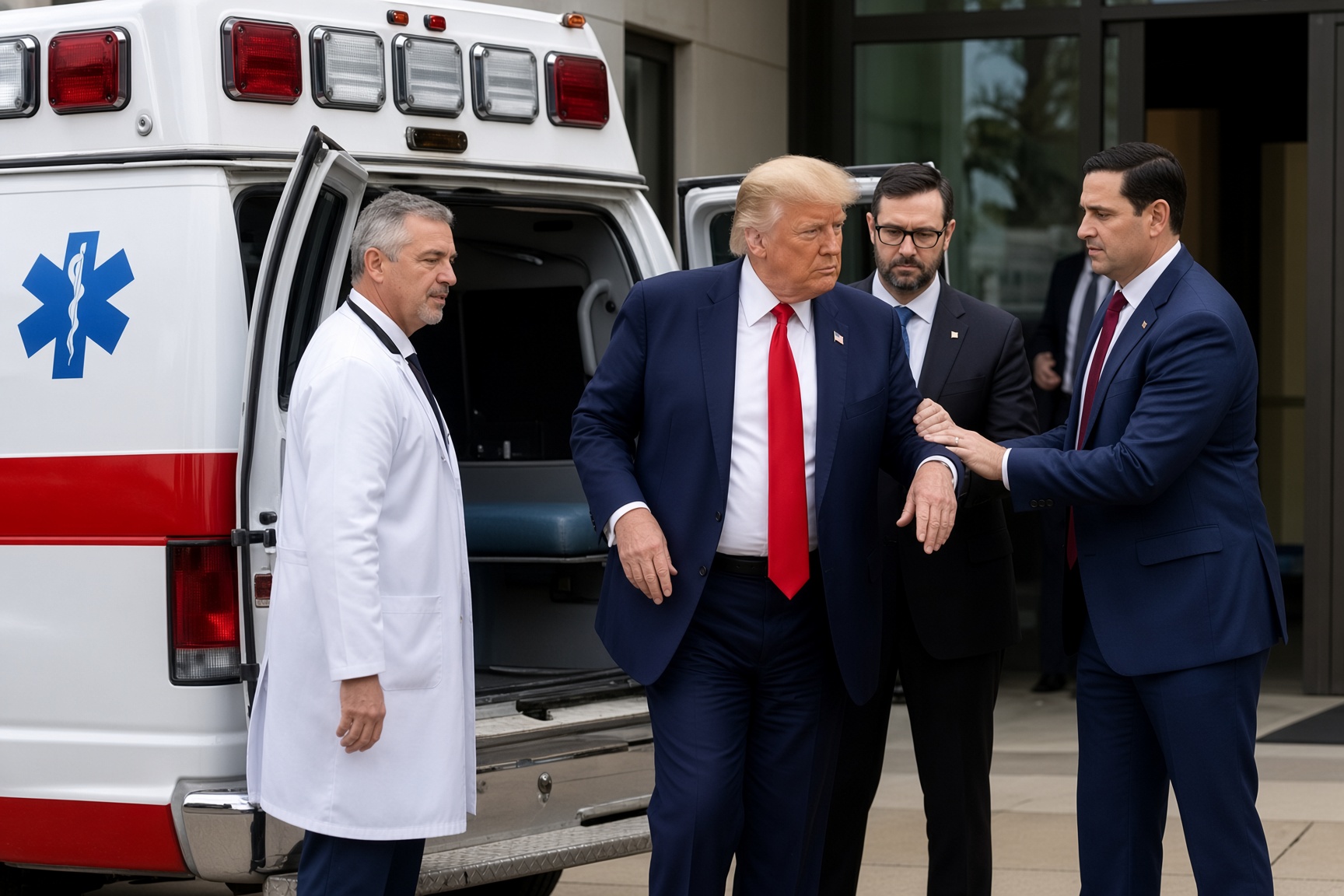
A short video circulating online shows a tightly framed arrival outside a building labeled Walter Reed. A white ambulance with red and blue markings is parked flush against the entrance, its rear doors open wide. A man in a white coat stands on the pavement and steadies Donald Trump as he steps down from the vehicle’s rear platform. Trump, wearing a dark blue suit and a bright red tie, moves carefully, testing the step before placing his full weight on the concrete.
Two men in dark suits close in immediately. One takes Trump’s arm, not pulling but providing a fixed point while he finds his balance. The doctor remains planted, guiding him off the last edge of the platform and onto level ground. Once both feet are down, Trump steadies himself, turns toward the glass doors, and the circle of aides tightens around him. The pace is measured. One aide keeps a hand at Trump’s back; another releases his arm once he is walking on his own. The group stays compact as the doors open and the party crosses the threshold into the lobby. The camera, set slightly low, pans with them until they are nearly inside. No speech is audible. The clip lasts only a few seconds.
The building is modern, with large windows, clean lines, and brickwork meeting glass. A blue sign above the entrance reads “WALTER REED” in bold white letters. Daylight is even. Other figures stand faintly near the doors. The ambulance does not move; its open rear and red side stripe remain visible as the group disappears inside.
What the footage emphasizes is procedure: who stands where, who offers a hand or an arm, how the step from vehicle to pavement is managed, and how the short walk to the doors is paced. Trump’s hair and red tie make him immediately recognizable. The white coat isolates the medical figure against the dark suits. The open ambulance and the hospital name supply the setting the images themselves do not explain.
Viewers should treat the clip as a depiction, not as verified news. Similar videos circulated in 2026 with the same hospital setting and the same claim of an unannounced visit. Fact-checkers examining those recordings found mismatched signage, lettering that became unreadable on close inspection, and AI watermarks. Walter Reed stated that the markings visible in the footage did not match the facility. The White House denied that any hospitalization of that kind had occurred.
By contrast, Trump’s 2020 stay at Walter Reed for COVID-19 treatment was real and publicly documented. Arrival and departure were filmed by news cameras as part of a motorcade using the hospital’s front doors, not as a quiet step-down from an open ambulance of the kind shown here. That episode involved known medical care, public statements, and a visible return to the White House; the 2026 clips offered none of those confirming details.
The recording ends as the group disappears inside and the ambulance is left in the frame. The scene is short, quiet, and built around a single transition—vehicle to pavement to door. Its visual clarity and the recognizability of its central figure account for much of its circulation, yet the absence of independent confirmation, the discrepancies noted by fact-checkers and the hospital, and the White House denial remain the decisive context. In the absence of corroborating records or contemporaneous official acknowledgment, the footage stands as an unverified depiction rather than evidence of an actual event.