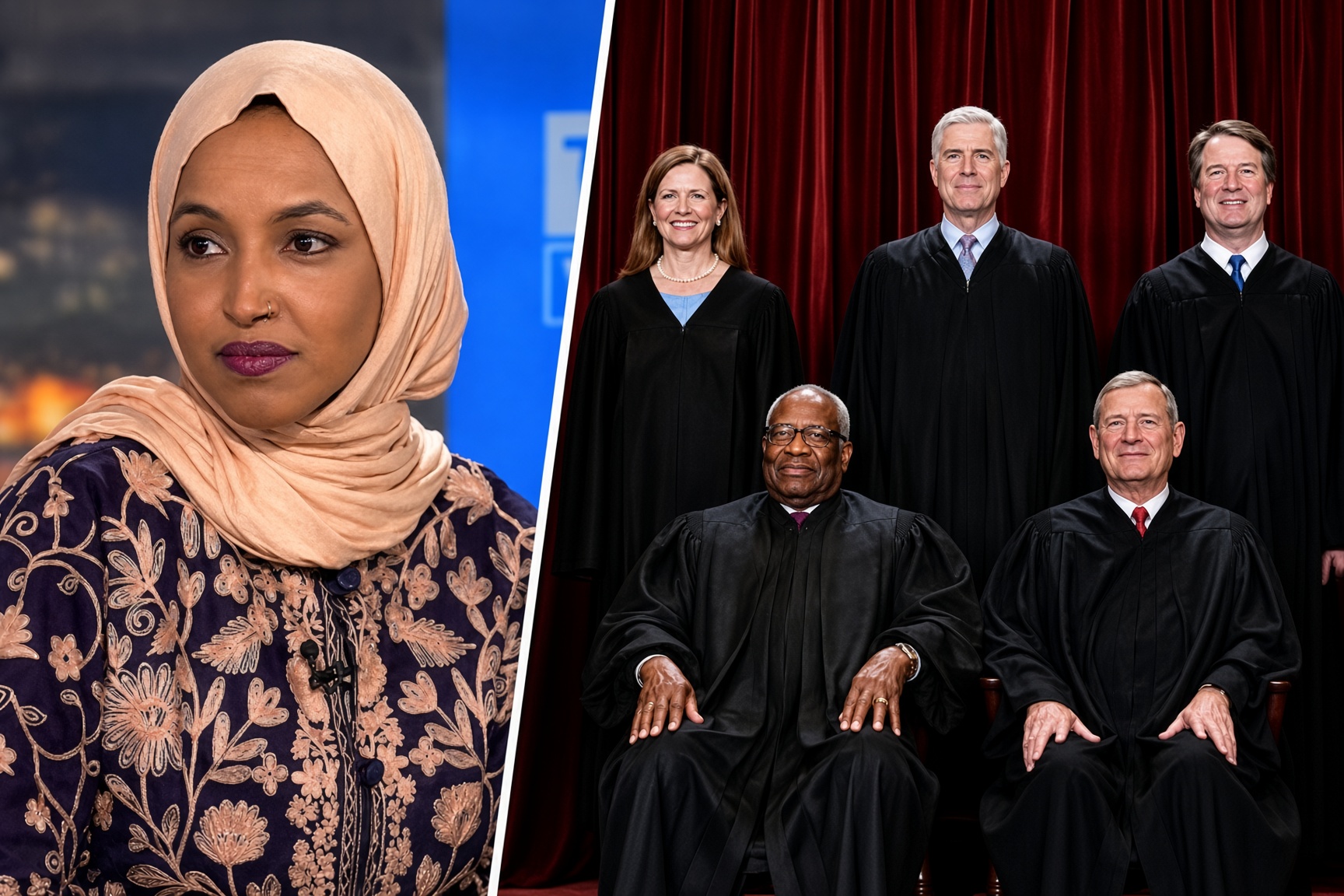
President Donald Trump’s renewed calls to remove Democratic Rep. Ilhan Omar from Congress have intensified scrutiny of a federal investigation into her citizenship status, raising the prospect of an unprecedented constitutional confrontation over congressional qualifications.
“Let’s get her the Hell out of there,” Trump said Monday during an appearance in Mississippi, referring to the Minnesota lawmaker. The president has repeatedly demanded Omar’s departure while citing longstanding, unproven allegations concerning her immigration history and a prior marriage. The president cannot unilaterally remove a member of Congress; any effort to unseat her would depend on constitutional procedures and, potentially, the federal courts.
The dispute centers on a Justice Department inquiry examining whether Omar improperly obtained U.S. citizenship through immigration paperwork connected to her late father. Homeland Security Investigations agents searched Omar’s Washington, D.C., residence on October 12 after securing a court-authorized warrant. Agents seized her cellphone, computers, notebooks, and passport. Investigators have also subpoenaed relatives and reviewed naturalization records as they assess whether her citizenship could be revoked. Omar, who was born in Somalia, arrived in the United States as a refugee and became a naturalized citizen in 2000. She has repeatedly denied any immigration fraud. Federal authorities have neither charged her nor established that she obtained citizenship unlawfully.
Omar has also denied separate allegations that her former husband, Ahmed Nur Said Elmi, is her brother or that their marriage involved immigration fraud. Those claims remain unproven.
The constitutional stakes are significant. Article I requires House members to be at least 25 years old, citizens of the United States for at least seven years, and inhabitants of the states they represent at the time of election. That citizenship requirement could become decisive if authorities obtain a court judgment revoking Omar’s naturalization.
Legal experts say the case could test issues not fully resolved by the Supreme Court’s 1969 decision in Powell v. McCormack. In that case, the House refused to seat Democratic Rep. Adam Clayton Powell Jr. after allegations involving the misuse of congressional funds and payroll practices. The Court held that Congress may not exclude a duly elected member who meets the qualifications explicitly set forth in the Constitution.
Former Deputy Assistant Attorney General John Yoo has argued that the ruling could actually support congressional action if Omar were legally determined not to be a citizen. “Powell essentially means that Congress cannot add on to the minimum qualifications set out in the Constitution,” Yoo told Fox News Digital. Because citizenship is itself one of those qualifications, he said, Congress could enforce it if Omar were found not to satisfy the requirement.
Constitutional scholar Cully Stimson has emphasized the distinction between excluding a candidate who lacks constitutional qualifications and expelling an already seated member for misconduct. That distinction could prove especially important if Omar wins reelection and the citizenship investigation remains unresolved when the new Congress convenes.
One potential path would involve House Republicans challenging Omar’s eligibility to be seated if authorities produce evidence undermining her citizenship. Such a challenge would almost certainly generate litigation over the evidence, the proper procedures, and the scope of congressional authority. The alternative would be to seat her and then pursue expulsion, which under Article I requires a two-thirds vote of the House.
Republican Florida Rep. Randy Fine has already indicated he would move for expulsion if investigators establish immigration fraud or citizenship problems. “I absolutely will demand expulsion immediately,” Fine said. Expulsion presents a different constitutional question; the Supreme Court has never directly ruled on the outer limits of Congress’s power to expel its own members. The Constitution expressly grants each chamber the authority to expel members by a two-thirds vote. The 2023 expulsion of former Republican Rep. George Santos could become relevant, as some of the misconduct examined by the House originated before his election. Stimson noted that lawmakers could potentially argue that any immigration-related misrepresentations continued after Omar entered Congress, drawing parallels to arguments advanced in the Santos proceedings.
Separately, Omar faces an ongoing investigation into her financial disclosures and businesses associated with her current husband, Timothy Mynett.
Any attempt to remove Omar would mark a rare and highly contested use of Congress’s constitutional powers. With the citizenship inquiry still active and no charges filed, the outcome remains uncertain—and likely to be resolved, at least in part, in federal court.