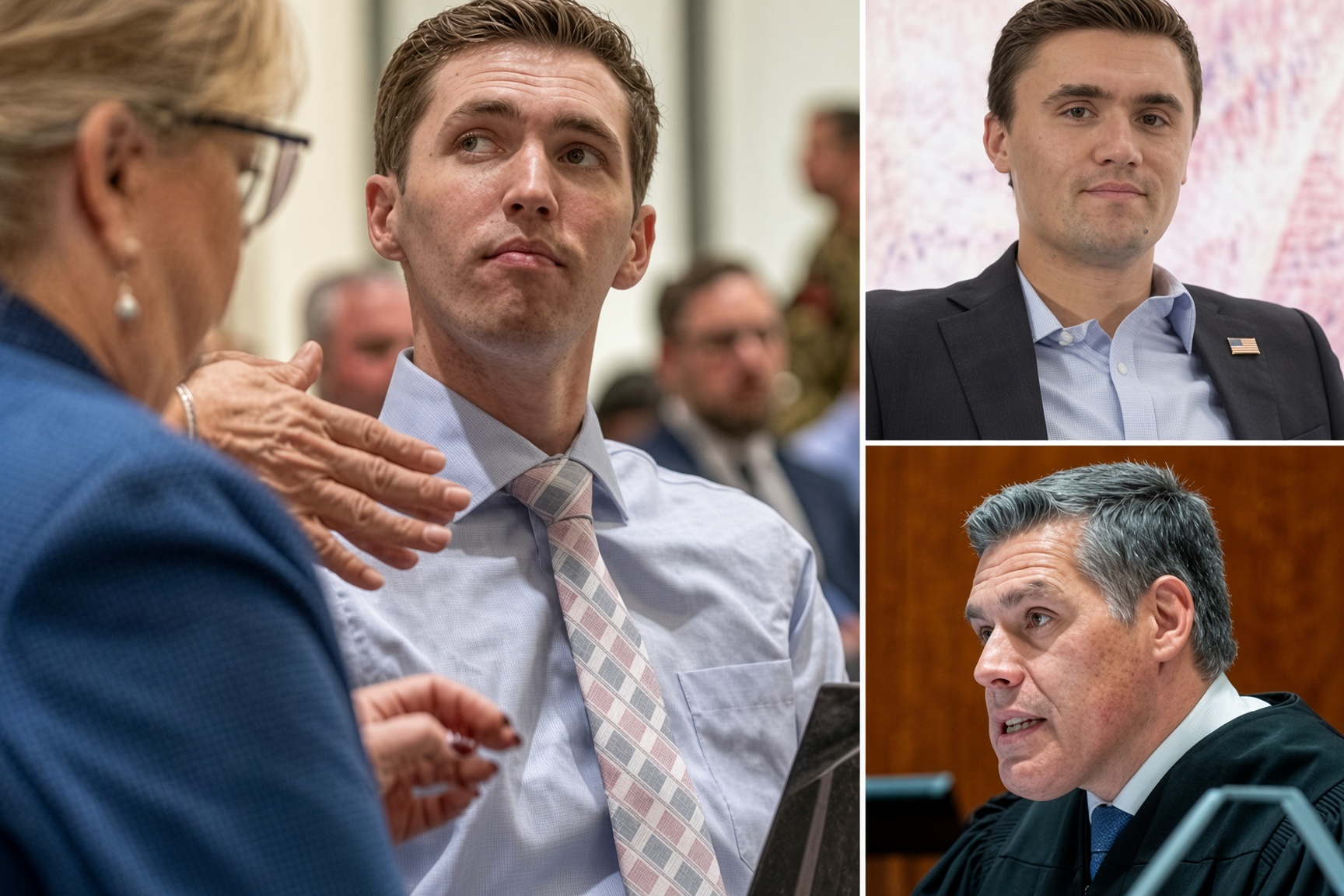
A Utah County judge ruled Friday that Tyler Robinson remains eligible for the death penalty if convicted of aggravated murder in the September shooting of conservative commentator Charlie Kirk. Judge Tony Graf Jr. also held Deputy Utah County Attorney Christopher Ballard in civil contempt for certain public statements about the strength of the evidence, while rejecting the defense’s request to remove capital punishment as a potential sentence.
Robinson has been charged in the case and is being held in jail. He has not yet entered a plea. Under Utah procedure, he is not expected to do so until after his preliminary hearing, which is scheduled to last approximately one week in early July. Robinson is expected to appear by video from jail for upcoming proceedings.
The ruling stems from a defense motion arguing that prosecutors violated a gag order and other court rules through media statements. Prosecutors countered that they were responding to what they described as a misleading characterization in a defense court filing. That filing, according to prosecutors, contributed to viral news coverage suggesting the Bureau of Alcohol, Tobacco, Firearms and Explosives (ATF) could not link the bullet that struck Kirk to the rifle authorities say Robinson used—his grandfather’s firearm.
Court records indicate the ATF’s toolmark analysis on the bullet fragment recovered from Kirk was inconclusive. Examiners said they could not determine whether the fragment was fired from the rifle in question. Prosecutors noted, however, that the caliber of the recovered fragment matched the rifle and that a spent casing found at the scene matched casings associated with the weapon. They argued that neither the gag order in Robinson’s case nor general state court rules prohibited them from correcting what they viewed as an incomplete or misleading public characterization of the ballistic evidence.
Judge Graf found that prosecutors were within their rights to address the ballistic issue. He ruled that Ballard was not in contempt for those specific comments. However, the judge determined that Ballard crossed a line in at least one interview by expressing confidence in the overall strength of the evidence against Robinson and, in the judge’s view, improperly offering an opinion on the defendant’s guilt. That finding formed the basis of the civil contempt ruling.
Graf rejected the defense’s proposed remedy of barring the death penalty. Instead, he indicated he would expand the jury selection process to help ensure an impartial jury, addressing any potential prejudice from the public statements.
The dispute has produced a series of sharply worded exchanges between the sides. Prosecutors have accused the defense of using court filings to release information they consider misleading. The defense has accused prosecutors of showing “hubris” by discussing the case in media interviews despite the gag order. Robinson’s legal team has also unsuccessfully sought to restrict cameras from the courtroom; Judge Graf previously denied that request, and last week he denied a defense motion to stay the case while that ruling is appealed.
Separately, prosecutors recently disclosed that Lance Twiggs, a 22-year-old former roommate of Robinson, has been granted limited use immunity for statements he made during a recorded interview with prosecutors on April 20. Twiggs, described in court filings as a former roommate and romantic partner of Robinson, previously spoke with investigators after the September shooting. According to prosecutors, during the April interview Twiggs reiterated earlier statements that Robinson admitted to carrying out the shooting, said he had concealed the firearm afterward, disposed of clothing connected to the incident, and instructed Twiggs not to speak with law enforcement.
Prosecutors have indicated that portions of Twiggs’s recorded interview, along with text messages exchanged between Twiggs and Robinson, may be introduced at the preliminary hearing. They opposed a defense request to compel Twiggs to testify in person at that hearing, arguing that his appearance was unnecessary because investigators already possess the recorded statement and the messages. The limited use immunity generally means the contents of the April interview cannot be used against Twiggs in future criminal proceedings against him.
The preliminary hearing is expected to cover multiple days. Prosecutors have said they may present the Twiggs materials as part of their showing of probable cause. Robinson’s defense has not yet tested the allegations at trial or through a full evidentiary hearing. The case has moved forward in recent weeks with a series of procedural rulings, including the death-penalty eligibility decision and the denial of the stay related to courtroom cameras.
Judge Graf’s Friday order leaves capital punishment available as a sentencing option if Robinson is ultimately convicted of aggravated murder, while imposing a narrower sanction on the prosecutor’s office for the statements deemed to violate the gag order. Expanded jury selection is intended to mitigate any impact of the public discussion of the case. The preliminary hearing in early July is the next major scheduled proceeding, at which the state will seek to establish probable cause and Robinson is expected to enter a plea afterward.