James Fishback, the investment executive who mounted a long-shot bid in Florida’s 2026 Republican gubernatorial primary, has announced he will seek the presidency in 2028.
Fishback entered the Florida race in November 2025, positioning himself as a conservative outsider emphasizing affordability for working families and tighter immigration enforcement. He founded the investment firm Azoria and launched Incubate Debate, a nonprofit focused on student debate programs. During the gubernatorial campaign, his platform included proposals to curb corporate purchases of single-family homes, restrict employment-based visas, eliminate property taxes, and block new data-center development. Those stances set him apart from other Republicans competing to succeed term-limited Gov. Ron DeSantis.
President Donald Trump endorsed U.S. Rep. Byron Donalds in the primary rather than Fishback. The field also included Lt. Gov. Jay Collins and former House Speaker Paul Renner. In the August Republican primary, Donalds won decisively with 796,267 votes, or about 47.9 percent of the ballots cast. Fishback finished with 173,575 votes, roughly 10.4 percent, while Collins took second place with approximately 25.1 percent in the multi-candidate contest. Fishback’s campaign website has since noted that the Florida election is over while signaling that another political chapter is beginning.
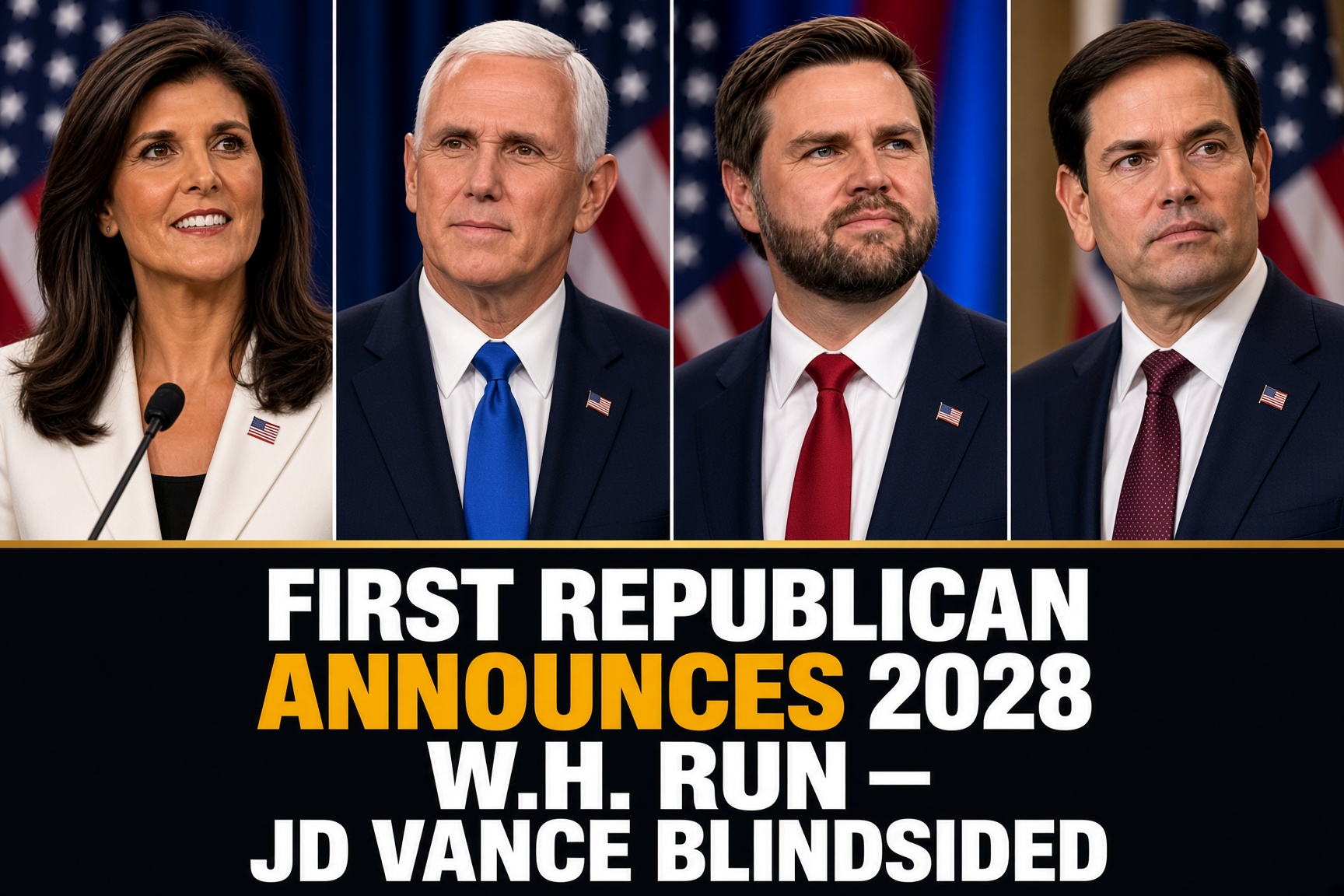
The announcement comes as early national polling sketches a still-fluid picture of the 2028 race, more than two years before the first primary contests. A New York Times/Siena University survey released this week shows clearer consolidation on the Republican side than among Democrats. Among Republican primary voters, Vice President JD Vance led with 33 percent support. Secretary of State Marco Rubio placed second at 23 percent. Together the two figures associated with the Trump administration drew 56 percent. President Trump himself registered 8 percent when listed as an option, even though the 22nd Amendment bars anyone from being elected president more than twice. Florida Gov. Ron DeSantis received 3 percent, and 26 percent of Republican respondents said they were undecided.
On the Democratic side, the same poll found 45 percent of primary voters undecided about whom they would support if the contest were held today. Former Vice President Kamala Harris was the most frequently named candidate at 12 percent, followed by California Gov. Gavin Newsom at 9 percent. Former Transportation Secretary Pete Buttigieg drew 7 percent, Rep. Alexandria Ocasio-Cortez of New York 6 percent, Georgia Sen. Jon Ossoff 4 percent, and Arizona Sen. Mark Kelly 3 percent. An additional 15 percent of Democratic respondents volunteered a name outside the listed field, underscoring how unsettled the party’s potential field remains.
Vance’s early lead is consistent with other national surveys conducted in 2026. An October Focaldata poll for the Financial Times, for example, showed Vance at 38 percent among likely Republican primary voters, Rubio at 24 percent, DeSantis at 9 percent, and Donald Trump Jr. at 7 percent. The Times/Siena results suggest Rubio currently represents Vance’s strongest potential competition among Republicans, though both remain members of the Trump administration and neither has formally entered the 2028 race. Trump has praised both men when asked about the party’s future, prompting speculation that an eventual endorsement could shape the contest.
The poll offers only an early snapshot. No major-party primary campaign is formally underway, and the eventual fields could look substantially different by the time candidates begin announcing. Republican voters appear more settled around figures close to the current administration, while a large plurality of Democratic primary voters have yet to coalesce around any single candidate. Harris’s 12 percent showing in the Times/Siena survey is weaker than her support in several other national polls taken earlier in the year, illustrating how fluid preferences remain on the Democratic side.
Fishback’s decision to enter the national conversation adds another name to a Republican field that, according to current surveys, is already narrowing around Vance and Rubio. Whether his outsider message on housing costs, immigration, and taxes resonates beyond Florida will depend on how the race develops and whether established figures formally launch campaigns. For now, the polling indicates that Republican primary voters have identified clear early frontrunners, while Democrats are still searching for one.