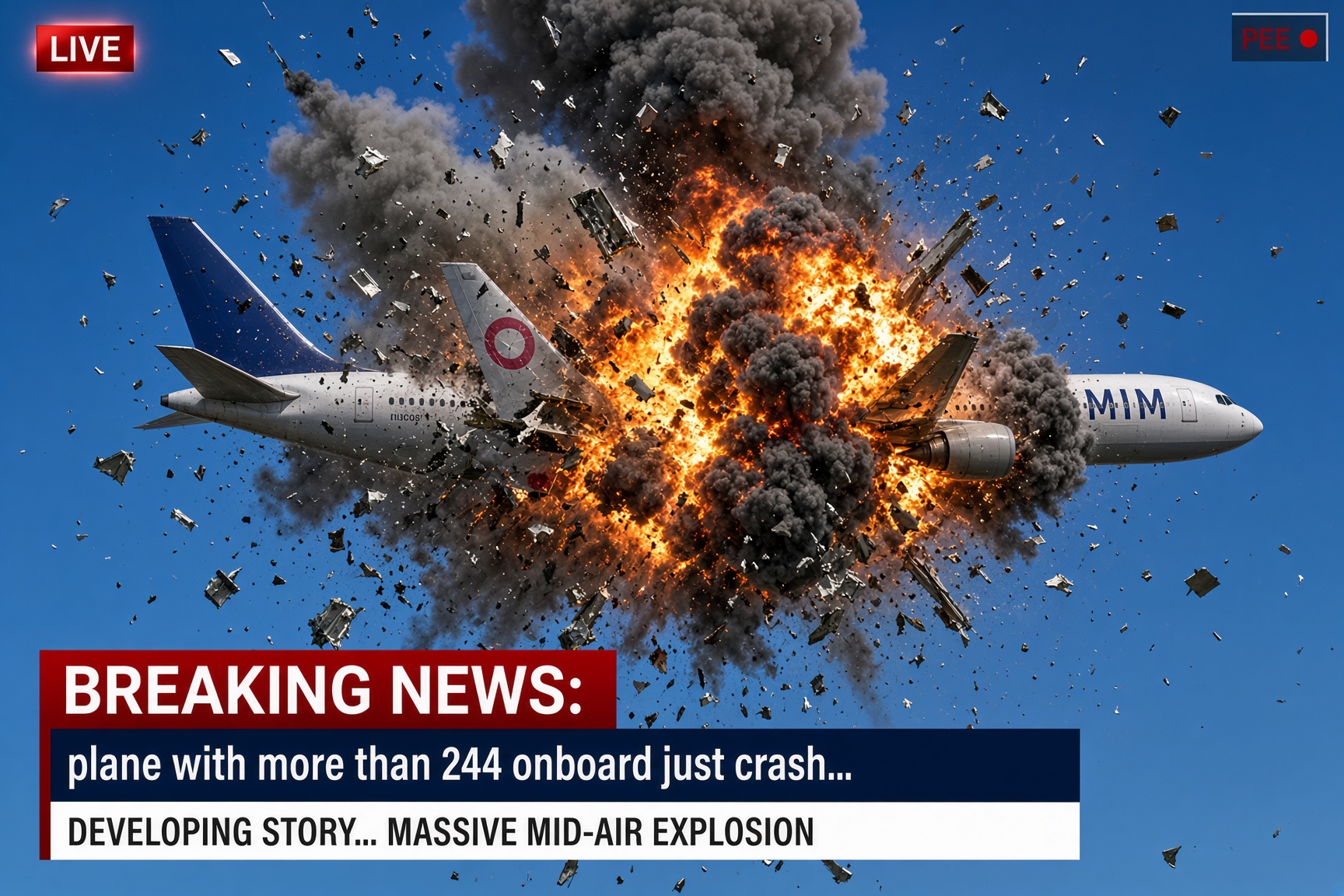
NEW DELHI — Emergency crews launched a large-scale response after a passenger aircraft crashed shortly after departing an airport in the capital, drawing firefighters, medical teams, rescue specialists and law-enforcement personnel to the site while authorities worked to determine what had occurred and account for everyone on board.
Early indications suggested the aircraft went down soon after takeoff, producing a broad emergency operation in the surrounding area. Smoke and flames were reported near the wreckage as first responders moved to secure the perimeter, search the debris field and assess whether any passengers or crew had survived. Officials cautioned that details released in the first hours of an aviation disaster frequently shift as investigators collect evidence and reconcile airline records with information from airports, hospitals and response agencies.
Exact figures for the number of people aboard, casualties and the condition of any survivors remained unconfirmed pending official verification. Firefighters arriving at a major aircraft accident scene confront intense heat, aviation fuel, unstable sections of the fuselage, damaged structures and scattered debris. Rescue teams must proceed methodically while searching for individuals who may be trapped inside the wreckage or thrown clear of the main impact zone. Medical personnel stood ready to triage the injured and arrange rapid transport to hospitals.
In the opening hours of such an event, conditions are often chaotic, especially when the aircraft is carrying a large number of passengers. Hospitals across the region can activate mass-casualty protocols to prepare for a sudden influx of patients, coordinating with emergency agencies to open treatment areas and ensure the most seriously injured receive immediate care. At the same time, authorities typically establish controlled perimeters around the crash site. Restricting public access protects bystanders, allows crews to operate safely and helps preserve evidence that may later prove essential to determining the sequence of events.
One of the most urgent tasks is establishing precisely who was aboard. Airlines maintain passenger manifests, yet confirming the status of each person requires cross-checking those records against airport data, identification documents, hospital admissions and reports from responders. The process can take considerable time. Officials also work directly with families to supply verified information rather than relying on incomplete or circulating accounts.
For relatives waiting to learn the fate of a loved one, the period immediately after an aviation disaster is especially difficult. Unconfirmed reports, images and casualty estimates can spread rapidly online, while preliminary numbers often change as search and recovery continue. Authorities commonly urge the public to refrain from sharing unverified passenger lists, photographs or claims about survivors and fatalities. Identification work must be handled with care, particularly when injuries are severe or the destruction is extensive.
Once the immediate emergency phase advances, investigators turn to reconstructing how the accident occurred. Aviation accident inquiries are typically comprehensive and may involve multiple agencies. Teams examine flight-data recorders, cockpit voice recorders, air-traffic-control communications, maintenance history, weather data and operational records. They also inspect engines, flight-control systems, electrical components and structural remains. The distribution and condition of the wreckage itself can yield important clues about the aircraft’s speed, altitude, trajectory and configuration in its final moments. Witness accounts, radar tracks and airport surveillance footage frequently form part of the evidence base.
Definitive conclusions are rarely available in the earliest stages. Major aviation accidents are often complex events in which mechanical issues, human factors, weather, airport conditions, air-traffic management or other elements may interact. Preliminary speculation should not be treated as an official finding. Investigators document the locations of major components, analyze impact patterns and collect material that can help establish the sequence of events. Even when an aircraft is heavily damaged, recorders may still yield data on performance and crew actions before impact. Maintenance records—prior inspections, repairs, component replacements and reported issues—also receive close scrutiny, as do weather conditions and airport operations when they appear relevant.
While technical work proceeds, families and friends face the most immediate personal consequences. Family assistance centers are often established to provide information, transportation, counseling and other support. Airlines and government agencies typically coordinate to help relatives navigate identification processes and receive confirmed updates. The emotional strain can be severe when information remains incomplete for hours or longer. Officials are expected to release verified updates while avoiding premature conclusions.
Conflicting accounts are common in the early period, particularly on social media. Images and video may circulate before authorities confirm their timing or location, and unofficial casualty figures may not have been independently verified. Such material should be treated with caution until responsible authorities confirm it.
Determining the cause of a major aircraft accident is seldom an immediate process. Investigators must gather physical evidence, analyze technical data, interview witnesses and reconstruct the chain of events. Depending on the complexity of the case, the inquiry can continue for months or longer. The objective extends beyond assigning responsibility. Investigators also seek to identify safety deficiencies and contributing factors that can be addressed through changes in aircraft design, maintenance practices, pilot training, airport procedures, air-traffic management or other systems. Findings from a major investigation can therefore influence regulations and procedures intended to reduce the risk of similar accidents in the future.
For the moment, authorities remain focused on the immediate priorities: searching the site, treating the injured, identifying those who were aboard and supporting affected families. The circumstances that led to the crash remain under investigation, and early reports should not be regarded as a final account. As emergency crews continue their work and investigators begin reconstructing the flight’s final moments, additional information is expected once it has been verified.
Until then, the most reliable picture of the disaster will come from evidence collected at the scene, official passenger records, emergency response agencies and aviation investigators. For families awaiting answers, the investigation is more than a technical exercise. It is the process through which authorities will ultimately establish what happened to their loved ones and determine what lessons can be drawn from one of aviation’s most serious emergencies.