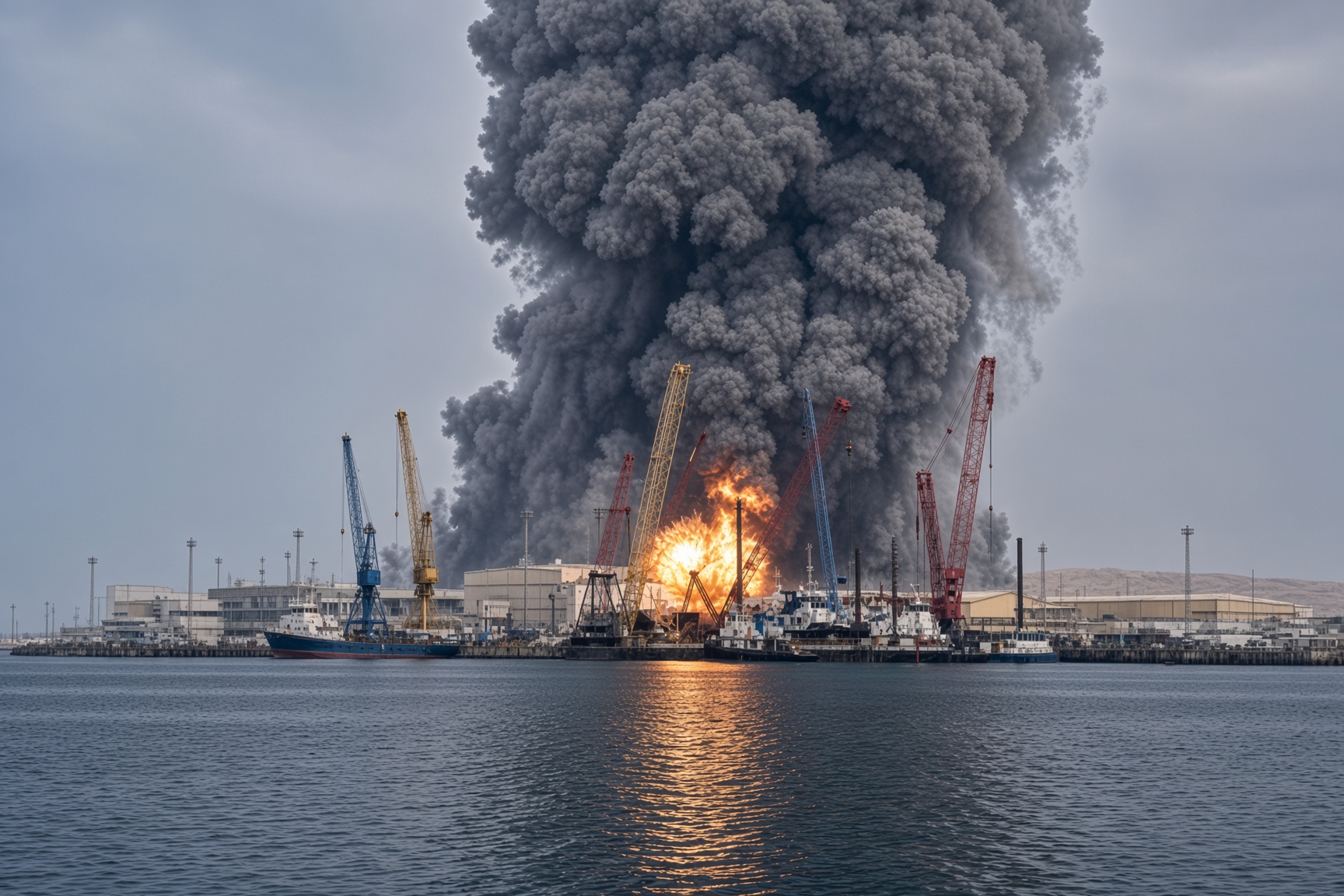
MANAMA, Bahrain — The Persian Gulf has again shifted onto an open war footing after Iranian forces launched coordinated, multi-axis salvos of medium-range ballistic missiles and one-way attack drones against strategic installations hosting United States military personnel across the region. The bombardment forced allied Gulf capitals into emergency defensive postures, triggered continuous surface-to-air missile engagements, and set off civil-defense alerts in communities already prepared for further escalation.
The offensive marks a clear breakdown of localized containment. What had previously unfolded through covert maritime skirmishes and limited border friction has expanded into an overt, theater-wide campaign. Washington maintains a broad military presence distributed across Bahrain, Qatar, Kuwait, and the United Arab Emirates. As Tehran accelerates asymmetric retaliation, those forward installations and the sovereign nations that host them have been drawn directly onto the tactical front line.
In the United Arab Emirates, audible detonations and low-altitude intercepts were reported near major urban centers as regional early-warning networks tracked incoming tracks. Emirati air-defense units operating layered batteries that include the Terminal High Altitude Area Defense (THAAD) system and Patriot PAC-3 platforms moved to engage projectiles that entered national airspace. Particular attention focused on Al Dhafra Air Base south of Abu Dhabi. The sprawling compound functions as a critical logistics and tactical hub, housing U.S. Air Force reconnaissance wings, airborne early-warning squadrons, and aerial refueling tankers. Iranian state media has repeatedly claimed high-impact strikes against American infrastructure at the base. Western defense analysts and regional authorities have urged caution, stating that firm conclusions about runway disruption, command-node damage, or structural integrity require independent commercial satellite imagery and certified post-strike assessments.
The Kingdom of Bahrain, located at the geographic center of the Gulf littoral, remains under exceptional operational strain. The island hosts Naval Support Activity Bahrain, the operational headquarters for U.S. Naval Forces Central Command and the U.S. Fifth Fleet. That command oversees allied maritime security missions spanning the Persian Gulf, the Red Sea, and the Arabian Sea. Together with airfield operations at Shaikh Isa Air Base, Bahrain constitutes the strategic nerve center of American naval deterrence in the Middle East. Its prominence makes it a recurring target whenever Tehran broadens retaliatory operations. During the recent salvos, Bahraini ground-based missile defenses, working in tandem with forward-deployed U.S. Navy Aegis guided-missile destroyers patrolling offshore, engaged multiple inbound targets, producing visible intercept plumes over coastal areas.
Farther north on the Qatar peninsula, Al Udeid Air Base faced a comparable state of alert. As the forward operating headquarters for U.S. Central Command (CENTCOM) and host to the Combined Air Operations Center (CAOC)—the facility that coordinates combat and surveillance aviation across the Central Theater—Al Udeid ranks among the Pentagon’s most sensitive overseas assets. Independent satellite imagery from earlier skirmishes had already shown localized fragmentation damage to external support infrastructure at the perimeter. Coalition personnel were again ordered into reinforced subterranean shelters as surface-to-air interceptors launched across the night sky.
Kuwait has likewise seen its territory drawn into the missile corridor. Domestic interceptor batteries conducted active engagements against low-flying drones and ballistic trajectories directed near logistics staging areas that support U.S. Army Central operations and heavy prepositioned equipment. The coordinated strikes highlight a stark reality for Gulf Cooperation Council partners: host nations are expending high-end, multi-million-dollar interceptor inventories to protect sovereign territory from attacks arising from an ideological and geopolitical contest they cannot resolve on their own.
Beyond the immediate kinetic effects, the widening barrage carries substantial risks for the global economy, centered on the Strait of Hormuz. The narrow waterway handles roughly 20 percent of the world’s seaborne petroleum transit and lies within range of Iranian mobile coastal defense batteries, surface radar arrays, and Islamic Revolutionary Guard Corps fast-attack craft. The elevated tempo of missile launches, low-altitude drone activity, and coastal alerts has constrained commercial navigation. International shipping lines and major energy companies have suspended routine schedules, choosing to anchor crude tankers outside the Gulf of Oman or divert vessels on the longer route around the southern tip of Africa. Marine insurance syndicates have raised war-risk premiums toward near-record levels, increasing shipping costs and contributing to higher refined fuel prices. Energy trading desks in London, New York, and Singapore are monitoring the confrontation amid sharp volatility. Prolonged maritime disruption or the placement of naval mines in the transit lanes would generate an immediate supply shock in international crude markets, with secondary effects on industrial supply chains and global inflation.
The expanding range of Iran’s ballistic operations indicates that Tehran possesses both the stockpiles and the operational readiness to strike American assets across neighboring territories while bypassing direct state borders. At the same time, the dense concentration of forward-deployed U.S. personnel constrains Washington’s ability to absorb repeated kinetic strikes without conducting direct counter-operations against launch sites and associated command networks. Allied military commands are prioritizing the management of air-defense magazine depths, the hardening of vulnerable support facilities, and the early identification of inbound saturation attacks before they test terminal defense layers.
For the broader international community, the crisis has entered a more hazardous phase. With early-warning radars remaining active and armed interceptors held on continuous alert, the margin between calibrated tactical responses and a wider regional conflict has narrowed sharply. A single projectile that penetrates an air-defense screen and causes heavy casualties at a base in Manama, Doha, or Abu Dhabi could rapidly overwhelm existing diplomatic channels and push the Persian Gulf into a confrontation that proves difficult to contain.