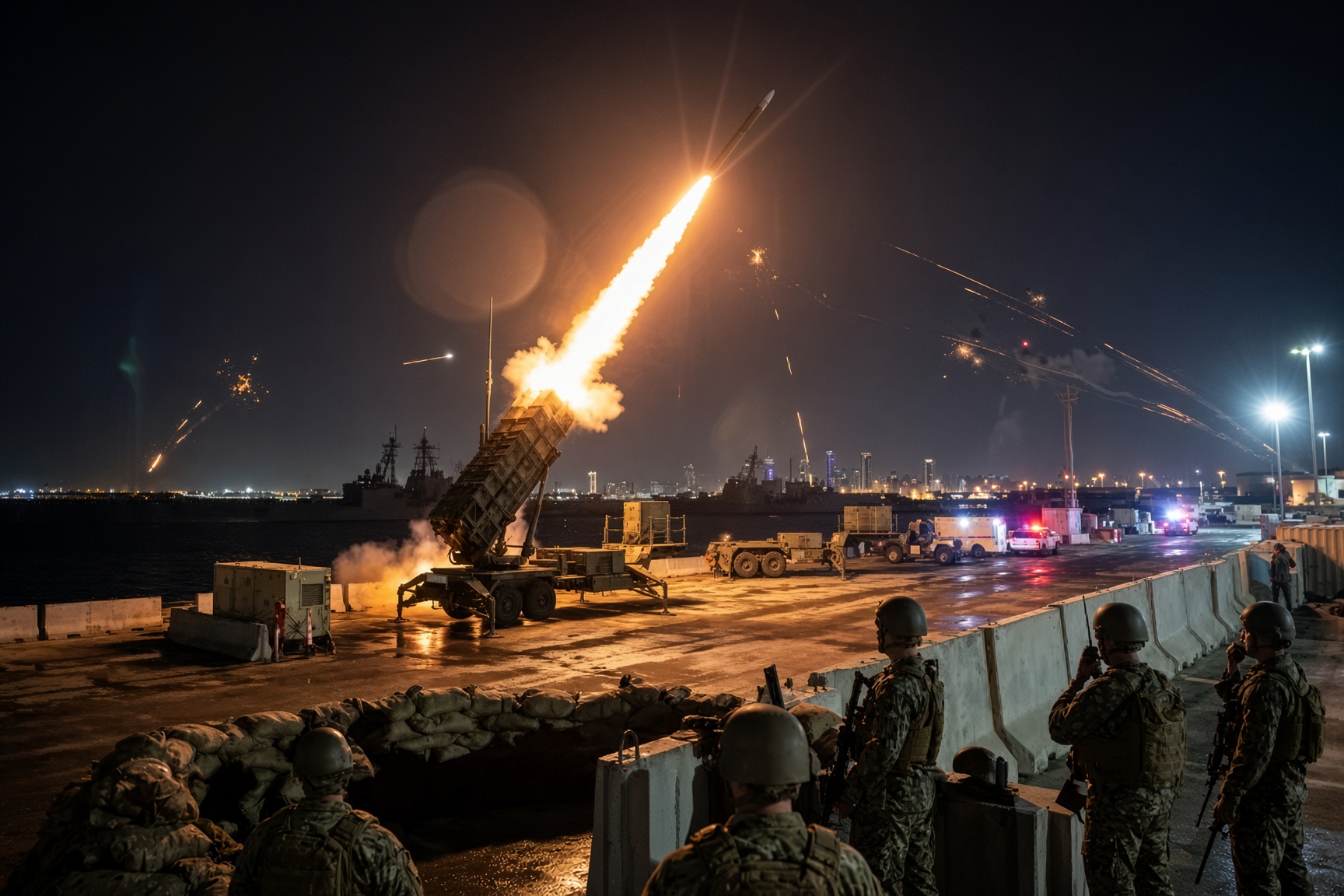
MANAMA, Bahrain — The Persian Gulf has once again shifted onto an open war footing after Iranian armed forces launched coordinated, multi-axis salvos of medium-range ballistic missiles and one-way attack drones toward strategic installations hosting United States military personnel across the region. The widespread bombardment forced allied Gulf capitals into emergency defensive postures, triggered continuous surface-to-air missile engagements, and sent blaring civil-defense alerts through communities already braced for unconstrained escalation.
The offensive underscores a decisive breakdown of localized containment. What once played out through covert maritime skirmishes and calibrated border friction has metastasized into an overt theater-wide campaign. Washington maintains an expansive military architecture distributed across Bahrain, Qatar, Kuwait, and the United Arab Emirates; as Tehran accelerates its asymmetric retaliation, those forward installations and the sovereign nations hosting them have landed directly on the tactical frontline. Multiple rounds of Iranian attacks against U.S. bases and assets have been documented across the region, highlighting a rapidly deteriorating security environment in which host nations find themselves absorbing the immediate kinetic consequences of a confrontation they did not initiate.
In the United Arab Emirates, audible detonations and low-altitude intercepts have reverberated near major urban centers as regional early-warning networks tracked incoming trajectories. Emirati air-defense units—operating layered batteries that include the Terminal High Altitude Area Defense (THAAD) and Patriot PAC-3 platforms—scrambled to engage projectiles breaching national airspace. The density of the attack forced simultaneous engagements across multiple sectors, underscoring both the sophistication of the integrated defense network and the sustained pressure it now faces.
Strategic Military Installations Under Threat
Planners focused particular attention on Al Dhafra Air Base, situated south of Abu Dhabi. The sprawling compound serves as an indispensable logistics and tactical hub, housing U.S. Air Force reconnaissance wings, airborne early-warning squadrons, and frontline aerial refueling tankers that enable long-range operations across the theater. While Iranian state media routinely issues claims of high-impact strikes against American infrastructure at Al Dhafra, Western defense analysts and regional authorities emphasized the need for caution. Definitive conclusions regarding runway disruption, command-node damage, or structural integrity require independent commercial satellite imagery and certified post-strike assessments before any definitive accounting of effects can be established.
“Our air-defense networks operated with high precision, mitigating what could have been a catastrophic intrusion,” an Emirati defense spokesperson said under standard anonymity protocols. “However, the sheer volume of this multi-directional assault represents a massive, unacceptable escalatory leap.”
The reliance on highly integrated, multi-tiered interceptor networks highlights how vital—and how deeply strained—Gulf Cooperation Council (GCC) defensive assets have become under the tempo of repeated barrages.
Multi-Front Offensive Strains Littoral Allies
The Kingdom of Bahrain, situated at the geographical center of the Gulf littoral, remains under exceptional operational strain. The island nation hosts Naval Support Activity Bahrain, the operational headquarters for U.S. Naval Forces Central Command and the U.S. Fifth Fleet, which oversees allied maritime security missions extending across the Persian Gulf, the Red Sea, and the Arabian Sea. Coupled with airfield operations at Shaikh Isa Air Base, Bahrain represents the strategic nerve center of American naval deterrence in the Middle East. That prominence makes it an inevitable target whenever Tehran broadens its retaliatory doctrine.
During recent salvos, Bahraini ground-based missile defenses, operating in tandem with forward-deployed U.S. Navy Aegis guided-missile destroyers patrolling offshore, engaged multiple inbound targets, filling coastal skies with intercept plumes. Iran has repeatedly claimed attacks against U.S.-linked facilities in Bahrain, including Sheikh Isa, while Bahraini authorities have reported intercepting incoming threats during previous barrages. The geographic compactness of the island amplifies the operational challenge: even successful intercepts occur in close proximity to populated areas and critical infrastructure.
North along the Qatar peninsula, Al Udeid Air Base confronted an identical state of alert. As the forward operating headquarters for U.S. Central Command (CENTCOM) and host to the Combined Air Operations Center (CAOC)—the facility that coordinates all combat and surveillance aviation across the Central Theater—Al Udeid remains one of the Pentagon’s most sensitive overseas assets. Independent satellite imagery from prior skirmishes confirmed localized fragmentation damage to external support infrastructure at the perimeter, and coalition personnel were once again ordered into reinforced subterranean shelters as surface-to-air interceptors ignited across the night sky. The base’s role as the primary air coordination node means any sustained disruption carries theater-wide implications for surveillance, tanker operations, and strike package planning.
Kuwait has likewise found its geographic territory pulled into the missile corridor. Domestic interceptor batteries were forced into active engagements to defend against low-flying drones and ballistic vectors aimed near logistics staging areas that support U.S. Army Central operations and heavy prepositioned gear. The presence of substantial U.S. ground-force infrastructure has drawn Kuwait into the same defensive calculus as its littoral neighbors, requiring continuous expenditure of scarce interceptor munitions.
The coordinated strikes expose a stark reality for Gulf Cooperation Council partners: host nations are being compelled to expend high-end, multi-million-dollar interceptor stockpiles to shield their sovereign territory from attacks stemming from an ideological and geopolitical contest they cannot unilaterally resolve. Magazine depth, resupply timelines, and the risk of saturation attacks have become central planning concerns for every capital along the Gulf.
Global Energy Security at Risk
Beyond the immediate kinetic fallout, the widening barrage poses catastrophic risks to the global macroeconomy, centered entirely on the Strait of Hormuz. Funneling roughly 20 percent of the world’s petroleum transit, the narrow chokepoint sits directly within range of Iranian mobile coastal defense batteries, surface radar arrays, and Islamic Revolutionary Guard Corps fast-attack craft. The intensifying tempo of missile launches, low-altitude drone intrusions, and coastal alarms has severely choked commercial navigation. International shipping lines and major energy conglomerates have suspended routine maritime schedules, electing to anchor crude tankers outside the Gulf of Oman or reroute vessels along the extended passage around the southern tip of Africa.
The disruption has already forced significant rerouting and idling of vessels. Marine insurance syndicates have responded by adjusting war-risk insurance premiums to near-record thresholds, compounding overall shipping overhead and directly inflating refined fuel costs. Energy trading floors in London, New York, and Singapore are tracking the confrontation with extreme volatility; prolonged maritime interdiction or the deployment of naval bottom-mines within the transit lanes would deliver an immediate supply shock to international crude markets, sparking ripple effects across industrial supply chains and global inflation indices. Even without a full closure of the strait, sustained elevation of risk premiums and reduced throughput volumes are already transmitting higher energy costs into broader economic indicators.
The Breakdown of Strategic Deterrence
The widening scope of Iran’s ballistic actions demonstrates that Tehran possesses both the logistical stockpiles and the operational willingness to bypass state borders and target American assets across neighboring territories. Concurrently, the heavy concentration of forward-deployed U.S. personnel limits Washington’s capacity to absorb repeated kinetic strikes without executing direct, punishing counter-sorties against launch facilities and command networks. Each successful Iranian salvo that forces defensive expenditures and sheltering of personnel incrementally raises the threshold at which the United States may calculate that restraint has become more costly than retaliation.
For allied military commands, the operational priorities remain managing air-defense magazine depths, hardening vulnerable support buildings, and identifying inbound saturation attacks before they challenge terminal defense systems. Continuous radar surveillance, rapid decision cycles, and precise interceptor allocation have become the daily operational reality across the Gulf.
For the international community, the regional crisis has entered an exceedingly dangerous phase. With early-warning radars perpetually active and armed interceptors positioned on continuous alert, the margin between calibrated tactical deterrence and an unconstrained regional conflagration has dwindled to negligible margins. A single projectile penetrating an air-defense screen to inflict heavy casualties at a base in Manama, Doha, or Abu Dhabi could instantly overwhelm existing backchannels and push the Persian Gulf into a conflict that defies containment. The combination of dense U.S. forward presence, limited interceptor inventories, energy-market exposure, and Iranian demonstrated willingness to conduct multi-axis attacks has compressed the space for de-escalation to its narrowest point in years.