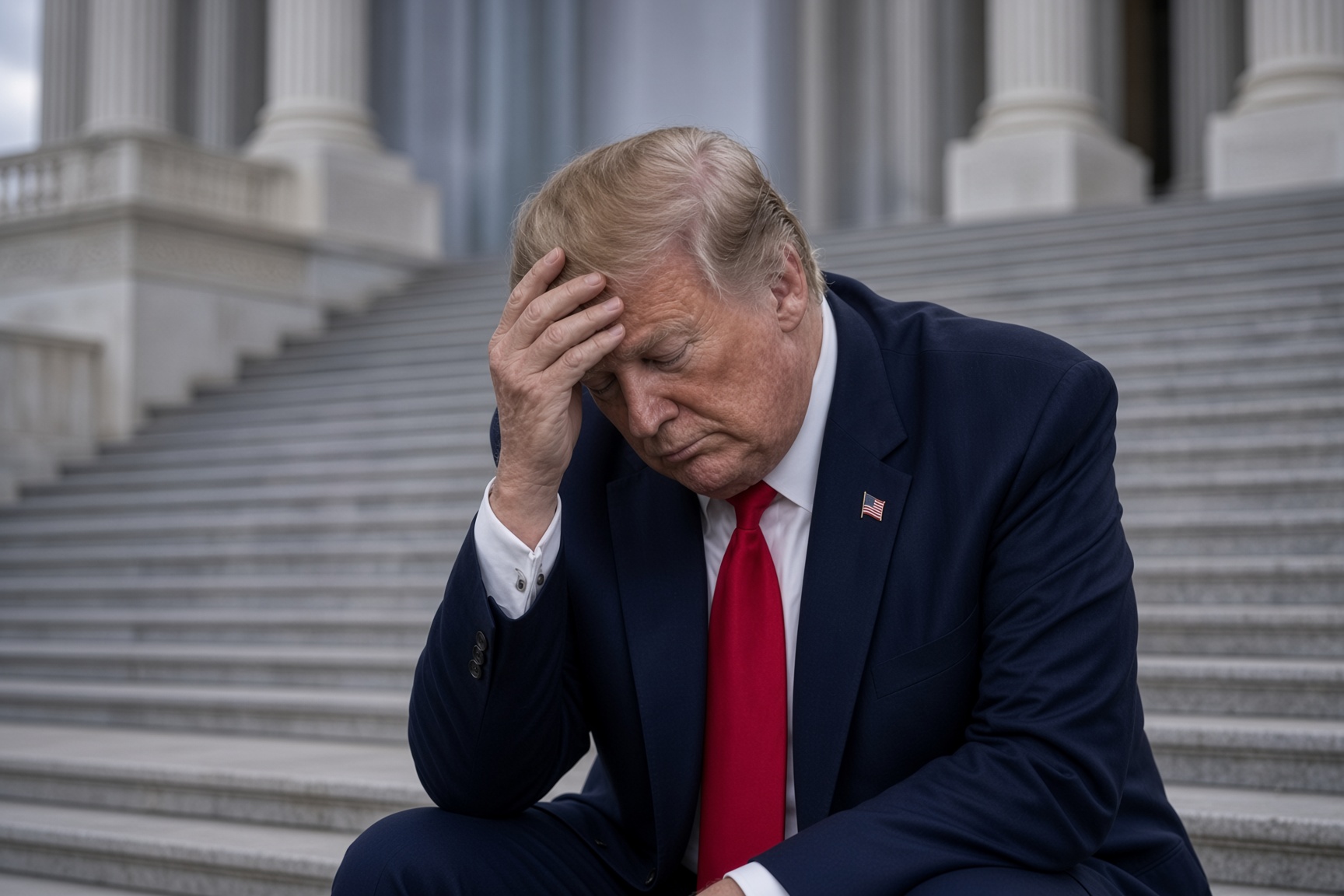
In the capital, where motorcade sirens and shouted questions from the press corridor form a kind of ambient weather, a half-hour of unusual quiet arrived on Thursday. It offered a rare view of Donald Trump standing, for once, in the gravitational field of his own accumulated record rather than directing the field itself. The interval contained none of the familiar apparatus he has refined over a decade: no amplified rock anthems, no raised stage, no placards, no remarks delivered from behind ballistic glass. What witnesses registered was simply an unscripted pause—an older man against the gray masonry of a city that has absorbed the consequences of his decisions for ten years running. It was not staged contrition and not surrender. It read more as a momentary compression of time, the high-velocity combat of recent years briefly yielding to the slower, less negotiable fact of a historical ledger.
From the moment he descended the escalator in 2015, Trump’s operating method has been continuous forward motion. Dominate the day’s coverage, escalate every confrontation, and treat stillness as vulnerability. That approach carried him through two impeachments, four criminal cases, the aftermath of the Capitol riot, and an improbable return to the presidency. Detached, however, from the protective volume of rallies and the immediate loop of digital reaction, the kinetic layer thinned. In the quiet corridor he appeared neither as the populist remaking a party nor as the executive issuing orders into speakerphones. He was a 79-year-old man encountering an institutional boundary that no amount of velocity fully erases: the power to set the national conversation is temporary; the traces left in statutes, dockets, and alliances are not.
Observers long familiar with the executive branch noted that the interval’s force came from its lack of insulation. Moves once launched as tactical answers to a 24-hour cycle have already hardened into binding precedents, reconstituted appellate courts, and durable shifts in trade and security arrangements. The protective blur of the next headline has thinned, leaving the fixed geometry of constitutional process more visible. In an environment that rewards short clips and polling crosstabs, prolonged silence resists easy packaging. It supplies no ready soundbite for evening panels and no immediate fundraising hook. The partisan readings that will follow are predictable. Supporters will treat the reserve as composed endurance under institutional pressure. Critics will treat it as evidence of fatigue or narrowing room. Both readings can be true in part; neither exhausts the structural point.
No occupant of the office leaves the machinery untouched or is left untouched by it. Authority radiates outward through a reshaped judiciary, revised commercial rules, and altered habits of civic argument. The bureaucratic apparatus continues on its own schedule, largely indifferent to the personal style of the person behind the Resolute Desk. As noon passed, the ordinary cadence of the District returned: intersections reopened for motorcades, correspondents resumed stand-ups on the North Lawn, and the ordinary revolutions of government resumed. No statement commemorated the pause, and pool cameras recorded no frame built for the evening shows. Still, the half-hour marked a visible threshold in the present political era.
Historical judgment rarely arrives as a single cinematic event. It accumulates in the unscripted intervals when performance yields, even briefly, to institutional fact. For Trump the lasting measure will not be set by decibel levels at arenas or by the volume of any single social-media cycle. It will be set by how courts, alliances, and civic structures absorb and retain the architecture he has already put in place. In the middle of the capital, the silence was not the absence of an event. It was the audible sound of that architecture beginning to outlast the velocity that produced it.