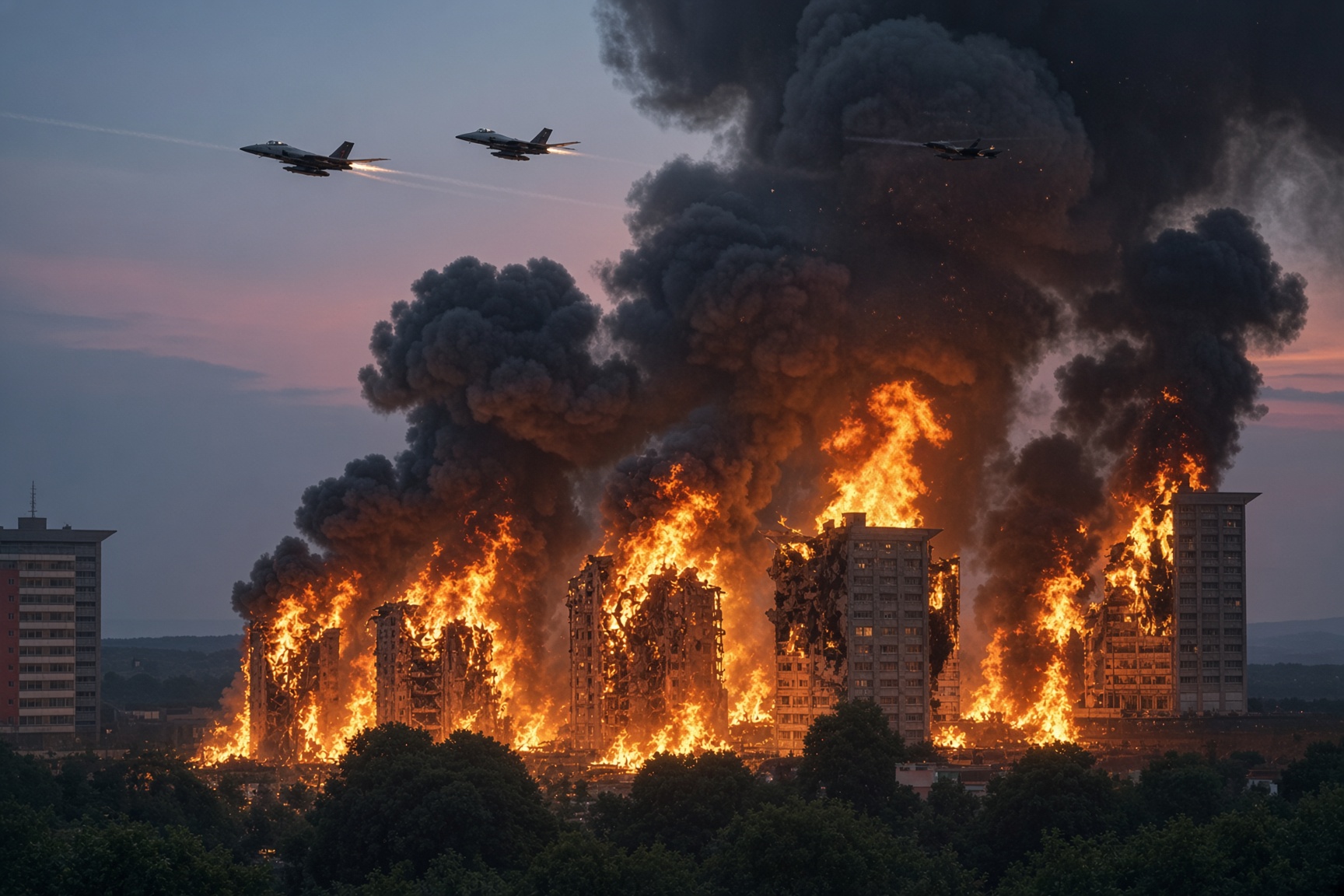
A recently released video created within the military simulation platform Arma 3 has attracted significant interest among players and enthusiasts of realistic military gaming. The production presents an imaginative, large-scale fictional confrontation between two major global powers. While the visuals, equipment, and tactical portrayals aim for a high degree of authenticity, the content is entirely fictional. It is designed for entertainment and as a tool for exploring strategic concepts. Clear disclaimers throughout emphasize that the scenarios do not represent or reflect any real-world events.
From its opening moments, the video establishes a dramatic and immersive atmosphere. Viewers are placed within a carefully constructed battlefield in which modern military units operate in a coordinated and dynamic environment. The creators have prioritized realism by incorporating a wide range of contemporary equipment, including main battle tanks, attack and transport helicopters, fighter jets, and special operations forces. Each element is rendered with careful attention to detail, creating a sense of authenticity while remaining firmly inside the bounds of simulation.
The central theme revolves around a hypothetical multi-domain confrontation that unfolds across varied terrain. Urban areas, open landscapes, and elevated or mountainous regions all appear, offering diverse settings for tactical operations. These environments are not merely visual backdrops; they actively shape the strategies employed by the simulated forces. The use of varied geography underscores a core reality of modern warfare: terrain can significantly influence movement, visibility, logistics, and outcomes.
One of the video’s most prominent features is its focus on armored warfare. Tanks maneuver across the battlefield, engaging targets, providing mobile firepower, and supporting infantry. The sequences illustrate the necessity of close coordination between armored units and dismounted troops. Positioning, timing, communication, and mutual support emerge as decisive factors in maximizing the effectiveness of these powerful vehicles. Viewers see how armor can dominate open ground yet remain vulnerable without proper combined-arms protection.
Aerial combat receives equally substantial attention. Fighter jets execute precise maneuvers, conduct strikes against ground targets, and contest control of the airspace. These sequences highlight the strategic importance of air superiority in contemporary military doctrine. Dominance in the skies provides greater freedom of maneuver, protection for ground forces, and the ability to shape the battlefield from above. The visual presentation of these air operations adds both spectacle and instructional value.
Helicopters play a versatile and vital role throughout the depicted scenarios. Attack helicopters deliver close air support, engaging enemy positions and vehicles with precision. Transport helicopters rapidly move troops and equipment across the theater, enabling quick reinforcement or exploitation of opportunities. This dual capability demonstrates the flexibility of rotary-wing aviation in modern operations, where the ability to shift forces rapidly can prove decisive.
Special operations forces form another central component. These elite units are shown conducting high-risk missions that demand precision, stealth, intelligence gathering, and tight coordination with larger formations. Their actions often target critical objectives or create conditions for conventional forces to succeed. The inclusion of these specialized elements adds narrative depth and illustrates the role of highly trained personnel in complex, multi-layered operations.
Throughout the video, the concept of combined operations is repeatedly explored. Ground forces, air assets, and supporting elements function as an integrated whole rather than isolated arms. This approach mirrors modern military doctrine, which stresses synchronization across domains. By showing how these elements interact in real time, the simulation offers viewers a clearer picture of the planning and execution challenges involved in large-scale joint operations.
The production is distinguished by its cinematic presentation. Advanced camera work, thoughtful lighting, synchronized sound design, and carefully timed effects create an engaging experience. Explosions, vehicle movement, environmental details, and radio communications are integrated to heighten immersion. These techniques help bridge the gap between gameplay footage and traditional cinematic storytelling, broadening the video’s appeal beyond dedicated simulation enthusiasts.
Despite the high degree of visual realism, the creators consistently communicate the fictional nature of the content. Explicit disclaimers inform viewers that the events are hypothetical and not based on actual occurrences. This distinction is important; the level of detail could otherwise lead to confusion. By framing the work clearly as a simulation exercise, the creators place the material in its proper context.
The educational dimension is another notable strength. While entertainment is the primary aim, the video provides observable insights into military strategy and tactics. Viewers can follow decision-making processes, unit deployments, the interplay of different capabilities, and the consequences of timing or coordination. This makes the content particularly relevant for those interested in strategic studies, professional military education, or simply a deeper understanding of how modern forces might operate.
The popularity of such simulations reflects growing interest in realistic gaming experiences. Platforms like Arma 3 give creators the tools to design complex scenarios that approximate real-world conditions through detailed modeling, large-scale maps, and extensive modding support. This flexibility enables content that is both engaging and informative. The video in question exemplifies what skilled creators can achieve within this framework, combining technical proficiency with narrative design.
Community participation further supports the success of these projects. Enthusiasts share custom scenarios, exchange feedback, refine tactics, and discuss the realism of various approaches. This collaborative environment encourages continuous improvement and the production of increasingly sophisticated simulations. The video contributes to that ecosystem by offering a detailed, high-production example of modern military simulation.
Ethical considerations are addressed through the framing of the content. The creators avoid any suggestion that the scenarios represent or glorify real-world conflict. Instead, they emphasize technical accuracy, strategic principles, and the educational potential of the medium. By presenting the work as a fictional exercise, they promote curiosity and understanding rather than sensationalism, aligning with the broader use of gaming as a tool for exploration and analysis.
Technological advances in game engines have been essential to enabling this level of detail. Modern rendering capabilities allow complex environments, realistic vehicle physics, dynamic lighting, and convincing effects. These tools enhance immersion and permit creators to stage scenarios that closely resemble the look and feel of contemporary operations. Continued improvements in graphics, AI, and multiplayer infrastructure are likely to expand the possibilities for even more advanced simulations in the future.
Teamwork and coordination receive consistent emphasis. Every unit has a defined role, and overall success depends on effective collaboration. Communication between elements ensures that operations proceed with minimal friction. This focus reflects real-world principles of command, control, and mutual support, reinforcing the authenticity of the simulation even within a fictional setting.
Narrative structure strengthens the overall experience. Rather than a series of disconnected clips, the video follows a cohesive progression from initial deployment through escalating engagement. This structure maintains viewer interest and supplies context for individual sequences. The movement from preparation to full-scale operations creates continuity and a sense of purpose.
Diverse operational environments further enrich the presentation. Urban fighting, open-field maneuvers, and operations in elevated terrain each introduce distinct challenges related to visibility, cover, mobility, and logistics. By incorporating these varied conditions, the video shows how tactics and force employment must adapt. The variety also demonstrates the versatility of the underlying simulation platform.
Realism is reinforced by careful attention to equipment appearance, operational procedures, and the interplay of different systems. While the overarching scenario remains fictional, these details contribute to a believable and immersive experience. The balance between grounded portrayal and imaginative construction is a major reason for the video’s appeal.
Strategic thinking is another recurring theme. Actions are presented as elements of a larger plan, with success depending on sound decision-making, resource allocation, and the ability to respond to changing circumstances. Viewers can observe how different choices influence the flow of the battle, gaining insight into the complexity of modern operations. This focus adds a clear educational layer.
As interest in military simulations continues to expand, productions of this type are likely to grow in popularity. They offer a distinctive combination of entertainment and learning that appeals to a broad audience. By examining realistic concepts within a clearly fictional framework, creators can explore sophisticated topics in an accessible manner.
Ultimately, the video stands as a strong demonstration of what modern simulation technology and skilled creators can achieve. Through realistic visuals, strategic depth, and cinematic presentation, it provides a compelling example of the genre. For audiences, the essential takeaway is to appreciate the content as a fictional exploration of strategy, coordination, and the interplay of modern military capabilities. The scenarios are not real, yet they can still illuminate principles of planning and execution. By recognizing the purpose and boundaries of the simulation, viewers can enjoy the production while gaining a clearer appreciation for the demands of large-scale operations.
In summary, this Arma 3 military simulation video distinguishes itself as a high-quality work that successfully blends entertainment with educational value. Its detailed portrayal of modern combat elements, combined with an unambiguous emphasis on fiction, keeps the material both engaging and responsibly presented. It serves as a clear illustration of how gaming platforms can be used to examine complex ideas in a creative and controlled setting.